No keyboards or screens, just unparalleled computing power


 2
2
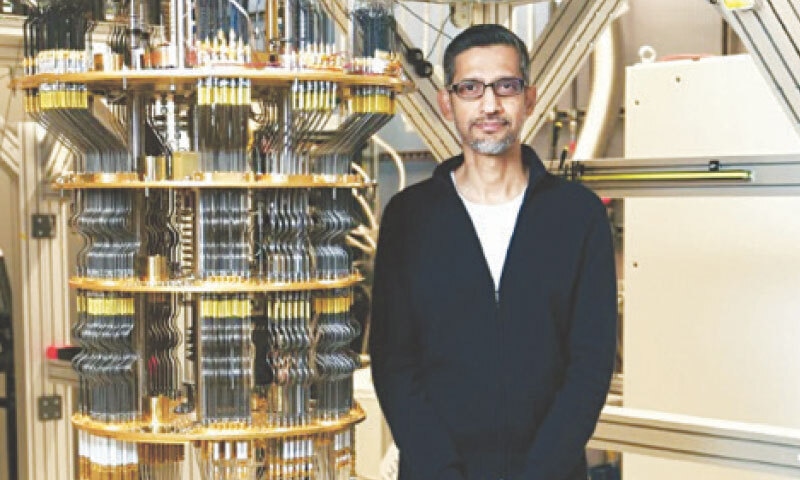

THE cutting edge of the frontier of the world, of technology, of growth may sound like science fiction, but it is rapidly becoming economic fact.
Inside a Google facility in Santa Barbara, California lives Willow, the most powerful computer in the world. But this is no ordinary PC, it is a quantum computer.
In the words of BBC economics editor, Faisal Islam, “[it] looks like a golden chandelier and contains the coldest place in the known universe”, but contains “technology pivotal to financial security, Bitcoin, government secrets, the world economy and more”.
Willow is an oil barrel-sized series of round discs connected by hundreds of black control wires descending into a bronze liquid helium bath refrigerator keeping the quantum microchip a thousandth of a degree above absolute zero.
There are no screens or keyboards. Each quantum computer is given a name such as Yakushima or Mendocino, they are each wrapped in a piece of contemporary art, and various graffiti-style murals adorn the walls.
According to Hartmut Neven, Google’s Quantum AI chief, the Willow chip has settled “once and for all” the discussion about whether quantum computers can do tasks that classical computers can’t.
Willow, housed at Google’s quantum computing facility, is capable of solving within minutes complex problems that would take the best computer in the world ‘more than trillions of years’
Willow also solved a benchmark problem in minutes that would have taken the best computer in the world 10 septillion years — more than the age of the universe.
This theoretical result was recently applied to the Quantum Echoes algorithm, impossible for conventional computers, which helps learn the structure of molecules from the same technology used in MRI machines.
In Neven’s words, this quantum chip can help with many problems facing humankind right now.
“It will enable us to discover medicines more efficiently,” he told the BBC. “It will help us make food production more efficient, it will help us produce energy, to transport energy, to store energy… solve climate change and human hunger.”
“It allows us to understand nature much better, and then unlock its secret to build technologies that make life more pleasant for all of us.”
Some members of the team working on Willow have just received the Nobel prize for the original research into “superconducting qubits”.
According to IBM, a quantum bit (or qubit) is the basic unit of information used to encode data in quantum computing, and can be best understood as the quantum equivalent of the ‘bit’, used by classical computers to encode information in binary.
In contrast to a traditional bit (either 0 or 1), a qubit is capable of existing in a superposition of both states (both 0 and 1) simultaneously, allowing for vastly more complex data representation.
The Willow chip has 105 qubits. Microsoft’s quantum effort has 8 qubits, but uses a different approach. But the real race is to get to 1 million qubits for a “utility scale machine” that can do quantum chemistry, drug design, without error.
If you want to wrap your head around what it is capable of, imagine trying to find a tennis ball in one of a thousand closed drawers.
A classical computer opens each one in order. A quantum computer opens all of them at the same time.
Or similarly, instead of having to need a hundred keys to open a hundred doors in normal computing, quantum enables you to open all one hundred, with one key, instantly.
These machines will not be for everyone. They will not shrink down into phones or AI glasses or laptops.
But the point is that the power of these computers grows exponentially, and everyone is getting in on the act.
According to Sir Peter Knight, Chair of the UK’s National Quantum Technology Programmes Strategy Advisory Board, Willow has broken new ground.
“All the machines are really still at the toy model stage, they make mistakes. They need error correction. Willow was the first to demonstrate that you could do error correction, through repeated rounds of repairs, which improve,” he told the BBC.
Published in Dawn, January 9th, 2026