Punjab potato growers face collapse as oversupply deepens: experts urge export subsidy


 10
10
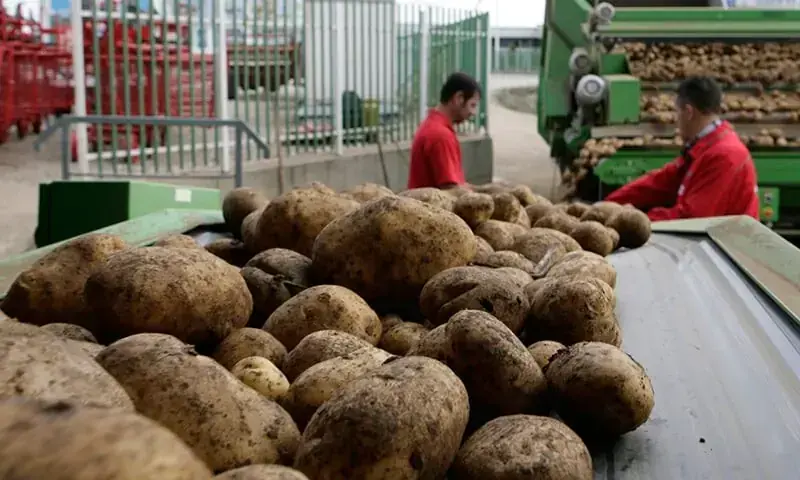

LAHORE: Punjab’s potato farmers and independent researchers called for urgent government intervention through subsidised exports as a massive production surplus collided with stagnant domestic demand and shrinking export prospects.
Due to the closure of the Afghanistan border over recent months, potato prices in Pakistan have plunged to rock-bottom levels.
Independent researchers and farmers across Sahiwal, Okara, Pakpattan, Kasur, and adjoining districts feared the market had already begun to collapse, and in some places, it had collapsed even before the full arrival of the new crop.
Wholesale prices had fallen below production costs, forcing some growers to plough standing crops back into the soil to avoid further losses. Potatoes were being sold in the market at Rs 20–25 per kg in the three districts of the Sahiwal division.
President of the Pakistan Kisan Ittehad, Khalid Mahmood Khokhar, while highlighting the miseries of potato farmers in the districts of Okara, Pakpattan, Sahiwal, Kasur, Khanewal, and Vehari, said they were “ruined”.
Khokhar further noted that a 60 kg bag of potatoes stored in cold storage was selling for only Rs 600–700 in the open market, while transportation costs alone amount to Rs 400.
“As a result, many farmers are unable to sell their produce from cold storage, and potato owners are reluctant to release their stock from cold storage.”
“Farmers,” he said, “have invested Rs 270,000–300,000 per acre in potato cultivation but are unable to recover even their input costs.”
Khokhar added that in the open market, potatoes were being sold at Rs 20–25 per kg, leaving growers with losses of Rs 235,000–250,000 per acre. He declared that 2025 was a “devastating year” for potato farmers in Pakistan.
Pind Sudhar, an organisation conducting independent market analysis and research, has tracked Punjab’s potato economy for over a decade, saying, “Exports without government support are not commercially viable because potatoes are cheap globally, while Punjab’s cost of production is comparatively high.”
“The crisis is fundamentally one of overproduction and inflation of supply,” said CEO Pind Sudhar Rashid Choudhry.
He hinted that private traders and commission agents could not shoulder export risks on their own.
“Transport costs, storage losses and weak prices in regional markets mean that unsubsidised exports often operate at a loss.”
“Last year’s experience underscores the risk that arises when Afghan markets are open: investors bought potatoes from farmers and stored them in anticipation of export demand. Farmers received reasonable prices, but traders suffered heavy losses when prices failed to recover,” said Ahmed Hasan, a large potato grower and cold storage operator from Depalpur, district Okara.
“This year, those investors will likely stay away,” said another cold storage operator in Sahiwal. “Without them, all the excess produce will flood the domestic market,” Ahmed Hasan further added.
The researchers stated the situation was further complicated by uncertainty over trade with Afghanistan. Although exports to Afghanistan historically absorb a relatively small share of Pakistan’s total potato output, their psychological impact on the market has been significant.
They added that open borders encouraged speculative buying and storage, helping stabilise farmgate prices. With Afghan markets unlikely to open fully this season, that buffer has disappeared.
Official figures showed that acreage under potato cultivation this season had risen by about 24pc compared to last year, driven by herd behaviour among farmers seeking returns from an input-intensive but high-output crop.
Production costs compounded the problem. Independent estimates put per-acre cultivation costs at over Rs300,000, significantly higher than official figures of Rs266,000. With farm gate prices falling to Rs10–15 per kg in some markets, growers were incurring losses even before harvest expenses were recovered.
Independent agricultural researchers estimated that Pakistan’s domestic potato demand stood at around 6.2 million tonnes annually, while the current season’s crop was expected to be double of that volume.
Even under optimistic assumptions, including exports of about 350,000 tonnes to Afghanistan and another 400,000 tonnes to other destinations, the surplus would only be temporarily absorbed, stabilising prices for a few weeks at best.
The researchers and farmers argued that the only viable short-term solution was for the Punjab government to procure potatoes directly from farmers and export them with a targeted subsidy.
While such an initiative would require several billion rupees, proponents said that the foreign exchange earned would offset part of the cost and help reduce the trade deficit. Independent researchers cautioned that subsidies alone were not a long-term fix.
They called for demand expansion through food processing, value addition and dietary diversification, alongside better production planning. However, they warned that without immediate action, the damage this season could be irreversible.
In December last year, it was reported that Pakistan’s potato market had crashed as the crop — stored for both exports and domestic consumption — was being offloaded in vegetable markets by farmers and stockists at prices that do not even cover transportation costs and cold storage rent.