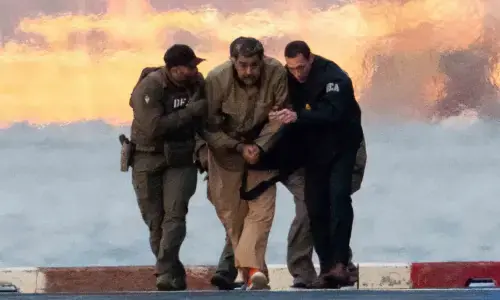
IT’S useful to know the lay of the land that Donald Trump sought to breach with the kidnapping of Venezuelan president Nicolás Maduro. Is there a power vacuum after Maduro’s exit? Evidently not. Will the Bolivarian republic crumble before the firepower of America? Unlikely, in view of the fact that too much Russian, Chinese and Iranian investment has gone into buttressing Bolivarian rule for it to be easily scuttled. Remember that Hugo Chávez was also kidnapped in a coup staged by the CIA. But his people rallied and Chávez returned to lead the country until his mysterious early death. Tariq Ali, in his memoirs, You Can’t Please All has a chapter on his meetings with Chávez and Maduro. It’s titled “Was Hugo Chávez murdered?” There’s a distinct possibility his cancer was induced.
The story, however, is about Donald Trump’s fear of Brics and his suspicion of the Bolivarian revolution Chávez launched after his electoral victory in Venezuela in 1998. This has irked the West. In this sense, the story hasn’t really moved forward since the Anglo-American Operation Ajax toppled Mohammad Mosaddegh’s elected government in Iran in 1953. That was about oil. Last week’s kidnapping of Maduro is also about oil even if the Trump administration is rowing back from its claim of running Venezuela.
What role is Brics playing to worry Trump, so much so that two key Brics members, Iran and Venezuela, are in America’s constant crosshairs? They are both heavily sanctioned countries. With Brics becoming a cohesive financial and economic platform, the hold of sanctions as a tool of US coercion would most likely be rendered ineffective, a key worry for the US.
Chávez’s Bolivarian revolution needs to be understood nicely for a good reason. Chávez leaned heavily on Simón Bolívar’s ideals of Latin American unity, sovereignty, and anti-imperialism. Simón Bolívar was the 19th-century liberator who led South America’s independence from Spain. However, dozens of roads and landmarks in the US and other Western countries are named after Bolívar. Chávez plotted something else.
We don’t know how many Venezuelans were killed. But there was resistance.
Nehru inaugurated a Simón Bolívar Road in Delhi’s diplomatic enclave in 1955. Bolívar inspired Nehru’s Non-aligned Movement and Third World solidarity. To the right-wing Narendra Modi government, the road would be an embarrassment. It was evident in the foreign ministry’s tame response to Trump’s attack on a Brics country. “Recent developments in Venezuela are a matter of deep concern. We are closely monitoring the evolving situation.” Thus spake the Brics host for later this year. In neighbouring Bangladesh, people took to the streets to protest the heist.
Trump has strong reasons to want to oust the Bolivarian republic. Chávez rewrote the constitution that established new rights, strengthened the executive, and allowed for re-election. Funded by oil revenue, he launched vast social programmes targeting poverty. These included free community healthcare, staffed initially by Cuban doctors; a massive literacy campaign; a mission for subsidised food, housing, and university education. A Qadhafi-like irritant but in the Western hemisphere, a challenge to the Monroe Doctrine.
In his adventurous attack on Venezuela, Trump looked like a quack dressed as a handyman assigned the task of staunching America’s slide as a Great Power. His bombing raids on seven nations last year defined his view of Pax Americana. His targets were Iraq, Iran, Yemen, Syria, Nigeria, Somalia and Venezuela. For all that and more, including the supervision of Israeli genocide of Palestinians, he demanded the Nobel Peace Prize, which went instead to a female Venezuelan dissenter who Trump cheered first but has distanced himself from after last week’s removal of Maduro to New York. Seymour Hersh noted that the bombings were inflicted without significant complaint from the Republican-led Congress.
Easily the most significant concern for the US is the Venezuelan state taking control of key sectors of oil, telecommunications, electricity, steel, and cement. The constitution is committed to the redistribution of large, unused estates to peasants. Currency and price controls are implemented to combat capital flight and inflation, though they also contributed to economic distortions. Venezuela under Chávez/Maduro pursued Latin American integration outside US influence, promoting the Bolivarian Alliance for the Peoples of Our America and offering subsidised oil for Caribbean nations. The revolution aimed to fundamentally transform Venezuelan society, moving it away from the neoliberal, two-party system that had dominated since 1958 and towards a model of ‘21st century socialism’.
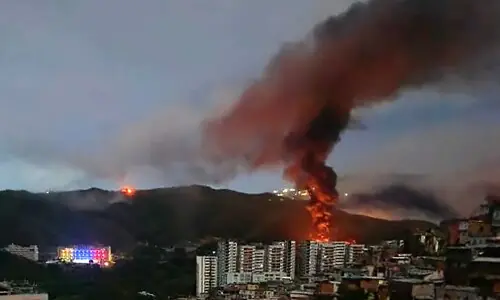
As usual, the news about the dangerous military intervention was used to highlight American intelligence and military prowess instead. Stories were circulated about the derring-do of the elite Delta Force commandos who seized Maduro and his wife by bombing their way into his heavily guarded palace. However, Cuba is mourning the death of 32 Cuban guards who were protecting the first family. They were killed in the air and ground mission. We don’t know how many Venezuelans were killed. But there was resistance, and that resistance is believed to be the signal for a rehearsed plan to turn a swoop on Venezuelan resources into a nightmare for Trump.
Sensing the resistance, Trump threatened Venezuela’s vice president, Delcy Rodríguez, with the fate of her president. Tapped to take control of the country after Maduro’s removal to the US, Rodríguez has claimed that the operation to arrest him had a “Zionist tinge”. She warned that “the extremists who have promoted armed aggression against our country — history and justice will make them pay”.
What role could Israel have played in the assault on a distant country? Not very different from the role that Iran has as a strategic ally of Bolivarian Venezuela. Israeli Foreign Minister Gideon Sa’ar was quick to congratulate Trump, saying the US “acted as the leader of the free world”. But Trump’s ties with Israel have split his MAGA base. As he struggles to keep his majority in both Houses of Congress in polls due in November, Trump may have overplayed his hand in using the military to fix runaway domestic challenges.
The writer is Dawn’s correspondent in Delhi.
Published in Dawn, January 6th, 2026