Venezuela opposition leader Maria Corina Machado wins Nobel Peace Prize, dedicates award to Trump


 0
0
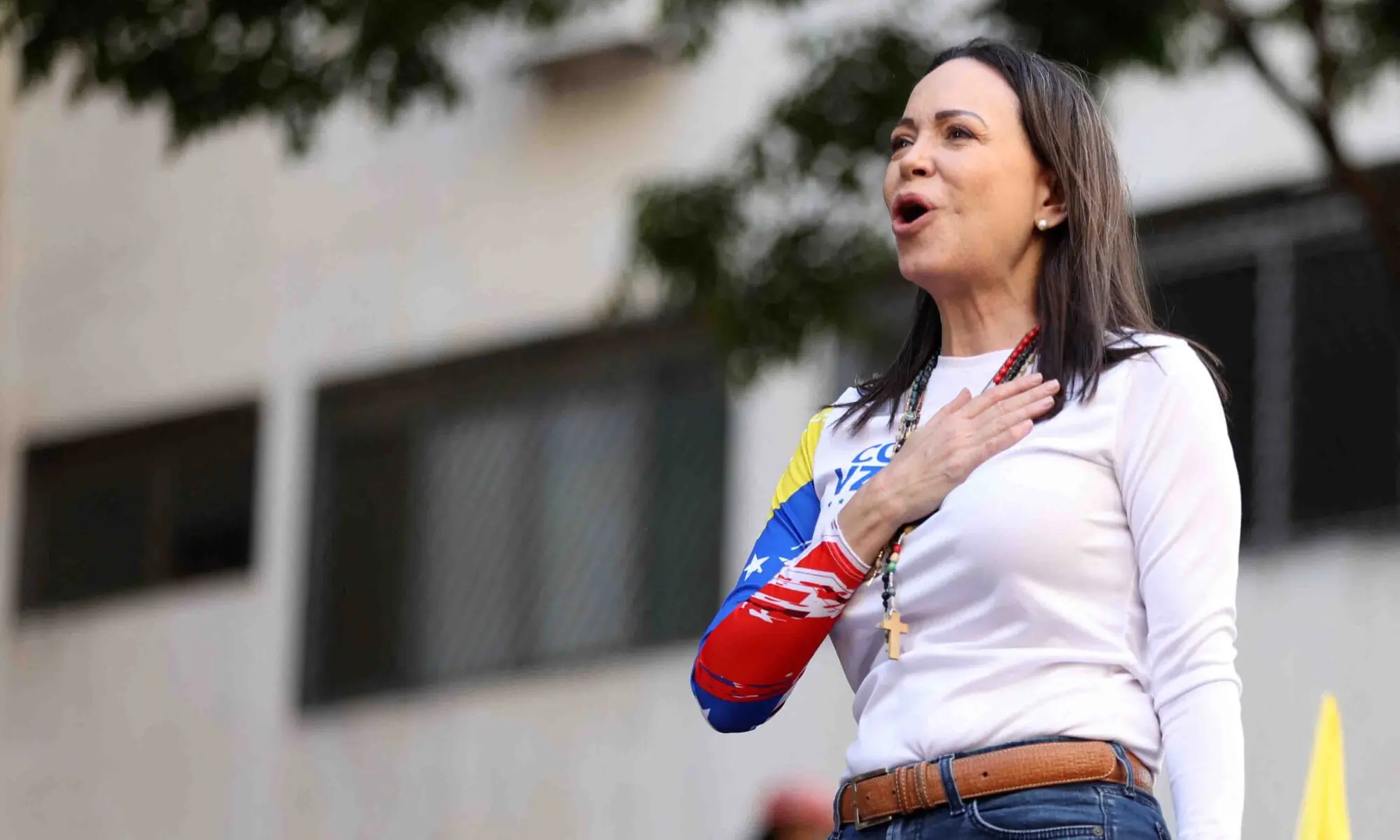

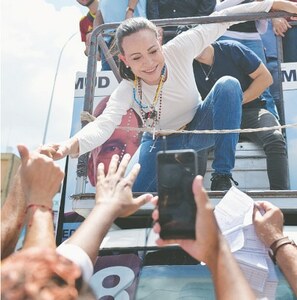
Venezuela opposition leader Maria Corina Machado received the Nobel Peace Prize on Friday.
The committee chose to focus on Venezuela at this time, in a year dominated by US President Donald Trump’s repeated public statements that he deserves the Nobel Peace Prize.
Machado was on this year’s TIME Magazine “100 most influential People” list, where current US Secretary of State Marco Rubio said she was the “personification of resilience, tenacity, and patriotism”.
“She is receiving the prize for her tireless work promoting democratic rights for the people of Venezuela and for her struggle to achieve a just and peaceful transition from dictatorship to democracy,” said Jorgen Watne Frydnes, the chair of the Norwegian Nobel Committee in Oslo.
“As the leader of the democratic forces in the Venezuela, she is one of the most extraordinary examples of civilian courage in Latin America in recent times,” he said.
He said that Machado had been a “key unifying figure in a political opposition that was once deeply divided; an opposition that found common ground in the demand for free election and representative government”.
“This is precisely what lies at the heart of democracy: our shared willingness to defend the principles of popular rule even though we disagree. At a time when democracy is under threat, it is more important than ever to defend this common ground,” he said.
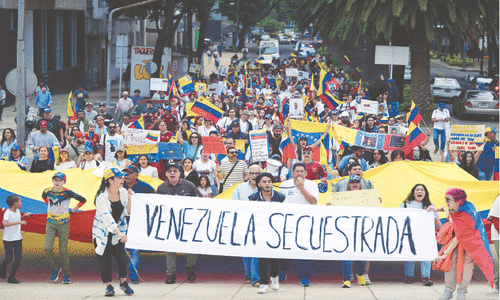
He stated that Venezuela had evolved from “a relatively democratic and prosperous country to a brutal and authoritarian state” that was suffering from a humanitarian and economic crisis.
“Most Venezuelans live in deep poverty even as the few at top enrich themselves. The violent machinery of the state is directed against its own population. Nearly eight million people have left the country. The opposition has been systematically suppressed by means of election rigging, legal prosecution, and imprisonment,” he said.
He further said that Venezuela’s authoritarian regime made carrying out political work in the country “extremely dangerous”, adding that Machado stood up for free and fair elections more than 20 years ago.
Frydnes said that the Venezuela opposition leader had spoken out for judicial independence, human rights, and popular representation.
“She has spent years working for the representation of the Venezuelan people,” he said. He further said that Machado was the opposition’s presidential candidate for the 2024 elections, but her candidacy was blocked by the regime.
“She then backed the representative of another party Edmundo González Urrutia in the elections. Hundreds of thousands of volunteers mobilised across the political divides. They were trained as election observers to ensure a transparent and fair election.
“Despite the risk of harassment, arrest, and torture, citizens across the country held watch over the polling stations. They made sure the final tallies were documented before the regime could destroy ballots and lie about the outcome,” he said, adding that the efforts of the collective opposition were innovative, brave, peaceful and democratic.
Frydnes went on to say that democracy was a pre-condition for lasting peace. “However, we live in a world where democracy is in retreat. Where more and more authoritarian regimes are challenging norms and resorting to violence.”
He said the repression of the Venezuelan population by its regime was not unique. “We see the same trends globally. Rule of law abused by those in control, free media silenced, critics imprisoned and societies pushed towards authoritarian rule and militarisation.
“In 2024, more elections were held than ever before. But fewer and fewer are free and fair.”
Noting that she has been forced to live in hiding in the past year, he said, “Despite serious threats against her life, she has remained in the country, a choice that has inspired millions.”
Frydnes said that Machado “embodies the hope for a different future — one where the fundamental rights of citizens are protected and their voices are heard”.
US President Trump had made no secret of his desire to win this year’s prize.
Since returning to the White House for his second term in January, the US leader has repeatedly insisted that he “deserves” the Nobel for his role in resolving numerous conflicts — a claim observers say is broadly exaggerated.
But Nobel Prize experts in Oslo had insisted in the run-up to Friday’s announcement that he had no chance, noting that his “America First” policies run counter to the ideals of the Peace Prize as laid out in Alfred Nobel’s 1895 will creating the award.
Machado dedicated the award in part to Trump.
“Oh my God … I have no words,” Machado told the secretary of the award body, Kristian Berg Harpviken, in a phone call which the Nobel Committee posted on social media.
“I thank you so much, but I hope you understand this is a movement, this is an achievement of a whole society. I am just one person. I certainly do not deserve it,” she added.
She later said, in an X post in English: “I dedicate the prize to the suffering people of Venezuela and to President Trump for his decisive support of our cause!”
Last year, the prestigious prize went to the Japanese anti-nuclear group Nihon Hidankyo, a grassroots movement of atomic bomb survivors from Hiroshima and Nagasaki.
The prize comes with a gold medal, a diploma and a prize sum of $1.2 million.
The award will be presented at a formal ceremony in Oslo on December 10, the anniversary of the 1896 death of the prizes’ creator, Swedish inventor and philanthropist Alfred Nobel.
The Peace Prize is the only Nobel awarded in Oslo, with the other disciplines announced in Stockholm.
Will she be able to attend ceremony?
It was not immediately clear whether she would be able to attend the award ceremony in Oslo.
Should she not attend, she would join the list of Peace Prize laureates prevented from doing so in the award’s 124-year history, including Soviet dissident Andrei Sakharov in 1975, Poland’s Lech Walesa in 1983 and Myanmar’s Aung San Suu Kyi in 1991.
Machado is the first Venezuelan to win the Nobel Peace Prize and the sixth from Latin America. Her three adult children are living abroad for safety reasons.
The United Nations human rights office welcomed the award to Machado as a recognition of “the clear aspirations of the people of Venezuela for free and fair elections”.
The head of the award committee, Joergen Watne Frydnes, said he hoped it would spur the Venezuelan opposition’s work.
“We hope that the entire opposition will have renewed energy to continue the work for a peaceful transition from dictatorship to democracy,” Frydnes told Reuters after the announcement.