• Captured leader, his wife plead not guilty to drug trafficking charges
• His successor softens her tone, expresses willingness to work with US
• Latin American leaders riled by US president’s threats hit back
• Moscow, Beijing, Tehran slam Washington’s actions; allies in London and Paris also wary
NEW YORK: Toppled Venezuelan President Nicolas Maduro pleaded not guilty on Monday to narcotics charges after his stunning capture by the US rattled world leaders and left officials in Caracas scrambling to respond.
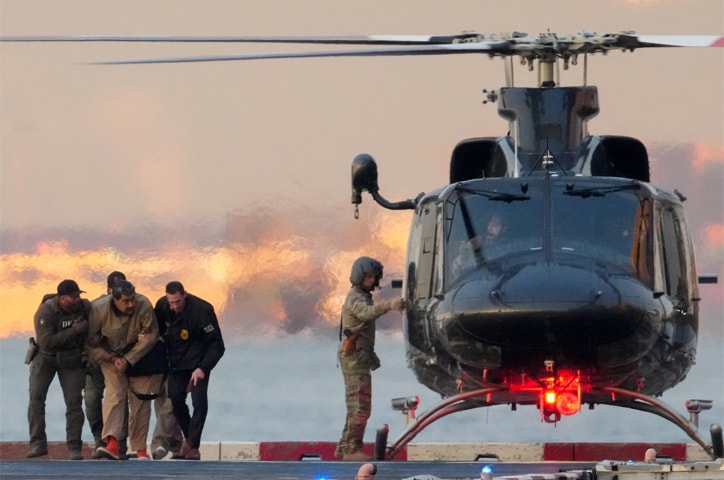
On Monday morning, Maduro — his hands zip-tied — and his wife were escorted by armed guards in tactical gear from a Brooklyn detention center to a helicopter bound for the Manhattan federal court.
The 63-year-old pleaded innocent in New York federal court to four criminal counts: narco-terrorism, cocaine importation conspiracy and possession of machine guns and destructive devices.
“I am innocent. I am not guilty. I am a decent man. I am still president of my country,” Maduro said through an interpreter, before being cut off by US District Judge Alvin Hellerstein.
His wife Cilia Flores also pleaded not guilty. The next court date was set for March 17. Dozens of protesters, both pro- and anti-Maduro, gathered outside the courthouse before the half-hour hearing.
Maduro is accused of overseeing a cocaine-trafficking network that partnered with violent groups, including Mexico’s Sinaloa and Zetas cartels, Colombian FARC rebels and Venezuela’s Tren de Aragua gang.
He has long denied the allegations, saying they were a mask for imperialist designs on Venezuela’s rich oil reserves.
Meanwhile in Caracas, after first denouncing Maduro’s capture as a colonial oil-grab and “kidnapping”, Venezuela’s acting president, Delcy Rodriguez, softened her stance, saying it was a priority to have respectful relations with Washington.
After being formally sworn in on Monday as the country’s interim president by her brother Jorge — the head of the national assembly legislature — she struck a softer note.
“We invite the US government to work together on an agenda of cooperation,” Rodriguez said. “President Donald Trump, our peoples and our region deserve peace and dialogue, not war.”
Venezuela’s parliament also forcibly denounced the capture of its leftist leader, while vowing support for his stand-in.
Trump has threatened another strike if Venezuela does not cooperate with opening its oil industry and stopping drugs. Trump also threatened Colombia and Mexico on Sunday, and said Cuba’s communist government “looks like it’s ready to fall”.
Just how the US would work with a post-Maduro government, full of sworn ideological enemies, is unclear. Trump appears to have sidelined for now the Venezuelan opposition, where many anti-Maduro activists had assumed this would be their moment.
The US position leaves the Venezuelan opposition, which the Trump administration says was robbed of victory by Maduro, out in the cold.
Lat-Am reactions
Latin American leaders responded sharply to Trump’s jibes.
Speaking to reporters on Air Force One on Sunday Trump made similar threats of military action against Colombia, saying the South American country is “very sick too” and “run by a sick man who likes making cocaine and selling it to the United States.”
“He has cocaine mills and cocaine factories and is not going to be doing it very long,” Trump alleged.
Colombia’s President Gustavo Petro rejected the threats, saying: “That’s not how you threaten a Latin American president who emerged from the armed struggle and then from the people of Colombia’s fight for Peace.”
Mexico’s President Claudia Sheinbaum said on Monday that the Americas ‘do not belong’ to any power after Trump invoked the Monroe Doctrine, asserting US “dominance” of the hemisphere.
“The Monroe Doctrine is a big deal, but we’ve superseded it by a lot, by a real lot. They now call it the Donroe document,” Trump told a news conference, slapping his name on the policy principle.
Sheinbaum hit back Monday, saying: “The Americas do not belong to any doctrine or any power. The American continent belongs to the peoples of each of the countries that comprise it.”
International warnings
China, Russia and Iran, which have longstanding ties with Maduro’s government, were quick to condemn the operation. Some US allies, including the EU, expressed alarm.
China called for Maduro to be “immediately released” in a condemnation of the US operation, which its foreign ministry said was a “clear violation of international law.” Iran said on Monday that its relations with close ally Venezuela remained unchanged and called for Maduro’s release.
Similarly, Turkish President Recep Tayyip Erdogan told President Trump that Venezuela must not collapse into chaos.
“Any attack on the sovereignty of the people and any violation of international law will generate serious complications within the international order,” Erdogan said he told Trump over the phone.
Meanwhile, French President Emmanuel Macron on Monday said he “neither supported nor approved” the US military operation to grab Venezuelan leader Nicolas Maduro.
On Monday, government spokeswoman Maud Bregeon reported Macron as telling cabinet ministers: “We defend international law and the freedom of peoples. The method employed is neither supported nor approved.” She said Macron added that, for Venezuela, “if there is to be a transition, then the 2024 winner must obviously play a central role in it”.
UK premier Kier Starmer said on Monday it was up to the United States to justify its actions in Venezuela after capturing Maduro, describing the situation as “not straightforward”.
“What we need in Venezuela is a peaceful transition to democracy. That was our position before this weekend, it remains our position,” Starmer told reporters.
Published in Dawn, January 6th, 2026