Following are key facts about the oil industry of Venezuela, whose President Nicolas Maduro was captured by US forces on Saturday, according to US President Donald Trump.
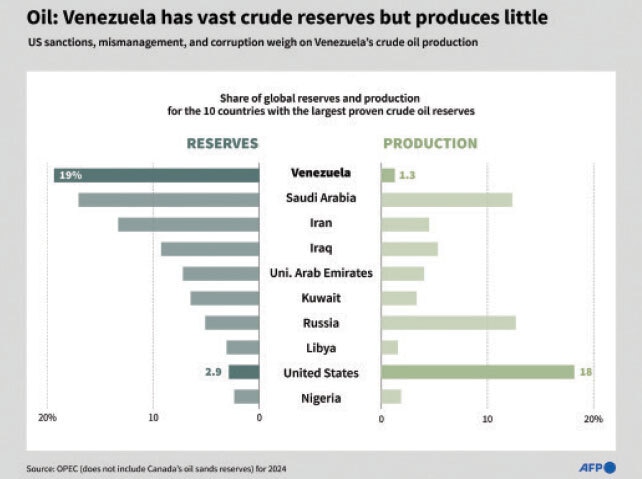
Venezuela has the world’s largest oil reserves but its crude output remains at a fraction of capacity due to mismanagement, lack of investment and sanctions, official data shows.
Venezuela holds about 17 per cent of global reserves or 303 billion barrels, ahead of Organisation of the Petroleum Exporting Countries (Opec) leader Saudi Arabia, according to the London-based Energy Institute.
Its reserves are made up mostly of heavy oil in the Orinoco region of central Venezuela, making its crude expensive to produce, but technically relatively simple, according to the US government’s energy department.
Production
Venezuela was a founding member of Opec with Iran, Iraq, Kuwait and Saudi Arabia.
The country was producing as much as 3.5 million barrels per day in the 1970s, which at the time represented over 7pc of global oil output. Production fell below two million bpd during the 2010s and averaged some 1.1 million bpd last year or just 1pc of global production.
“If developments ultimately lead to a genuine regime change, this could even result in more oil on the market over time. However, it will take time for production to recover fully,” said Arne Lohmann Rasmussen from Global Risk Management.
If regime change is successful, Venezuela’s exports could grow as sanctions are lifted and foreign investment returns, said MST Marquee analyst Saul Kavonic.
“History shows that forced regime change rarely stabilises oil supply quickly, with Libya and Iraq offering clear and sobering precedents,” said Jorge Leon, head of geopolitical analysis at Rystad Energy. Trump told Fox News on Saturday the United States would be very strongly involved in Venezuela’s oil sector.
Joint ventures
Venezuela nationalised its oil industry in the 1970s, creating Petroleos de Venezuela S.A. (PDVSA). During the 1990s, Venezuela took steps to open the sector to foreign investment. Following the election of Hugo Chavez in 1999, Venezuela mandated majority PDVSA ownership of all oil projects. PDVSA set up ventures in the hope of boosting production, including with Chevron, China National Petroleum Corporation, ENI, Total and Russia’s Rosneft.
Exports
The United States used to be the main buyer of Venezuelan oil but since the introduction of sanctions, China has become the main destination in the last decade.
Venezuela owes about $10 billion to China after China became the largest lender under late President Hugo Chavez.
Venezuela repays loans with crude transported in three very large crude carriers previously co-owned by Venezuela and China.
Two of those supertankers were approaching Venezuela in December when Trump announced a blockade of all tankers going in and out of the country.
The vessels are now waiting for instructions, according to PDVSA documents and shipping data, as Venezuelan exports have been mostly halted.
Published in Dawn, January 4th, 2026