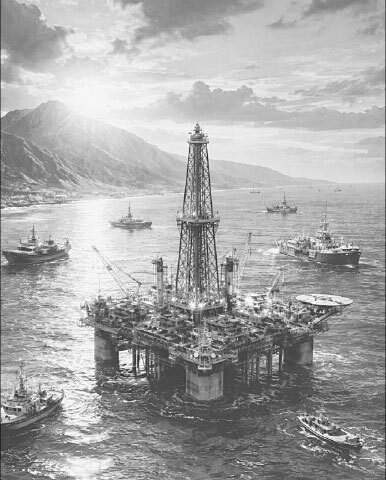
PAKISTAN has successfully revived its offshore exploration efforts after a hiatus of nearly two decades. The recently launched offshore bid round has attracted strong interest from both domestic and international companies, signalling re-newed confidence in the country’s energy sector. The government plans to drill its first offshore oil well in March next year in the eastern offshore Indus Block C near Sujawal district, and, depending on positive results, as many as 25 additional wells could eventually follow.
In October, the government awarded 23 offshore exploratory blocks to four consortia led by domestic exploration and production companies. Covering nearly 53,500 square kilometres across the Indus and Makran basins, these blocks will undergo geological and geophysical surveys, seismic data acquisition, and detailed interpretation over the next three years to identify drilling prospects. Exploratory drilling in the subsequent phase will ultimately determine the commercial viability of any discoveries.
A landmark feature of this bid round is the involvement of foreign entities, including those from Turkiye and Hong Kong. In addition to foreign capital, these awards are expected to bring advanced offshore technology to Pakistan. In an environment marked by dwindling foreign investment, this renewed interest is a welcome development.
Over the last decade, Pakistan’s onshore exploration and production (E&P) sector has experienced significant setbacks as several major international companies either exited the market, or scaled down operations. Against this backdrop, the confidence demonstrated by foreign partners in the offshore sector is rather encouraging.
As of June 30, Pakistan had consumed nearly 81 per cent of its proven oil reserves of 1,245 million barrels, leaving about 353 million barrels recoverable after recent discoveries and revisions. At current production levels of 60,000-75,000 barrels per day, against a demand of around 400,000 barrels, the remaining reserves may last only 15 years, forcing annual oil imports worth over $12 billion.
Natural gas reserves show a similar decline: of the original 63.24 trillion cubic feet (TCF) of recoverable resources, 43.73 TCF have already been produced, leaving about 19 TCF. With output falling from mature fields and no major new finds, these reserves, too, may not last beyond another 15 years, compelling Pakistan to import around 8.7 billion cubic metres of LNG annually.
Pakistan’s offshore region, comprising the Indus and Makran basins, has seen limited exploration. Only 18 wells have been drilled since independence; none commercially successful. Early efforts by some companies provided valuable geological information, but yielded no discoveries. The most recent attempt, the Kekra-1 well drilled in 2019, also failed, prompting the driller’s exit. A 2023 offering of 12 offshore blocks likewise attracted no bids.
Spanning almost 300,000 square kilometres and bordering energy-rich neighbours, such as Oman, the United Arab Emirates and Iran, Pakistan’s offshore region remains geologically promising despite earlier disappointments. In September 2024, reports indicated that Pakistan may hold significant offshore oil and gas deposits.
Pakistan has waited many decades for a breakthrough in offshore exploration. The coming years will determine whether this renewed push becomes a historic success, or another missed opportunity. For now, however, the sense of possibility is greater than it has been in a more than a generation, and that alone is a step forward.
Hussain Ahmad Siddiqui
Islamabad
Published in Dawn, January 2nd, 2026