The Near Abroad: Another Year Of Peril

WHILE the Middle East continued to be rocked by war and upheaval in 2025, conflict and the threat of conflict were also witnessed in several other global hotspots, namely Ukraine, Venezuela and South-East Asia. In many of these theatres, American foreign policy — as interpreted by Donald Trump — played a key role in fuelling conflict, even though the American president sought to present himself as the great peacemaker of this age.
Amongst the two biggest developments in the Middle East were the Gaza ceasefire taking effect in October — the result of Mr Trump’s grand scheme for the battered, occupied Palestinian enclave, and the region at large — as well as the devastating 12-day Iran-Israel war in June. Elsewhere, the American leader claimed that peace in the Ukraine-Russia war was “closer than ever”, though his European allies and the Ukrainians themselves seemed less enthusiastic about the prospects of peace. The Americans also rattled their sabres at Venezuela conquistador-style, and as the year ended, the chance of a real shooting war between Washington and Caracas remained high.
A genocide paused
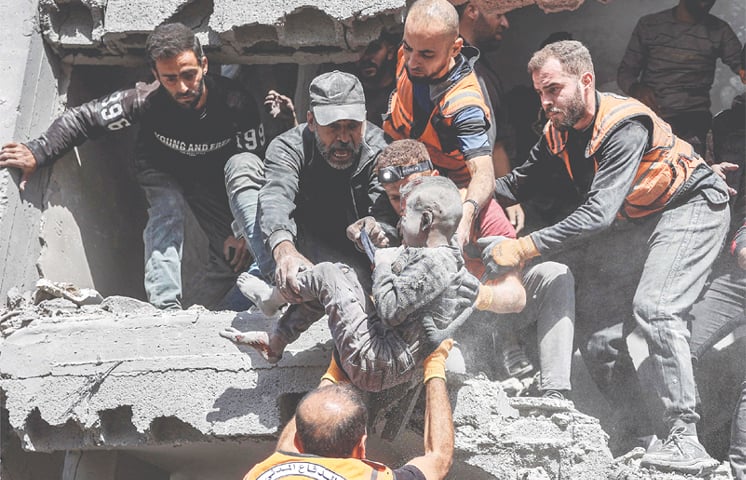
The Israeli genocide, overtly and covertly supported by many in the ‘collective West’, was mercifully halted in October, as the Trumpian peace plan was accepted by all sides, announced with great fanfare in the Egyptian Red Sea resort town of Sharm el-Sheikh. While an earlier ceasefire had also been reached between Israel and Hamas in January, this subsequently collapsed in March thanks largely to Tel Aviv’s frequent breaches of the truce.
However, the truce signed in October has largely held, backed as it is by several Muslim states, including Pakistan, and despite flagrant Israeli violations. As per one count, over 400 Palestinians have been butchered by Israel since the October truce came into effect.
But both before and after the October truce, the Palestinians’ suffering was immense. As per the Integrated Food Security Phase Classification, a famine was declared in Gaza in August, largely due to Tel Aviv’s blockades of food and aid. Meanwhile, several international bodies and experts agreed that Israel was carrying out a genocide in Gaza, including the UN Independent International Commission of Inquiry and the International Association of Genocide Scholars. Even after the genocide was paused following the Sharm el-Sheikh truce, Gaza’s civilians continued to face the elements in pathetic conditions, with reports of several infants dying of cold due to insufficient shelter.
The future of the American-led ‘peace plan’ is even more shaky, as progress towards phase two of the scheme has been excruciatingly slow. Critics have dubbed the Trumpian plan a neocolonial exercise to put Gaza under indefinite foreign occupation, particularly through the so-called ‘Board of Peace’, to be headed by Mr Trump himself, and the International Stabilisation Force, a military contingent made up of foreign troops supposedly to keep the peace in Gaza.
Many states, including Arab backers of the peace plan as well as Pakistan, have begun to have second thoughts about joining the ISF, considering the fact that it would entail disarming Hamas and other Palestinian resistance groups by force. In effect, the American plan seeks to do through Arab and Muslim states what Israel has thus far failed to achieve: defeating the Palestinian resistance.
Critics have dubbed the Trumpian plan a neocolonial exercise to put Gaza under indefinite foreign occupation.
The fact is that the insistence on the disarmament of Hamas, and Israel’s decision to occupy considerable parts of Gaza permanently, may mean that in 2026, the Gaza peace plan may well collapse. Hamas is willing to lay down its arms once a commitment to a Palestinian state is made. Israel has done everything possible to ensure a viable Palestinian state never emerges. Moreover, the fact that the Israeli defence minister has said they will “never leave Gaza”, points to a permanent occupation, which will automatically torpedo the Trumpian peace plan. If the plan does collapse, one can expect the unfortunate possibility of Israel resuming its genocide in Gaza with even more ferocity.
Rising lion, true promise
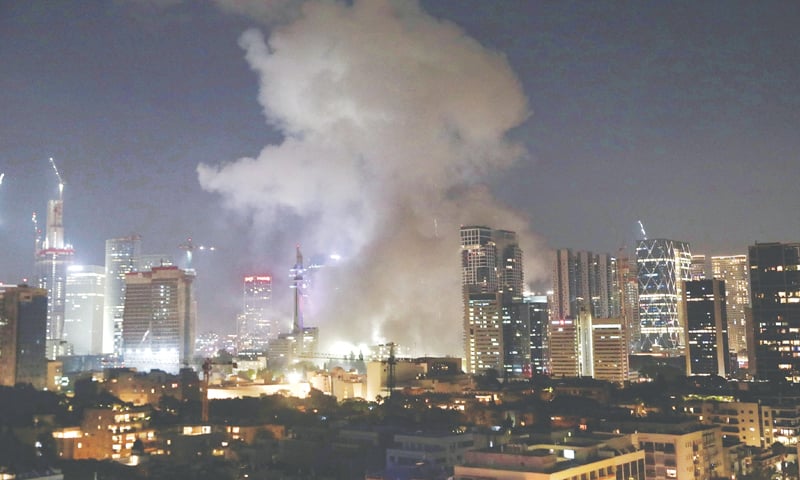
The other major conflagration of global import in 2025 was the June 12-day war between Israel and Iran. While both protagonists had traded blows twice in 2024 — largely in connection with the Oct 7, 2023 events and their aftermath — last year Tel Aviv and Tehran engaged in their first fully fledged hot war.
In the run-up to the June war, Iran had been engaging indirectly, and in some instances directly, with the US to try and resolve the nuclear issue. Though progress was not significant, the talks reflected the fact that a diplomatic solution could possibly be found to peacefully resolve Iran’s nuclear question.
However, Israel is not in the business of peaceful resolutions of issues, and just a day after the International Atomic Energy Agency said that Iran was not complying with its nuclear obligations — Tehran argued the IAEA’s findings were “politically motivated” — Tel Aviv launched its unprovoked attack on Iran through the so-called Operation Rising Lion.
The initial hit was devastating. It seemed that the Iranians had been caught off guard, as Israel obliterated the upper echelon of the Iranian military structure. Among the major targets were top generals of the Sipah-i-Pasdaran, as well as Iran’s army chief Gen Mohammad Baqeri. As with the Hezbollah pager attack in Lebanon a year earlier, many felt that Tel Aviv could not have carried out such a thorough attack without inside information from within Iran.
But after the initial shock, the Iranians dusted themselves off and replied to Israel in kind, through what they termed Operation True Promise III (parts I and II had taken place in 2024). In total Iran lobbed hundreds of missiles and up to 1,000 drones at Israel. Israel also hit major Iranian targets throughout the conflict, but Tel Aviv maintained strict military censorship to obfuscate the true extent of the damage suffered from Iranians missiles. Yet amongst the reported targets was the Weizmann research facility and several Israeli military bases and intelligence facilities. At the end of the 12-day war, Israel was said to be critically low on interceptors, and if the war dragged on, it could have spelt serious trouble for the Zionist state.
At one moment during the war, when Donald Trump bombed Iranian nuclear facilities, it appeared that the Middle East was on the edge of an apocalyptic new conflict. But realpolitik prevailed, and after Tehran symbolically struck an American base in Qatar, the belligerents stepped back and accepted a ceasefire.
However, Israel appears to be itching for another round. This time, Benjamin Netanyahu is reportedly trying to convince Donald Trump to hit Iran’s ballistic missile facilities. Mr Trump’s remarks after both men met at his Florida mansion on Dec 29 strengthen this impression. Therefore, it may be very possible that in 2026, we may see the next round in this battle. Iranian President Masoud Pezeshkian said earlier in December that Israel, the US and Europe were waging a “full-fledged war” on his country and that Iran would deliver a “decisive response”. All indications, therefore, point to another round of hostilities between Iran and the US/Israel in the new year.
Lebanon and Syria
Elsewhere in the Middle East, Lebanon and Syria remain flashpoints. In 2025, there was much talk of disarming pro-Iran Lebanese armed group Hezbollah. Former army chief Joseph Aoun, who was elected president in January, made no bones about disarming Hezbollah. Yet the Lebanese Shia movement had no such plans. In the meantime, Israel violated the Lebanon ceasefire thousands of times, killing hundreds. It seems there is a unique definition of the word ‘ceasefire’ in Tel Aviv. There are strong chances that wholesale Israeli aggression against Lebanon may resume in 2026 as important actors in Tel Aviv have said they will disarm Hezbollah by force. The Lebanese group says its arms are essential to ward off the Israeli threat.
Meanwhile, Syria also remains unsettled a year after its jihadist liberators set the Bashar al-Assad regime packing. As Syrian interim President Ahmad al-Sharaa, once known as jihadi commander Abu Mohammad al-Jolani, tries to consolidate his rule over Syria, he has to contend with sectarian massacres, often involving his ideological comrades, as well as the Israeli occupation of large swathes of Syrian territory.
Signalling Mr Sharaa’s full rehabilitation and embrace by the collective West, he was granted three audiences with Donald Trump in 2025; for the first time in Riyadh in May, secondly at the UN General Assembly in New York in September, while finally receiving a White House reception in November. Yet friendship with America did little to stop Israeli assaults on Syria. Israel consolidated its illegal occupation of Syrian territory in 2025, while continuing its military strikes against the country. In one attack, Tel Aviv reportedly struck only a few metres from the presidential palace, sending an unambiguous message to Mr Sharaa.
At the same time, there were several serious incidents of sectarian strife in the outgoing year. In clashes between members of the Alawi community and pro-government militias in March, nearly 2,000 people were reportedly killed, mostly Alawi civilians. There were also clashes between the Druze community and Bedouin tribes in April and July, while the year ended with mass protests as an Alawi mosque was bombed in December. These sectarian fault lines, together with ethnic fissures with Syria’s Kurds, and the lurking danger of jihadi groups going rogue, presents a major challenge to the Sharaa administration.
The Ukraine imbroglio
Throughout 2025 there were several instances where Mr Trump indicated that peace in Ukraine was ‘close’, but as the year closed, a peaceful denouement to the Russia-Ukraine war seemed remote. In February, during a meeting at the White House, Mr Trump and his Vice-President J.D. Vance tore into visiting Ukrainian President Volodymyr Zelensky with reckless abandon, accusing him of being “ungrateful” to America. In contrast, Mr Trump rolled out the red carpet for Russian President Vladimir Putin at their Alaska summit in August. Later meetings between Trump and Zelensky were less pugnacious. But the back and forth between America, Ukraine and Russia seemed little more than political theatre. Even if the Ukraine conflict is somehow magically resolved in 2026, the confrontation between Europe/Nato and Russia seems like a fait accompli. After all, in 2025, top Swiss, British, German and Polish generals all warned their people to prepare for a future war with Russia. Perhaps the most chilling warning came from the French chief of staff in October when he said that France must be prepared to “lose its children” in a potential conflict. Therefore, there are very real chances that the proxy war between Russia and the collective West may metastasize into something even uglier in 2026 and beyond.
In other trouble spots, Thailand and Cambodia clashed at the border in two major engagements, in July and in December. As these lines were being written the ceasefire between the neighbours remains tenuous.
Meanwhile in the Caribbean, the US began a military build-up to encircle Venezuela, accusing Caracas of everything from narcoterrorism to sending criminals in the guise of illegal migrants towards the US, threatening the Latin American state with regime change. It designated Nicolas Maduro’s government a ‘terrorist’ group, while seizing Venezuelan ships. Caracas has deemed this “international piracy”. While militarily there is no match between the two, America’s gunboat diplomacy against Venezuela sets a dangerous precedent, and puts into question, yet again, Mr Trump’s supposed aversion to foreign wars.
The fear is that these separate and seemingly unconnected conflicts may coalesce into a larger global conflagration in the new year. While talk about World War III may be alarmist, the gathering storm clouds on the horizon certainly do not point to a more stable and peaceful world in 2026.