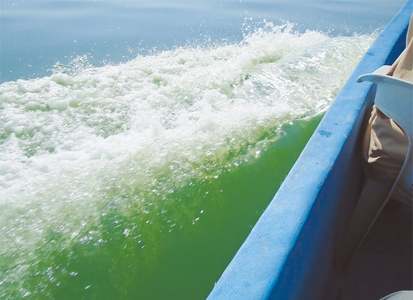
Experts rule out toxic threat after Balochistan waters turn green
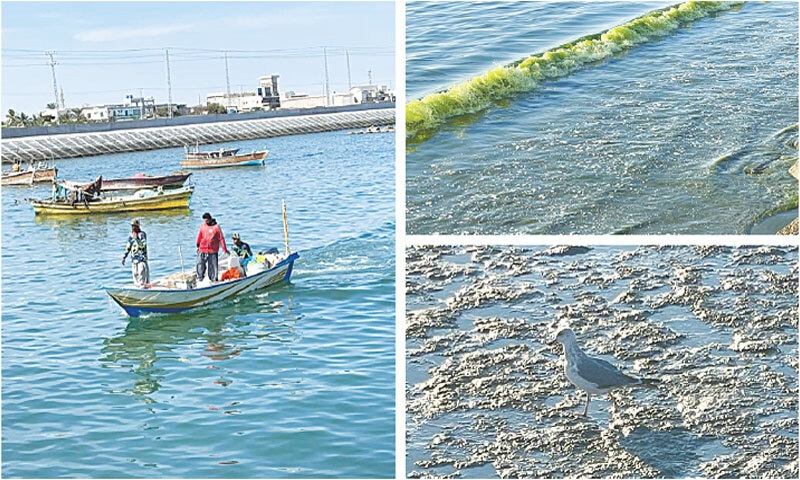
• Term algal blooms along the coast not unusual
• WWF says bloom not caused by pollution
• A unicellular marine organism blamed for the occurrence
KARACHI: Seawater along Pakistan’s coast, especially Gwadar, Pasni, Jiwani and Ormara in Balochistan, has turned green by an algal bloom, marine experts reported on Saturday.
However, they declared that the bloom posed no toxic threat.
“Strong winds and ocean currents have pushed large quantities of algae toward near shores, also amassing rotting seaweeds, which has stunk up the beaches,” said Abdul Rahim, Deputy Director at the Gwadar Development Authority, adding the bloom was caused by a single-celled marine organism Noctiluca.
Algal blooms, he explained were rapid growths or gathering of algae in water bodies and they could cause red, brown, green or blue pigmentation in the water, depending on the type of algae.
According to the GDA official, the intensity of these blooms has increased over a decade along Balochistan’s coast.
Earlier, he pointed out, there was one bloom in one or two years but now the region was seeing two to three blooms in a year.
“This is happening all over the world and researchers have linked this change to the rapid warming of oceans, which is providing them with favourable conditions to grow.”
Muhammad Moazzam Khan, Technical Adviser at the World Wide Fund for Nature-Pakistan, said the Noclituca bloom has also spread to neighbouring Iran. “This year, the bloom has started in Pakistani waters in November and spread along the Karachi coast. Currently, it exists in patches along the entire Pakistan coast, especially along the area between Pasni and Jiwani, where it’s dense.”
The occurrence of green blooms, he pointed out, along the coast of Pakistan wasn’t unusual.
“The organisation has been monitoring Noctiluca bloom since 2012 and reported its occurrence every year in winter (between November and February); however, in some years, such blooms are extensive and spread in vast areas along the coast of Pakistan,” he added.
“The winter bloom is a characteristic of the north Arabian Sea. There have been studies conducted by WWF-Pakistan, which indicate that the bloom is triggered by the spread of cold water from upwelling in some part of the Arabian Sea and its spread under the influence of eddy formation during this period,” Mr Khan said, adding: “Linking this bloom with Eutrophication is not scientifically substantiated. Noctiluca scintillans is a small, free-floating organism that may appear in red, orange, green, or even colourless forms.”
He added: “The current bloom poses no toxic threat, and no associated fish mortality has been reported along the coast. Regular observations since 2012 show that nearly all Noctiluca blooms along the Sindh and Balochistan coasts have been non-toxic.”
In 2017, the Noctiluca bloom was so intense that it covered the entire Arabian Sea, including Iran, Pakistan, India, Oman, and the Persian Gulf, he added.
While the current Noctiluca bloom is being misinterpreted in some reports and wrongly linked to pollution, WWF-Pakistan clarifies that this bloom is a naturally occurring oceanographic phenomenon and is not caused by pollution.
Along Pakistan’s coast, blooms are most often green or orange and can spread extensively depending on seasonal conditions.
Although the organism itself is not green, the colour comes from its internal symbiont, Protoeuglena noctilucae, which enables it to photosynthesize and grow rapidly. Because Noctiluca is naturally bioluminescent, its presence creates the glittering glow reported at night.
Published in Dawn, December 28th, 2025