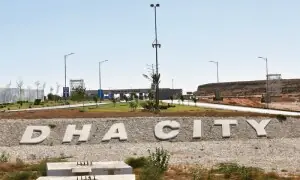
KARACHI: Although the National Cyber Crime Investigation Agency (NCCIA) had busted an “organised international gang” during raids in the Defence Housing Authority (DHA) a couple of days ago, Sindh Home Minister Ziaul Hasan Lanjar on Thursday shared details of the investigation, stating that 34 suspects, including 15 foreigners, had committed cyber fraud amounting to $60 million.
The NCCIA had, on Dec 19, claimed to have arrested the suspects, who were sent to prison on judicial remand by a court the next day.
Speaking at a press conference along with NCCIA Additional Director Tariq Nawaz at the Saleem Wahidi Auditorium of the traffic police in Clifton, the home minister said the arrested scammers were operating online investment scams, fraud schemes in which criminals build trust over weeks or months via social media platforms by tricking victims into investing in cryptocurrency and forex with the promise of large profit returns.
However, he chose not to mention the nationalities of the foreigners and said in response to a question that he was holding the press conference after a “comprehensive” investigation by the NCCIA, as it was a “serious issue” involving “foreigners from two or three countries with which Pakistan had important relations”.
“The victims were lured into investment by creating a login on fake investment platforms — which the victims considered legitimate due to fake conversations and activity in Telegram groups — controlled and managed by these scammers, where the victims were shown fake logins and made to believe that these were their investment portal accounts. From time to time, they were shown high profits on the fake online portal,” said the minister.
Mr Lanjar said an illegal gateway exchange set-up, along with 10,000 foreign SIMs, 37 computer systems and 40 mobile phones, was also recovered. These were mainly used to create fake accounts on social media and Telegram to generate a fake audience and participants in these groups, primarily on Telegram.
Lanjar chooses not to disclose identities of foreign nationals; says Centre raised issue of their involvement with respective countries
He said these foreign SIMs were used to receive personal identification numbers (PINs) and One-time passwords (OTPs) during the creation of Telegram IDs and were also used to communicate on WhatsApp, if required.
He revealed that the technical and financial investigation had led to a series of further developments, which were under investigation.
The home minister said the scammers’ main business operations pertained to managing and creating Telegram accounts, groups and social media accounts using foreign SIMs to convince and lure victims in Telegram groups for investments.
Other parts of the business related to the “collection and routing of funds in bank accounts of a target country, local arrangements, conversion of funds into cryptocurrency, and cross-border transfers to main international beneficiaries, he added.
Modus operandi
The home minister said the scammers’ modus operandi was to give “hope” to locals and foreigners that their money was being invested in business and that profits were being generated, though these were never transferred to the victims’ accounts. When the amount reached $5,000, the scammers began asking victims to submit fees on different pretexts, and once these fees were paid, the accused used to block the accounts.
He estimated the total fraud at $60 million.
Mr Lanjar said he had also received calls from citizens complaining that “illegal” call centres were being used for fraud, narcotics and other crimes.
He said NCCIA centres in Hyderabad and Sukkur were also receiving complaints about such frauds and crimes.
Mr Lanjar said the federal government issued no-objection certificates (NOCs) for opening call centres and also regulated them.In response to a question, he said the ministries of foreign affairs and interior had taken up the issue of foreign involvement in the scam with the relevant countries.
He said the government and law enforcement agencies generally provided security and protocol to foreigners, but legal action would be taken if they were found involved in criminal activities.
In response to another question, he said the NCCIA was an “important” institution, adding that there were “black sheep” in any institution. He said “significant action” had been taken against NCCIA officials allegedly involved in illegal activities recently.
However, the home minister avoided repeated questions about revealing the nationalities of the detained foreigners.
The NCCIA additional director also spoke on the occasion and said the case was just the “tip of the iceberg”.
He expressed hope that after the recent action against the criminals, there would be a “significant decline” in online fraud.
Mr Nawaz said the NCCIA had an “internal accountability mechanism”, under which several officers allegedly involved in crimes had been dismissed since May, while others were facing inquiries.
He added that the capacity of NCCIA officials was also being enhanced to deal with such “sophisticated” crimes and fraud.
Published in Dawn, December 26th, 2025