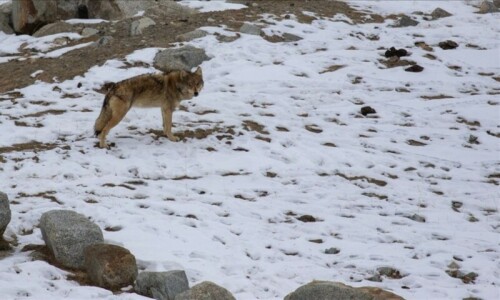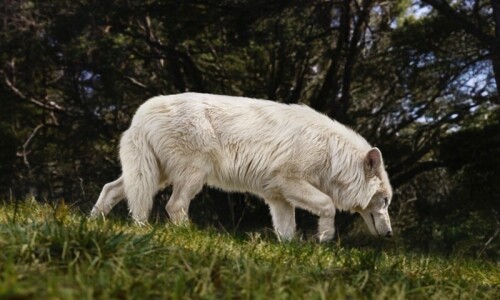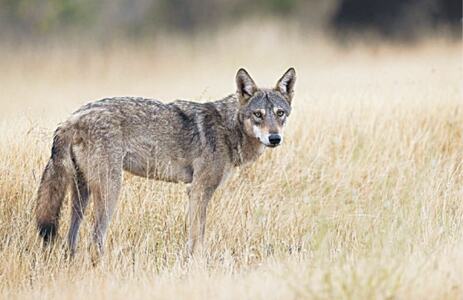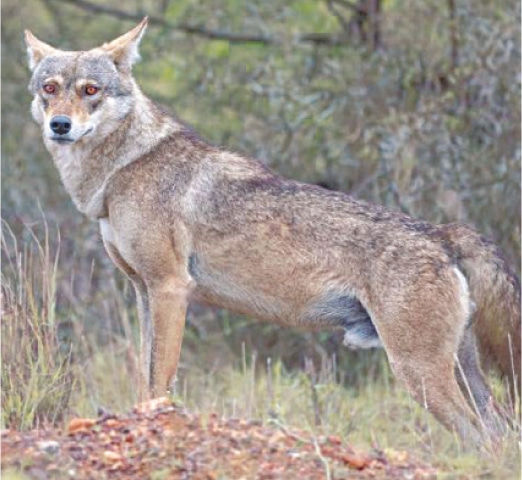
DERA GHAZI KHAN: The conflict between villagers and an endangered wolf population in the Sulaiman Range is going on and it has got more intense recently by a lack of consistent patrols by wildlife personnel.
The conflict stems from repeated wolf attacks on livestock.
According to reports, a pack of wolves has killed at least five cows and several smaller animals, including sheep and goats, in the Nanger, Bhorgrra and Pharah areas, in the west of Choti Zaireen.
In retaliation, the villagers, citing an absence of official solutions, have resorted to poisoning carcasses of animals.
“We poison the leftover meat of a hunted animal to kill the predators (wolves) when they come back to eat the rest,” says a villager, who spoke on condition of anonymity.
Wolves’ attacks in Sulaiman Range increase as their natural prey declines drastically
The wolf population in this region, which belongs to the highly endangered Indian wolf lineage, is considered very small, fragmented, and likely consists of only a few individuals or small, isolated subpopulations.
According to a study on the grey wolf estimated that just 200 wolves remained in Pakistan. Another study published in 2019, had given the number of wolves in the whole Sulaiman Range as just 15.
Wolves’ natural prey is markhor, ibex and urial and when it’s not available, the wolves turn to domestic animals around human population.
Following complaints after the recent attack, a team from the World Wildlife Fund (WWF) and wildlife officials visited the site. WWF activist Attaullah Birmani advocate says he inspected the area with a team, led by Deputy Director of Wildlife Sakhi Joya, and it collected evidence of the livestock killings.
He says the pack of wolves consisted of five members, including two cubs and their mother, but currently we find paw traces of only three, including two juveniles and one adult wolf.
Sakhi Joya says: “We are on site and working with the best intentions to resolve the villagers’ complaints”.
An environmentalist-cum-zoologist Umer Waqas told Dawn that human–wolf conflict in the region was first highlighted in 2016 when a pack of wolves was reported from one of the locations where recent incidents had occurred.
Wildlife observers indicate that the scarcity of natural wild prey within the wolves’ habitat has forced them to move down into the plains where they increasingly target the livestock herds of nomadic communities. As a result, dozens of human–wolf conflict hotspots have been identified, particularly in Choti Bala and surrounding areas. These conflicts have led to retaliatory killings of wolves by the local residents.
There is an urgent need to mitigate this conflict through the introduction of incentive-based compensation mechanisms for local communities, provided that livestock losses are verified to be caused by wolves. Such measures would help reduce retaliatory actions and foster coexistence.
Additionally, the reintroduction of suitable wild prey species, such as the wild donkeys, into the lower mountainous regions where remnant wolf populations persist should be considered.
Restoring the natural prey base would reduce predation pressure on livestock, thereby supporting both local livelihoods and the long-term survival and conservation of the wolf population.
Published in Dawn, December 24th, 2025