PML-N stalwarts back call for political dialogue

• Reference attended by multiple parties endorses talks to end instability, correct course
• Sana asks who is ‘declining dialogue’
• Law minister urges new national charter rooted in tolerance, asserts violence has no place in politics
LAHORE: Political leaders, including ruling PML-N stalwarts, from across the spectrum called for dialogue and restraint to achieve stability as political confrontation was causing instability and violence in the country.
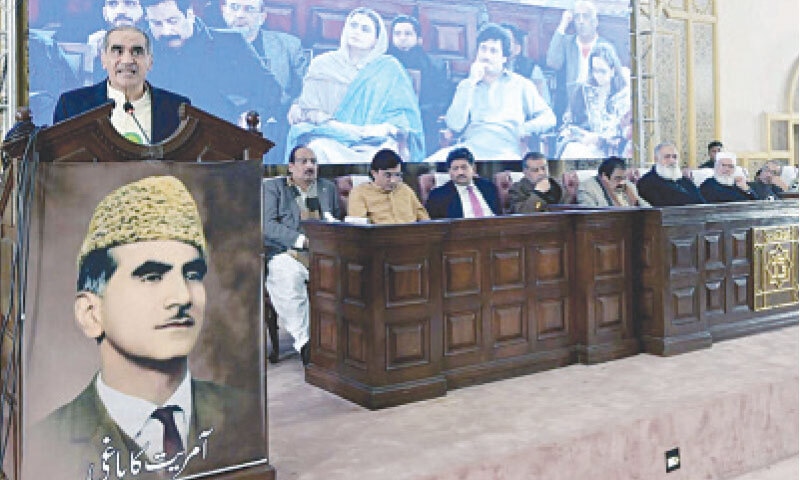
This call for reconciliation among political actors was made at the Khawaja Rafique Shaheed reference on Sunday, attended by PML-N leaders Rana Sanaullah, Saad Rafique, Azam Nazeer Tarar, National Democratic Movement leader Mohsin Dawar, and Jamaat-i-Islami leader Liaquat Baloch, among others.
This suggestion for a dialogue comes against the backdrop of a similar proposal by five PTI leaders currently incarcerated in Lahore’s Kot Lakhpat jail. In a letter, Shah Mahmood Qureshi, Dr Yasmin Rashid, Omer Sarfraz Cheema, Ejaz Chaudhry and Mian Mehmoodur Rasheed argued dialogue was the only viable path to steer the country out of its ongoing crises.
Speaking at the reference, Prime Minister’s Adviser Rana Sanaullah said political stability could only be achieved through restraint, mutual respect and sustained dialogue, warning that confrontation and violence repeatedly derailed Pakistan’s democratic course.
Rana Sana said no nation can progress through fighting, chaos and disorder, adding that attacks on defence installations were “gravely wrong” and unacceptable.
Referring to recent political flashpoints, he said the May 25, 2022, “attack” , a reference to a PTI rally, on Islamabad derailed a process that could have led to the dissolution of the assemblies and subsequently elections. He said talks on elections were later revived but stalled when PTI sought approval from its founder, but it was not granted. This was followed by the May 9 violence and preparations for further unrest.“If meetings are meant to prepare chaos and disorder, does the law allow everything to proceed unchecked?” he asked in an apparent reference to recent uproar about a ban on meetings with PTI leader Imran Khan.
According to the PML-N leader, political instability emerges when parties abandon dialogue for confrontation, stressing that the government has repeatedly offered talks. “Tell us — who is refusing dialogue? If it is us, we will correct ourselves; if it is someone else, name them,” he said.
Rejecting claims that elections were selectively fair or unfair, Rana Sana recalled that even in 2018 the opposition alleged mandate theft, yet extended an offer to work together in parliament — an offer that was rebuffed with threats of imprisonment by Imran Khan.
He also cited overtures made before the passage of this year’s budget, saying Prime Minister Shehbaz Sharif publicly invited the opposition for talks, including in the presence of the military leadership, proposing a ‘Charter of Pakistan’. “Who is declining political dialogue?” he asked again, urging clarity to remove ambiguities blocking stability.
Condemning terrorism, he referenced the Jaffar Express abduction, saying innocent passengers were killed due to identity cards from other provinces. He criticised what he termed a coordinated hostile narrative amplified within seconds by foreign media and echoed domestically.
He concluded by calling for respect, tolerance and political engagement to resolve disputes. “If elections are disputed, political parties, not the establishment, must decide the way forward. Political stability is essential for national progress,” he said, noting that while second-tier leadership within PTI favours dialogue, fear of backlash from within the PTI ranks has stifled it.
‘New national political charter’
Earlier, Law Minister Azam Nazeer Tarar urged a new national political charter rooted in tolerance and dialogue, while PML-N leader Khawaja Saad Rafique called for a ‘charter of democracy’ and a ‘charter of economy’, warning against inter-provincial polarisation and repeated assaults on the sanctity of the vote.
Mr Tarar stressed the need for dialogue, tolerance and a new political consensus to steer Pakistan out of deepening political and economic uncertainty, saying extremism and violence have no place in politics.
Emphasising restraint and respect for dissent, he called for listening to opponents, embracing positive criticism, and forging a national political charter to ensure stability. “Pakistan cannot move forward without political and economic stability. This is not for one person or one party — it is for the country,” he added.
Meanwhile, Saad Rafique also made a similar point about talks. He underscored that confrontation and chaos cannot strengthen the state, warning that repeated assaults on the sanctity of the vote had eroded public trust.
The PML-N leader urged engagement with all constitutional forces and dialogue with institutions to reduce political pressure and restore stability.
He also lauded Pakistan’s armed forces for recent successes, saying national morale had risen, and credited the current leadership for standing by the state in difficult times. He cautioned against widening inter-provincial rifts to focus on real challenges.
Ex-MNA Mohsin Dawar called for strengthening federalism through democratic means, while Liaqat Baloch warned that prolonged political instability was poisoning the federation and urged opening channels of dialogue and empowering local governments.
The reference concluded with a unified call to reject fascism, uphold constitutionalism, and pursue dialogue as the only sustainable path to a stable, democratic Pakistan.
Published in Dawn, December 22nd, 2025