EXHIBITION: A FINAL ODE
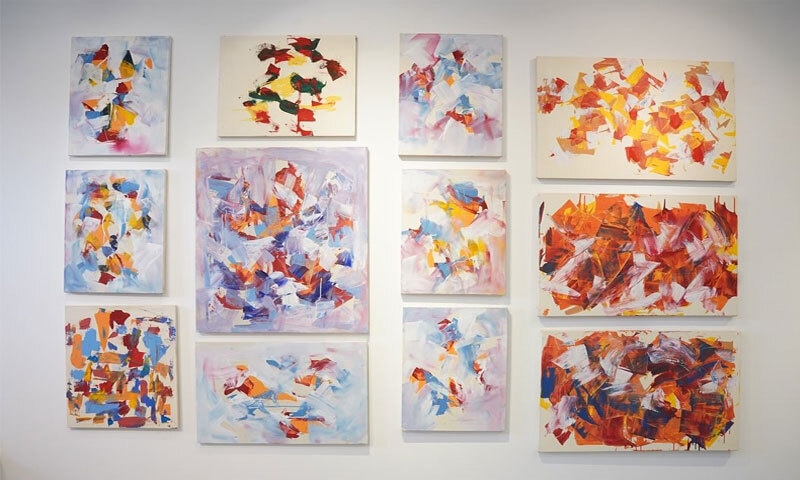

A posthumous retrospective of the artist Mashkoor Raza’s (1948-2025) work was held at Mainframe Gallery, Karachi. The show opened a window into the late modernist period in Pakistani art (1970s and 1980s), during which abstract and semi-abstract art enjoyed huge popularity.
Raza was a prolific painter. His prodigious output can be gauged from the number of works on display that have come from his family’s collection. Raza graduated from the Karachi School of Art in 1972, where he had painted under the tutelage of Mansoor Rahi. He subsequently became a teacher at the school that had nurtured his love for painting.
Raza’s output in the 1970s consisted of anodyne abstractions in oil that appealed to the expanding bourgeois segment of society. Pakistan was settling its tremors after the cataclysmic parting of East Pakistan during this decade. Like many Pakistani modernists, Raza’s art avoided allusions to politics or narrative depictions. His abstractions differed from the querying mood of Zubeida Agha’s work or the raucous riot of colour in Ahmed Parvez’s compositions. Instead, they offered decorative comfort and a release from the angst of the world.
Whites, reds and blues dominated Raza’s palette, as evidenced by this exhibition. Diagonal dashes and spherical forms coexisted on the surface of the canvas in rhythmic patterns, much like fine streams of water coming together from different directions and colliding gracefully. Besides purely abstract paintings, Raza also created a large body of work with horses and figures.
The artistic legacy of Mashkoor Raza, who passed away earlier this year, was celebrated at a recent retrospective
He used a somewhat Cubist style with broad, fat brushstrokes to create volume and form. The rendering captured musculature, form and movement exquisitely. The horses were often combined with roughly delineated riders and occasionally with scanty line drawings of women. The lineage for this depiction of women can be linked to Shakir Ali’s minimalist female shapes.
The retrospective enabled us to see the beauty of Mashkoor’s painted animals. There were monochromatic paintings of zebras and Siamese cats. They resembled Sumi-e style Japanese ink-wash paintings dating back to the Chinese Han dynasty, and sought to depict different intensities of ink with a single brushstroke.
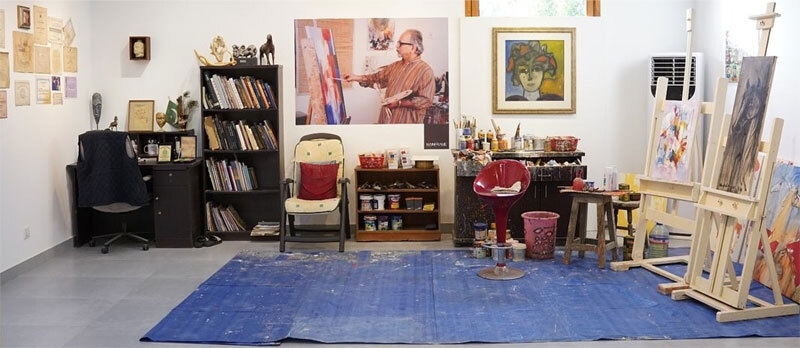
An interesting feature of the retrospective was the recreation of Raza’s studio on the brightly lit, upper floor of the gallery. This 3-D capsule into the past contained dark brown furniture, including a desk, a bookshelf and a chest of drawers containing tubes of paint. Two easels added to the theatrics of an artist’s studio.
Raza had received the Sitara-i-Imtiaz in 2023. This award was part of the items sitting atop the desk at the exhibition, along with a Hala vase containing a few peacock feathers. A box shelf with a Buddha head hung on the wall above. A painting by Wahab Jaffer, and another by Tassaduq Sohail, hung on the wall, along with a large photograph of Raza in his studio.
A bookshelf stood next to the desk, containing art books, catalogues, magazines and files. There were editions of the book Mashkoor Raza’s Journey and books on other artists such as Colin David, Sumaya Durrani, Tassaduq Sohail, Jimmy Engineer, Jamil Naqsh, Mona Naqsh and Nahid Raza. Art books on horses testified to the artist’s passion for the equine form so evident in his painting.
The chest of drawers was crammed with tubes and jars of paint. Encrusted drips of paint on the furniture made a poignant statement on the flurry of activity that the studio witnessed over decades.
Carefully preserved clippings from the press were also on display. They provided another time capsule, this time into art criticism that was contemporaneous to Raza’s years as an active painter. Notable art writers, including Salwat Ali, S. Amjad Ali, Marjorie Husain and Gregory Minissale had covered Raza’s many shows. Not all criticism was laudatory, as we can glean from Minissale’s sardonic appraisal: “Mashkoor possesses that rare sixth sense that enables him to be such a popular artist, having a sensitive finger on the pulse of mediocre public taste.”
Such a value judgment on public taste invites reflection on the art savviness of a society. Nevertheless, the boy from Moradabad who came of age as a painter in Karachi is testament to the aspirational possibilities that Karachi continues to provide to art.
‘The Last Hurrah: Mashkoor Raza (1948-2025)’ was on display at Mainframe Gallery in Karachi from November 8-15, 2025
The writer is an independent researcher, writer, art critic and curator based in Karachi
Published in Dawn, EOS, December 21st, 2025