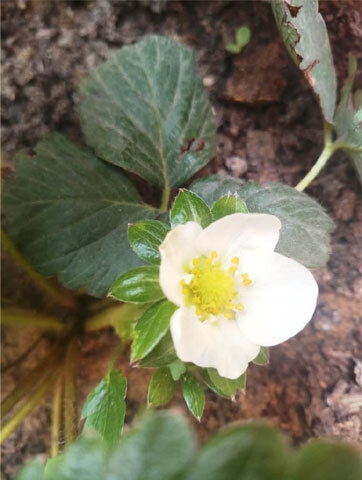
A successful strawberry harvest begins not with planting, but with patience. Properly acclimating your new runners — the long stems that grow from a mother plant, also called stolons — is the crucial first step to ensuring healthy plants, vibrant flowers and a bounty of sweet fruit.
Once you have purchased strawberry runners from a reputable nursery, place the containers in a shaded area that receives plenty of indirect sunlight for at least seven days. Alternatively, plant the runners in the ground with shade installed. This will provide them with ample time to recover from the shifting ‘shock’ stage.
When the runners appear to be erect, with healthy leaves and new ones emerging from their stems, it is time to shift the containers into sunlight or remove the shade for runners planted in the ground. Early morning sunlight till noon is now the order of the day for them.
From a home gardener’s perspective, one of the best aspects of growing strawberry runners is that there is no need to transplant the seedlings later. In fact, because strawberries have relatively small roots and compact plants compared to other fruit-bearing trees and plants, the spot where the runners are planted can serve as their permanent location.
Growing strawberries from runners requires patience, but it is worth the effort when you get your hands on the juicy heart-shaped fruit
However, it is imperative that, from the very beginning, strawberry runners are planted at a safe distance of at least one foot from each other. A dedicated six-inch pot for smaller plant varieties is sufficient.
When grown in open spaces or for commercial purposes, larger strawberry plants require at least 18 to 24 inches of space on either side to ensure optimal aeration. To maximise the number of plants in limited spaces, many gardeners use a zigzag planting pattern in raised beds. In greenhouses or in open fields, strawberries are best planted in rows — this is the case in Dir, Swat and Malakand. The space between these rows should be three feet, as some varieties can grow to 18 inches to two feet wide.
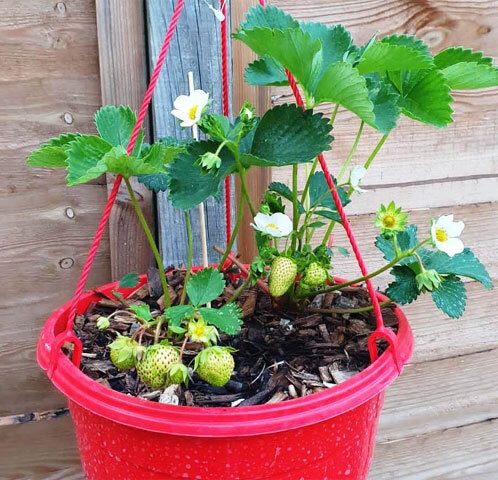
New foliage usually appears two weeks after a runner has been planted, as the roots firmly establish themselves in the soil. As fresh leaves start to emerge, the young plant begins to grow rapidly. Within a month, small buds start to form; these either continue to grow or, in some cases, enter dormancy before eventually blooming into white flowers.
Interestingly, strawberry plants also exhibit photoperiodism, which can greatly influence the flowering phase. Photoperiodism refers to a plant’s response to the two distinct periods of the day — the daylight period and the dark period at night. In most varieties, a decrease in daylight signals to the plant that it should enter its flowering-induction phase.
Watering is critical throughout the bud formation, flowering and fruiting phases. It should be done in a way that keeps the soil moist but not wet, while maintaining proper drainage. It is also important to water the plant near the soil’s surface, not from high above, as this will damage young plants.
There is a strong belief among strawberry farmers that the first year’s flowers should be removed entirely. This helps boost the plant’s foliage, growth and development, as more nutrients and energy are now available to the rest of the plant rather than being diverted to producing flowers and subsequent fruit development. However, for home gardeners, especially those growing in Karachi or a similar climate, this is not the case, as strawberry plants are seasonal there.
The strawberry flower is star-shaped, usually with five — and occasionally with six — petals. These are bright white, with a golden-yellow centre containing both male and female parts. Its base, the pistil, is the female reproductive part, while the stamens, arranged in a circle, are the male reproductive parts.
For pollination to occur, the pollen from the stamen falls on the stigma (the sticky tip of the pistil) of the same flower. This self-pollinating flower, however, relies on external pollinators, such as bees, insects and butterflies, to be fully pollinated to ensure well-formed fruit.

The strawberry flower is edible and can be used to garnish salads. However, most people prefer to wait for a few more weeks to get their hands on red, juicy strawberries and savour them!
Please send your queries and emails to doctree101@hotmail.com. The writer is a physician and a host for the YouTube channel ‘DocTree Gardening’ promoting organic kitchen gardening
Published in Dawn, EOS, December 21st, 2025