US ‘very grateful’ for Pakistan’s offer to be part of Gaza stabilisation force: Marco Rubio

US Secretary of State Marco Rubio on Friday disclosed that Pakistan had accepted inclusion in the proposed International Stabilisation Force (ISF) for Gaza, while stopping short of confirming a firm troop commitment.
Last Tuesday, Pakistan attended a conference in Qatar, which was hosted by US Central Command, to discuss the ISF’s command structure and other unresolved operational issues. Pakistan was among nearly 45 countries attending the meeting.
Responding to a question on whether Washington had received Pakistan’s consent to deploy troops for peacebuilding in Gaza, Rubio said the United States was “very grateful to Pakistan for their offer to be a part of it, or at least their offer to consider being a part of it,” adding that further clarity was still required before any country could be asked to formally commit.
“I feel very confident that we have a number of nation-states acceptable to all sides of this who are willing to step forward and be a part of that stabilisation force and certainly, Pakistan is key, if they agree to do so,” he added.
Rubio noted that key issues related to the force’s mandate, command structure, and funding arrangements were still under discussion.
“I think the next step here is announcing the Board of Peace [and] the Palestinian technocratic group that will help provide daily governance,” the secretary added.
“Once that‘s in place, I think that will allow us to firm up the stabilisation force, including how it’s going to be paid for, what their rules of engagement are, what their role will be in demilitarisation and so forth.”
The US State Department has formally approached more than 70 countries seeking troops or funding for the proposed force. Some 19 countries have reportedly so far indicated willingness to assist through troops, logistics, or equipment, with international deployment in Gaza potentially beginning as early as next month.
Diplomatic sources also told Dawn that Pakistan was considering deploying 3,500 troops as part of the ISF.
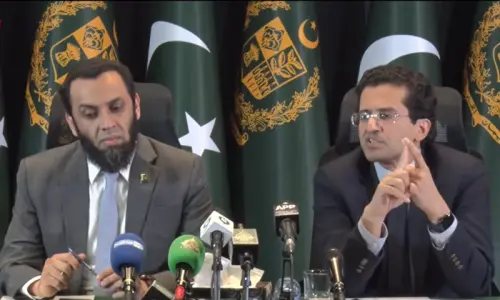
Rubio’s remarks come a day after Pakistan articulated its official position. Pakistan’s Foreign Office spokesman, Tahir Andrabi, said Islamabad had not yet decided on contributing troops to the ISF, indicating that discussions were still at an exploratory stage rather than reflecting a final commitment.
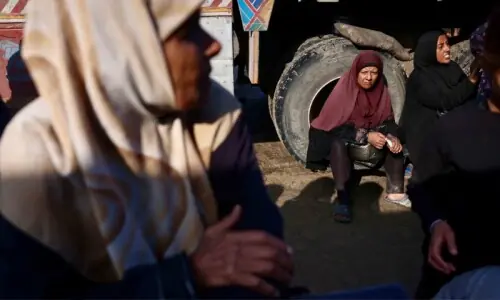
The Gaza Strip has been largely reduced to rubble after two years of Israel’s onslaught.
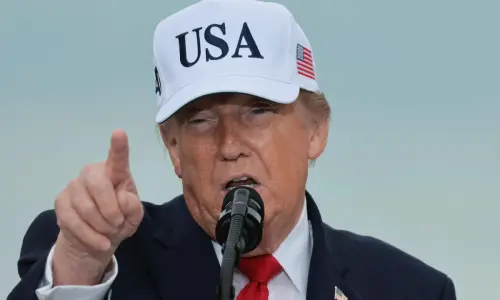
In September, US President Donald Trump unveiled a 20-point peace plan, which laid the foundation for the peace agreement signed in October by Israel and Hamas.
A cornerstone of the US-brokered Gaza Peace Agreement was the establishment of the ISF, composed mainly of troops from Muslim-majority countries.
In November, the UN Security Council adopted a US-drafted resolution endorsing President Donald Trump’s plan to end the conflict in Gaza, which also authorises the deployment of the ISF to the Palestinian enclave.
Thirteen UNSC members, including Pakistan, voted in favour of the resolution, while Russia and China abstained. However, Hamas rejected the resolution and also decried the establishment of an international force whose “mission includes the disarmament” of Palestinian resistance groups in Gaza.
International troops could be deployed in the Gaza Strip as early as next month to form a UN-authorised stabilisation force, two US officials told Reuters, but it remains unclear how Palestinian Hamas fighters will be disarmed.