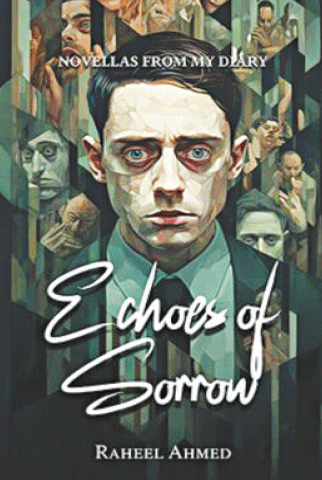
Echoes of Sorrow
By Raheel Ahmed
Legacy Books
ISBN: 978-627-7706-04-3
247pp.
Echoes of Sorrow is written by Raheel Ahmed, who has also authored Reforging Nations: The Definitive Chronicles of Zulfikar Ali Bhutto, Sheikh Mujibur Rahman and Indira Gandhi. Ahmed is a researcher and educator in the Department of Political Science at the University of Karachi; hence, the latter work falls into his ambit of specialisation.
Ahmed states that he has been recording ideas/experiences in his diary for several years. The seven stories, which the author refers to as “novellas”, in Echoes of Sorrow, his first foray into fiction, are the culmination of that process. The collection is distinguished by an erudite foreword written by writer Taha Kehar.
Urdu ghazals, nazms and vintage Bollywood and Lollywood songs are close to the heart of the author and have a ubiquitous presence in the stories he weaves. Couplets from Urdu poetry are used at the beginning of five stories. In the story ‘The Colour of Tears’, two entire songs, one sung by Mala and the other by Nusrat Fateh Ali Khan, are featured.
As the title suggests, the stories are all sad. But, in many of them, Ahmed weaves in suspenseful threads and knows exactly how much to divulge and what to keep hidden until the final curtain, keeping the reader on tenterhooks. The characters in the stories are developed with a sure touch. Readers become invested in the fates of the tales’ protagonists, for they seem real and familiar. There is, however, a hint of stereotypical thinking in the narratives, for it is often the female characters who are made to suffer, forbear and endure.
Wherever there is dialogue, be it between lovers, prison inmates or even between a bureaucrat and a supplicant, it is rendered smoothly and naturally. The one genuinely outstanding aspect of the tales that Ahmed has penned, however, is that each one has a twist in the tale. The revelation at the end casts a new colour on the story and requires a reassessment of the chronicle as a whole.
Despite uneven editing, a debut collection of seven stories keeps readers engaged with believable characters and its storytelling flair
The first story in Echoes of Sorrow is called ‘Alpha and Omega’. Its premise is the possibility of consciousness transfer from one brain to another. Such an operation can presumably transfer the consciousness of a dying person into a healthy body. How ethical it would be to do so and what the identity of the person with the alien brain would be become moot points.
‘Lie We Live’ is the shortest tale in the book. The hero’s loneliness and dejection are very well portrayed. Even though no reason is given for the older man’s isolation or why his only friend is the postman, the relationship between the two unfolds layer by layer, and suspense is maintained until the end.
‘To the Crossroad’ is a take on the legend of Shireen and Farhad. The main character falls in love with a renowned beauty from Lahore’s red-light district. In a bizarre turn of events, he makes an unexpected choice, leaving the female to face the music on her own.
‘Hope and Despair’ is a well-thought-out story about the Hindu community. A mother tries to procure enough money for the treatment of her gravely ill daughter. The required cash finally becomes available, but tragedy strikes, and all hope is lost. The uncertainties of life, the generally accepted stance toward the poor and the disdain shown to minorities in our culture are all delineated in this tragic tale.
Suspense is almost palpable in the story ‘Eternal Atonement’. The reader knows something horrific is about to happen. Like Chekhov’s gun, the envy in the heart of the central character foretells that evil is imminent. Mental illness is the subject of ‘The Colour of Tears’. The finale does not come as a total surprise, but the tale is well-crafted, and the characters are convincing. The last story in the collection, ‘In Another Life I’d Tell You’, is a romantic tale of mistaken identity. It is set in rural Punjab, and the quirks of village life are ably melded into the narrative.
The plots of the stories in Echoes of Sorrow are engaging and well-mapped out. However, their execution is uneven. In some cases, too many unnecessary details are included while, at other times, the reader is left groping for missed connections and attempting to reconcile contradictory statements. The narrative structure needs to be tighter and more consistent.
Additionally, the book suffers from a severe lack of editing. An overabundance of ellipses, misuse of capitals and missing quotation marks mar the first four stories. Sometimes, the dialogue’s format changes mid-story. The use of italics is also erratic. Some sentences are incomplete and others are clearly missing words. These flaws, though minor, make for jerky reading.
It is also unsettling to come across phrases that are directly translated from Urdu, such as calling the full moon “the 14th moon.” Perhaps it is the Urdu influence as well that causes the fluidity of tenses in Echoes of Sorrow. Quite unexpectedly, tenses change from one sentence to another in the same paragraph and even within a single sentence.
Urdu ghazals, nazms and vintage Bollywood and Lollywood songs are close to the heart of the author and have a ubiquitous presence in the stories he weaves. Couplets from Urdu poetry are used at the beginning of five stories. In the story ‘The Colour of Tears’, two entire songs, one sung by Mala and the other by Nusrat Fateh Ali Khan, are featured.
The last three stories are easier to read. The prose flows and errors are kept to a minimum. Descriptions of nature are included only when they enhance the plot, superfluous minutiae are avoided, and the tales are taut and better edited.
The last page of Echoes of Sorrow is adorned with a famous ghazal by Iftikhar Arif, accompanied by an English translation. Yet no explanation is given for its inclusion.
Ahmed, the brother of the renowned author and researcher Ayesha Siddiqa, has presented his thoughts and impressions to the world in this collection of stories. The yarns he spins are reflections of life, and he manipulates the storylines capably, with a flair for the dramatic. This may be Ahmed’s first book of fiction, but one hopes he finds a better editor and it is not the last.
The reviewer is a freelance writer, author of the novel The Tea Trolley and the translator of Toofan Se Pehlay: Safar-i-Europe Ki Diary
Published in Dawn, Books & Authors, December 21st, 2025