Equities scale new high as IMF inflow lifts investor sentiment


KARACHI: The Pakistan Stock Exchange (PSX) extended its bullish run during the outgoing week as investor sentiment strengthened following the International Monetary Fund’s (IMF) Executive Board approval of fresh financing and key policy measures to address structural bottlenecks.
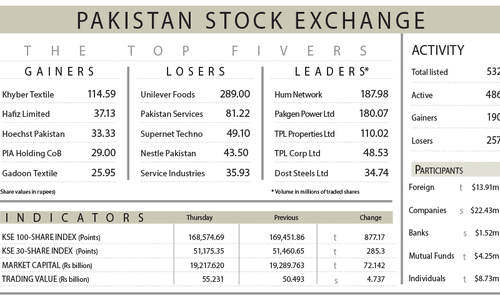
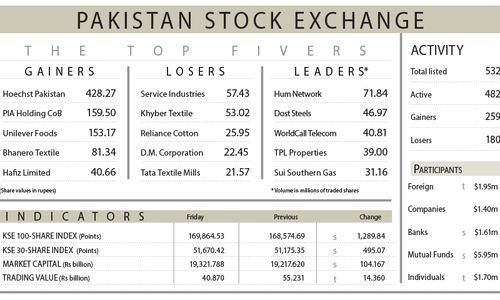
According to Arif Habib Ltd (AHL), the benchmark KSE-100 index closed at an all-time high of 169,865 points, gaining 2,779 points, or 1.66 per cent, week-on-week. The rally was largely driven by the IMF board’s clearance of a $1.2bn disbursement under the Extended Fund Facility (EFF) second review and an additional tranche under the Resilience and Sustainability Facility (RSF).
The approval included waivers for missed conditions and coincided with a landmark Rs659.6bn settlement of power sector debt, easing long-standing concerns over circular debt.Market participation improved notably.
Average daily traded volume rose to about 1.03bn shares, reflecting a 52pc year-on-year increase, while average daily traded value climbed to Rs49.5bn, up 23pc over the previous week.
KSE-100 index adds 1.6pc in outgoing week
Topline Securities noted that macroeconomic indicators released during the week further supported market confidence. Workers’ remittances in November stood at $3.2bn, up 9pc year-on-year, although down 7pc month-on-month. Cumulatively, remittances during the first five months of FY26 rose 9pc year-on-year to $16.14bn, underlining continued support from overseas Pakistanis.
Auto sector data also pointed to a gradual recovery. Car, light commercial vehicle, van and jeep sales declined 11pc month-on-month to around 15,400 units in November, but posted a sharp increase of over 52pc compared to the same month last year. In the first five months of FY26, cumulative auto sales rose 48pc year-on-year to about 75,000 units, reflecting improved availability and easing supply constraints.
In the fixed-income market, the government raised Rs981.7bn in the latest Treasury bill auction against a target of Rs1 trillion, with total participation exceeding Rs1.9tr. Yields eased marginally across all tenors by one to three basis points, signalling expectations of monetary stability ahead of the upcoming policy review.
On the external front, the State Bank of Pakistan’s foreign exchange reserves edged up by $12m during the week to $14.6bn, while commercial bank reserves also increased to about $5.02bn. The rupee appreciated slightly, gaining 0.04pc week-on-week to close at Rs280.32 against the US dollar.
Energy sector data showed mixed trends. Oil production inched up 0.1pc week-on-week to 66,014 barrels per day, while gas output rose sharply by 6.1pc to 2,917 mmcfd, supported by higher flows from Mari, Uch and Qadirpur fields. Power sector statistics indicated that net metering’s share in total electricity generation increased year-on-year in October, reflecting growing solar adoption, even as overall power generation declined 3.7pc annually.
The regulator has projected power demand growth of around 2.8pc in FY25.
AKD Securities said the sentiment was further buoyed by a series of policy and development announcements, including adjustments to oil marketing company and dealer margins, an incremental electricity package for industry and agriculture, approval of financing for the Karachi-Rohri section of ML-1, and progress on the Reko Diq project.
Additionally, the Asian Development Bank and the World Bank also approved a total of $940 million to Pakistan for reforms in the SOEs, water sector and safely managed water, sanitation and basic hygiene services.
Sector-wise, textile spinning, engineering, synthetic and rayon, textile composites, and glass and ceramics emerged as top performers during the week. In contrast, leather and tanneries, jute, leasing companies, refineries and vanaspati-related stocks lagged behind.
Flow-wise data showed mutual funds as the largest net buyers, while insurance companies recorded net selling.
Analysts said valuations remain attractive, with the KSE-100 index trading trading at a price-to-earnings multiple of 8.57x against its 15-year average of 8.80x, offering a dividend yield of 5.68pc versus the historical average of 6.18pc.
Analysts expect sentiment to remain positive in the near term, supported by IMF inflows, easing yields and the absence of major alternative investment avenues.
While the upcoming monetary policy is widely expected to maintain rates, even a modest interest rate cut could further underpin equity market confidence.
Published in Dawn, December 14th, 2025