Bilawal says PTI’s ‘extreme politics’ is ‘putting the party in jeopardy’, opposes ban
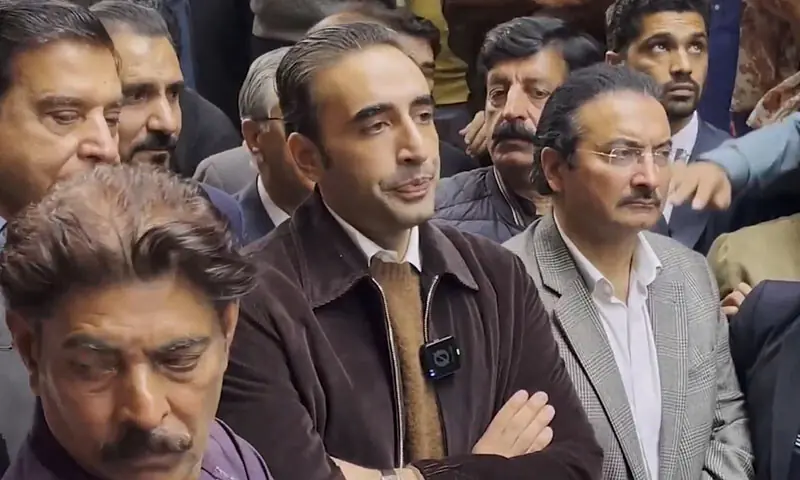
PPP Chairman Bilawal Bhutto-Zardari on Wednesday warned that a political party, in an apparent reference to the PTI, risks being banned due to its deliberate targeting of state institutions on social media, and urged it to “abandon such politics.”
A day earlier, the Punjab Assembly adopted a resolution to ban the incarcerated PTI founder and former prime minister Imran Khan and his party for being “anti-state”, following remarks by Inter-Services Public Relations (ISPR) Director General Lt Gen Ahmed Sharif Chaudhry, who assailed Imran for creating and spreading an “anti-army” rhetoric and stated that such narratives were now beyond politics and had become a “national security threat”.
Speaking to the media after visiting the residence of a late senior party worker in Lahore’s Baghbanpura neighbourhood, Bilawal said that the PTI is “targeting” the military leadership through social media and “concocting political conspiracies”.
“They attack institutions when Pakistan is passing through a critical phase,” he said. “I urge them to abandon these politics immediately. They have not only put their own party in jeopardy, but they have also left the political system and the people of Pakistan in a difficult spot.”
In response to a question about whether the PTI should be banned, the PPP chairman said that no political power wants conditions to become so bad that political voices are silenced.
“This will not be my preference or my choice, but what can I do when they continue to pursue extreme politics?” Bilawal asked. “Protest is your right, not entering and attacking military installations.”
The PPP chief also noted that amid a spike in terrorism, the PTI is attacking the institution combating militancy.
“We do not want a ban on any political party, but political forces must adopt a democratic attitude,” he said, adding that it was the government’s responsibility to provide political space to the opposition.
“They (PTI) are creating an environment in which bans could be imposed, what I want is irrelevant,” he said. “Someone needs to tell that man (Imran) to come to his senses and engage in politics. If he wants to do that, political doors will open, but if he wants to lead his party like an army, then he will be dealt with accordingly.”
Bilawal also demanded that the PTI focus on the problems of the people rather than “attacking our national heroes”.
“We will not stand silent while these people abuse our armed forces. We believe that this party is doing the work of the political antichrist,” Bilawal said.
He noted that the PTI’s behaviour amid a deteriorating security landscape in Khyber Pakhtunkhwa may even trigger discussions of governor’s rule, although he had not seen the KP governor’s statement on the matter.
“Governor’s rule is an extreme proposition, but if the political parties and leadership there (KP) weaken the nation and create conditions where it becomes difficult to fight terrorism, then we have the constitutional and legal obligation to impose it.
“The PPP is not demanding it, but the PTI’s actions and choices may lead to governor’s rule or a ban. Neither of those things are good.”
Referring to the brief war with India in May, the PPP chief claimed that Pakistan had responded firmly to Indian aggression, but noted that threats from New Delhi remain present, while terrorism emanating from Afghanistan is an alarming reality.
Bilawal stressed that internal challenges were also being addressed, and at such a time, “It is the responsibility of every patriotic citizen to stand with the country and its armed forces.”
Earlier in 2024, the federal government decided to ban the PTI and sought Article 6 proceedings against Imran, ex-president Dr Arif Alvi, and former National Assembly (NA) deputy speaker Qasim Suri.
The move appeared to be an attempt to prevent the PTI from becoming the single largest party in the NA, following the apex court’s ruling in the reserved seats case. However, the government did not follow through with the ban.
In October, the federal government approved a ban on the religiopolitical party Tehreek-i-Labbaik Pakistan (TLP) under the anti-terrorism act (ATA) following violent protests.
However, banning political groups is not a new practice in Pakistan. It has followed the country across decades — from martial laws to seemingly democratic setups.