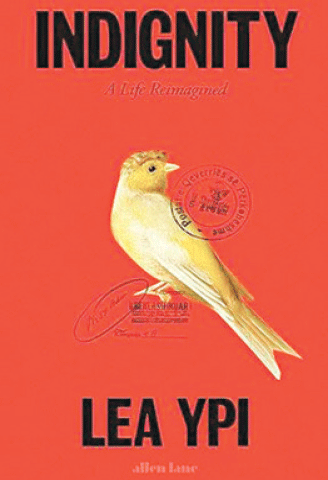
Indignity: A Life Reimagined
By Lea Ypi
Allen Lane
ISBN: 978-0241661925
368pp.
Lea Ypi rose to fame with the publication of her coming-of-age memoir, titled Free, in 2021. Since then, the book has been translated into more than 30 languages and continues to serve as a must-read book on Albania and the wider Balkans (I am told on a good authority that the book is the favourite read of development consultants and academics on the region).
Lea Ypi’s second book, Indignity, lifts one of Free’s chief characters — her paternal grandmother, Leman Ypi — and reconstructs Leman’s life through a combination of archival research, memory and imagination.
Lea is jolted into this life reconstruction work when a picture of her beaming grandmother on her honeymoon, in 1941 in Cortina in the Italian Alps, is posted on social media. The picture, which Lea had not seen before, attracts internet trolls, with damaging allegations of her grandmother being a fascist collaborator.
This sets Lea on a hunt to discover the real truth about her deceased grandmother and restore her to the pedestal of dignity from the murk of indignities heaped upon her in life and beyond. The resulting search takes her to five countries and eight archives.
The upshot of her archival and imaginative labours is a sheer joy to read. The book offers rich insights into the life and times of Leman Ypi, whose remarkable life straddled the collapse of the Ottoman Empire, the emergence of Albania as a newly communist state after the travails of the Italian invasion, and German occupation during the Second World War.
An unjust characterisation leads an Albanian academic and author to research her maternal grandmother’s life and times, offering profound meditations on memory, displacement, colonialism and European power politics
The book begins with a portrait of Leman’s early years in Salonica (now called Thessaloniki), the most cosmopolitan city in Greece, towards the dying days of the Ottoman Empire, in whose service some members of the Leman family, of ethnic Albanian origin, were gainfully employed.
Lea skilfully and imaginatively reconstructs the plural, cosmopolitan milieu of Salonica, composed of many cultural, religious and ethnic mansions. Lea’s portrayal of Salonica reminds me of British historian Mark Mazower’s Salonica, City of Ghosts: Christians, Muslims and Jews 1430-1950, which charts the rise and fall of Salonica as the most cosmopolitan and global of the Greek cities.

This traumatic and elegiac phase in the life of Salonica, when its multiethnic fabric was being forcefully undone on account of forced population transfers of Turks and Greeks, is deftly handled by Lea Ypi. What was integrated harmoniously over centuries is set to be disintegrated in the wake of the dissolution of the Ottoman Empire, with huge personal and political privations for those caught up in the drama of the time.
There are hints of resentment and helplessness in the face of the larger scale role of great European powers, through the Treaty of Lausanne and the League of Nations, in population transfers. The League of Nations, a creation of the US President Woodrow Wilson, rather than granting the previously Ottoman-colonised countries the right of self-determination as the key plank of the League, threw them back into the hands of new European colonisers, under the mandate administration.
Lea always lifts her narrative from personal to regional and global forces at work in the brutal unmixing of the harmoniously mixed-up population of Jews, Muslims and Christians of various ethnic and newly national affiliations.
Amid this personal and regional turmoil, in 1936, Leman — then only 18 and still single — makes a courageous decision to move to Albania, a country to which she has never been before. At the time of Leman’s arrival in Tirana, Albania is going through its own political convulsions, triggered by the successive Italian invasion and German occupation of the country, and the emergence of a national resistance movement.
Leman meets Asllan Ypi, the son of Xhafer Ypi, who served briefly as a prime minister of Albania in the early 1920s. Asllan and Leman hit it off well and soon get married. Asllan Ypi, educated in France, and friend of the future communist leader Enver Hoxa from their Paris days, is brimful of radical ideas, acquired from his stay in France.
Asllan’s political radicalism soon falls foul of the Enver-led communist government that came to rule the country after the end of the German occupation. Asllan is duly thrown in prison for his dissident political views and his alleged association with the British intelligence agents operating in Albania. Leman, too, ends up in a forced labour camp, as collateral damage.
Zafo (Xhafer Ypi), the father of the author, is the sole child of the couple (we encounter Zafo struggling to negotiate the adverse consequences flowing from his father’s political activism and incarceration in the first book Free). Lea, an academic philosopher, seems to imagine her characters as physical embodiments of certain lasting values, ideas, ideals and ideologies, for which they often pay a heavy personal price.
In Free, the characters represent some notions of feminism, civil society, neoliberalism, free market democracy, conservatism, Marxism and social democracy. The guiding and structuring concept of this book, however, is dignity. These forms cover a range of trying situations in which one’s innate sense of dignity is tested.
These actions range from Asllan’s criticism of his father’s conduct not measuring up to dignity, Xhafer Ypi’s notion of dignity as consisting in stopping the fires of chaos from spreading as an administrator, Leman’s idea of dignity as the capacity to do the right thing in the face of odds , and Lea’s maternal grandmother Mediha Hanim’s act ensuring that her husband, Ibrahim Pasha, dies a dignified death.
Interestingly, Lea accidentally stumbles upon another Leman Ypi, who is the namesake of her grandmother, in the archives. Besides restoring dignity to her own grandmother, Lea also gives the other Leman Ypi the dignity of a memorial in the final chapter of the book.
As a researcher, Lea sets great store in methodological reflections on her archival research approach and the role of archives in the construction of memory and the reconstruction of hitherto unexplored biographies. Each chapter begins with an extract from the sparse secret service archive and expands into a wider portrait of Leman’s life and times, by filling up the information gaps left in the archive through novelistic imagination and memory recall. In this way, Lea arrives at a considerably rounded view of her grandmother, which is a fitting and lasting retort to her internet trollers.
In the process, the book becomes a well-written and well-crafted gem, offering profound meditations on loss, love, memory, displacement, archival research, migration, colonialism, and European great power politics in the interwar period — issues as urgent in today’s world as they were in Leman’s times.
The reviewer is the author of Thinkers, Dreamers and Doers
Published in Dawn, Books & Authors, December 7th, 2025