Finance czar calls for consensus on resource-sharing

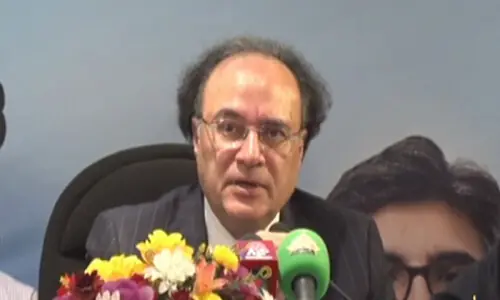
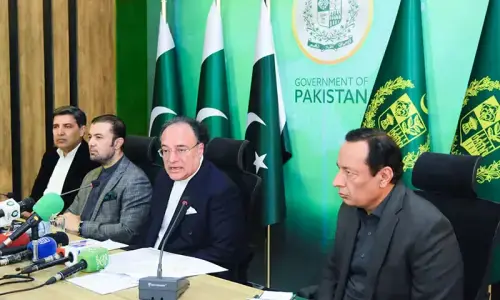
ISLAMABAD: As he linked funding allocations with outcomes, Finance Minister Muhammad Aurangzeb on Monday said the federal and provincial governments will have to move forward with consensus on the issue of the National Finance Commission (NFC) award.
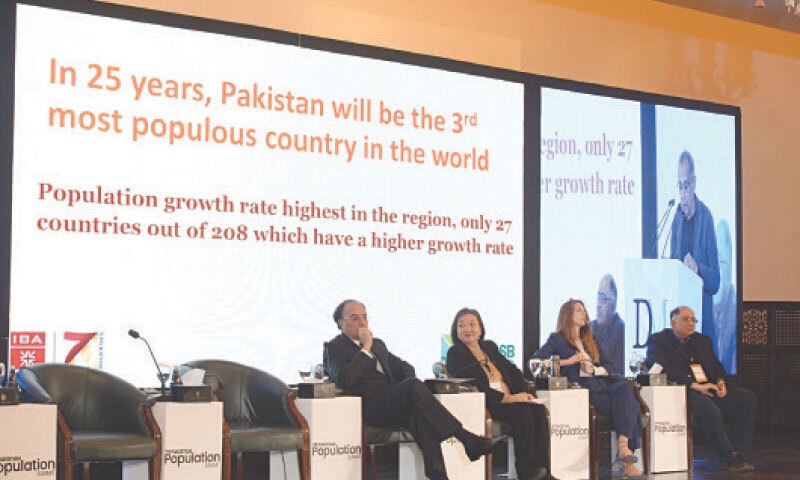
Speaking at the Pakistan Population Summit hosted by DawnMedia in the federal capital, the finance minister called for accountability of government projects, saying enough funding was available for initiatives having social impacts.
“It is not about tracking dollars spent, because we have enough dollars and billions of dollars are coming in. There is not much to show, therefore it has to be linked with outcomes,” the minister said. He went on to say that from the government perspective, “we need to be held accountable in terms of where this money is spent, and how [this] is being spent”. From that perspective, it is also in line with the social impact financing framework, he added.
The finance minister also said that the government would move forward on NFC with consensus. “It is about self-reliance and self-funding,” he remarked, adding he looked forward to “very constructive” discussions with chief ministers and provincial finance ministers. The federal and provincial governments would have to move forward with consensus, and the horizontal indices also included the population welfare issue, he added.
Despite billions in funds, nothing to show: Aurangzeb WB official says jobs without skills are a ‘liability’
Turning to the economy, he said the sustainable growth of GDP was affected by the 2025 floods, which was going to shave off roughly 0.5 per cent from the growth forecast. The minister said the government did not seek funding from international partners because the general consensus was that the government would finance the relief and rehabilitation itself.
“We cannot run to our multilateral partners and international donors for everything. It is not about the ego or dignity, it is about the resources we have and making sure that we repurpose these resources for what we really require in this country,” the finance minister said.
He called for the need to “recognise and negotiate” population growth and climate change. Speaking about Pakistan’s roadmap to a $3 trillion economy by 2047, Mr Aurangzeb stressed that it was “clear that these two existential issues have to be recognised and negotiated if we are to realise our full potential”. Continuing his address, the finance minister noted that “we have known the what and why for the longest time” behind population growth.
Mr Aurangzeb, who has repeatedly termed population growth as an “existential issue” for Pakistan, said, “There is no dearth of policy prescriptions. “Everything has to do now with the […] execution and the how part of it.”
British High Commissioner Jane Marriott stated that the UK has been a long-time partner of Pakistan on population, and “we stand with Pakistan to help achieve sustainable population growth to offer family planning choices for a fast-track equitable economy”. She said the UK has spent £11 million under three projects. These programmes helped avert over 5,000 pregnancy-related maternal deaths, she added. The high commissioner further said that the UK was also supporting a national family planning awareness campaign, which would dispel doubts about modern family planning methods and provide medically accurate advice.
World Bank Country Director Dr Bolormaa Amgaabazar observed that population growth was a “barrier to human and economic development”. Citing World Bank figures, she said a woman in Pakistan had 3.6 children on average, adding that it was higher than the rest of South Asia.
While noting that there was a difference in these statistics, with the bank’s being higher, Ms Amgaabazar asserted that they depicted the same thing - Pakistan’s fertility rate was much higher than its neighbours.
Dr Bolormaa Amgaabazar noted that 60pc of Pakistan’s population was under 30, adding that there was a “potential” for demographic dividend, but it would remain unrealised until people were provided jobs and skills. “Until then, it can turn into demographic liability,” she cautioned.
IBA Executive Director Dr Akbar Zaidi said the country’s economy is facing a “very, very sharp” decline. “It is irrefutable that Pakistan’s economy is not doing well, in relevant terms and in absolute terms, it is much worse than it has been over the last few years.” Dr Zaidi said that Pakistan was estimated to be the third most populous country in the world in 25 years.
Dr Zaidi further noted that unemployment had been growing in the last five to seven years. Citing economist Dr Hafeez Pasha’s data, he said the real wage of workers in Pakistan has seen a 20pc in just the last three years.
He also mentioned Pakistan’s declining ranking in the UN Human Development Index, terming the figures “extremely worrying trends”. Dr Zaidi said, “Today, we are half a century behind where South Korea is.”
Lahore University of Management Sciences (LUMS) Vice Chancellor Dr Ali Cheema underscored the importance of centring women in solutions aimed at population growth.
He further noted: “Don’t think about population as a separate service to be provided under the Public Sector Development Programme (PSDP), but [rather] we want to centre that (population) as part of growth, if you do not bring population down, you are not gonna get growth up.”-
Published in Dawn, December 2nd, 2025