NCSW strongly condemns Justice Najafi’s ‘misogynistic, irresponsible’ remarks on Noor Mukadam case
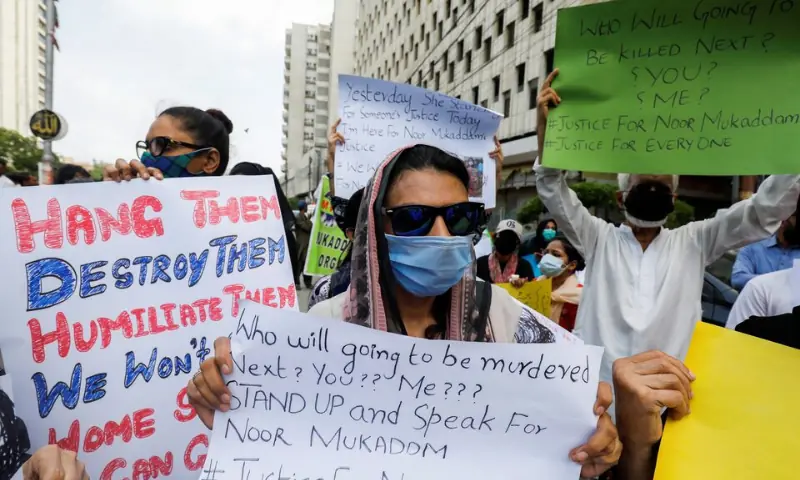


The National Commission on the Status of Women (NCSW), a statutory body working for women rights, on Friday condemned the “misogynistic and irresponsible remarks” made by Justice Ali Baqar Najafi on the Noor Mukadam case, saying that they reflected a “harmful mindset that shifts responsibility away from the perpetrators of violence and onto women themselves”.
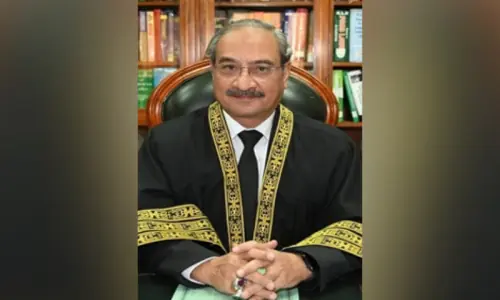
Justice Najafi — a member of the three-judge bench of the Supreme Court that had upheld the death penalty awarded to Noor’s murderer — attributed the ghastly 2021 murder to what he described as a vice prevalent in society.
In his additional note, which surfaced on Wednesday, Justice Najafi upheld the sentence handed to Zahir and observed that “the present case is a direct result of a vice spreading in the upper society which we know as ‘living relationship’ [sic]”. It appeared the judge was referring to a live-in relationship, where two unmarried individuals in a romantic relationship cohabitate.
The judge also observed that societal compulsions in such non-marital long-term relationships were ignored to defy not only the law of the land, but also personal law under Islamic Sharia which, he regretted, amounted to a direct revolt against Islam.
In a statement issued today, the NCSW said it “strongly condemns” the “misogynistic and irresponsible remarks” made by Justice Najafi.
“Such statements constitute clear victim-blaming and reflect a harmful mindset that shifts responsibility away from the perpetrators of violence and onto women themselves,” the commission said.
“No woman’s choices, real or perceived, can ever justify or explain brutality, murder or any form of gender-based violence,” it added.
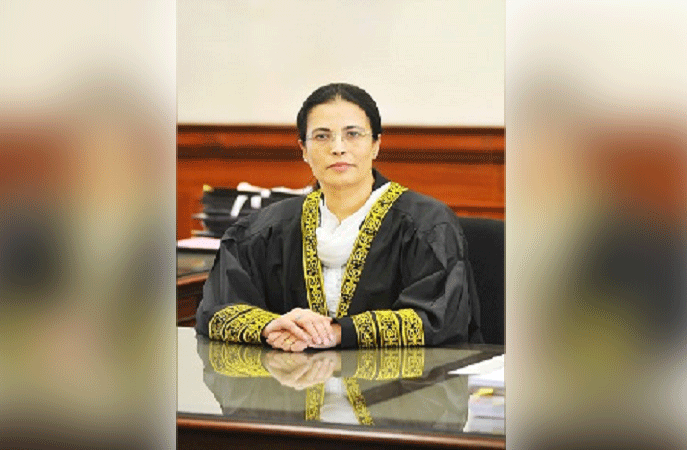
The commission further said that the remarks were also in contradiction of a previous judgment by Justice Ayesha Malik, where she emphasised that the language used for victims must be “sensitive, respectful and free from the personal biases of judges”.
According to NCSW, Justice Malik’s judgment clearly called on the judiciary to avoid moralising and stereotyping narratives that shame or blame women.
“The comments made in this case disregard that judicial responsibility and risk undermining public trust,” the statement stressed.
“The NCSW calls on all members of the judiciary to uphold constitutional values, maintain impartiality and ensure that courts remain spaces where survivors and victims are treated with dignity and respect,” the commission stated, adding that justice must be based on facts and law, “not personal judgment or bias”.
The NCSW was established by a presidential ordinance in July 2000 and is a statutory and autonomous body mandated to examine the policies and programmes for women development and gender equality. It also reviews laws, rules and regulations affecting the status and rights of women and suggests repeal, amendment or new legislation essential to promote the interests of women.
The judge’s observations, which surfaced just a day after the International Day for the Elimination of Violence Against Women, had triggered criticism from many on social media, including lawyers and journalists.
A day earlier, during a meeting of the Senate Functional Committee on Human Rights, Justice Najafi’s remarks were deemed “ridiculous”, with the committee questioning what would happen to the conviction rate in cases against women if a judge himself had made such remarks.