‘Tweaks bar FCC from hearing pleas against SC decrees’


 1
1

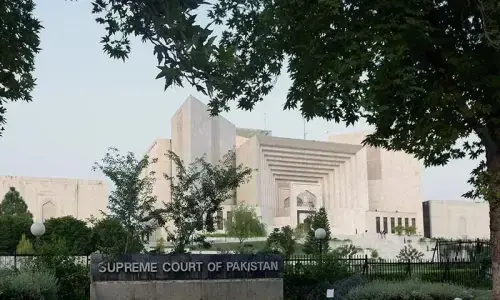
ISLAMABAD: The Federal Constitutional Court’s (FCC) jurisdiction to hear intra-court appeals (ICAs) came under question on Monday when a senior counsel objected to the court taking up appeals that had earlier been filed under the Supreme Court (Practice and Procedure) Act, 2023.
“If the FCC hears and decides ICAs that were moved against decisions of the Supreme Court, it will create the impression that the court is sitting as an appellate forum over Supreme Court judgements, whereas the 27th Constitutional Amendment contains no such provision,” argued senior counsel Ibad-ur-Rehman Lodhi.
Consequently, Chief Justice Aminuddin Khan, who was heading a six-member FCC bench, adjourned the proceedings to allow the counsel to file an appropriate petition on the matter. The counsel later told Dawn that he would file a miscellaneous application within the present ICA instead of submitting a separate petition.
The issue arose when the FCC bench, also comprising Justices Syed Hasan Azhar Rizvi, Ali Baqar Najafi, Muhammad Karim Khan Agha, Rozi Khan Barrech and Arshad Hussain Shah, took up a set of ICAs concerning the All Public Universities BPS Teachers Association (APUBTA), an organisation that had earlier highlighted vacant positions across public-sector universities, including vice-chancellors, presidents, vice presidents, registrars, faculty heads, department heads, controllers of examination, and directors of finance.
Question of jurisdiction surfaces when court takes up varsity teachers’ appeals
When the case was taken up, Advocate Lodhi representing one of the petitioners, vice chancellor Dr Akhtar Ali Kalhoro of the NFC Institute of Engineering, Multan, argued that the FCC could not hear the matter because the appeal had been filed under Section 5 of the SC (Practice and Procedure) Act, 2023.
He contended that the matter should instead be referred back to the SC, which had issued adverse remarks against the petitioner. However, the CJ reminded him that the SC could no longer hear petitions filed under Article 184(3), which relates to the enforcement of fundamental rights, now omitted under the 27th Constitutional Amendment. “Where is Article 184(3) in the Constitution as it stands today?” Justice K.K. Agha asked.
The counsel responded that at the time the appeal was filed before the SC, Article 184(3) was still in effect, even though Article 175(E) now vests original jurisdiction in the FCC to hear such matters. He noted that no appeal or petition under Article 175(E) was pending before the SC that would require transferring cases to the FCC; rather, the appeals had been filed under Article 185 of the Constitution. Justice Najafi observed that the amendment had broadened the scope and concept of the Article, bringing such matters within the FCC’s domain.
“Confusion inevitably arises when matters are left to assumption,” the counsel argued, adding that lawmakers did not address this anomaly. He reiterated that the SC was not seized of any petition under Article 175(E) that would warrant transferring cases to the FCC after its creation.
“Why don’t you file a separate petition on this point?” Justice Najafi suggested.
The counsel replied that if the FCC proceeded with the appeal, it would give the impression that the court was acting as an appellate body over SC decisions. He added that Article 175(F) of the 27th Amendment clearly states that the FCC may hear and determine appeals arising from judgements of a high court made under Article 199 — and not those of the SC.
During the hearing, the FCC also appeared constrained by the lack of readily available copies of the Pakistan Legal Decisions or the Supreme Court Monthly Review for quick reference to prior decisions. The bench had to rely on books provided by the counsel, with two judges sharing a single copy at a time.
Published in Dawn, November 25th, 2025