Centre committed not to ask for further 'sacrifices' after freeze on provinces' development funds: Bilawal


 0
0
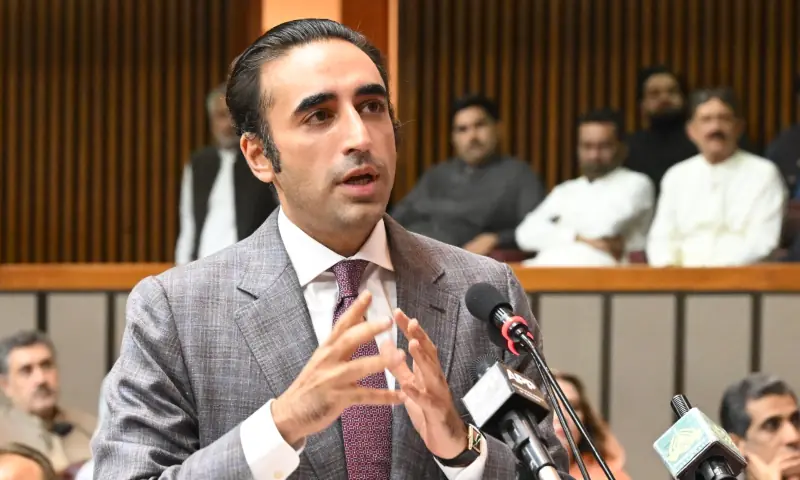

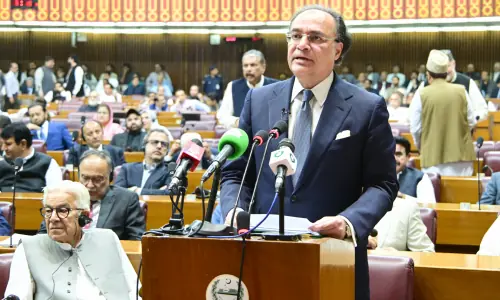
PPP Chairperson Bilawal Bhutto-Zardari said on Thursday that the federal government had promised that allocations for provinces under the 7th National Finance Commission (NFC) award would be “protected”, and that the Centre would not request any further “help or sacrifice” following the recent decision to freeze development allocations for the provinces.
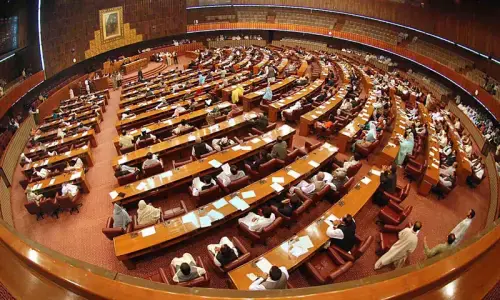
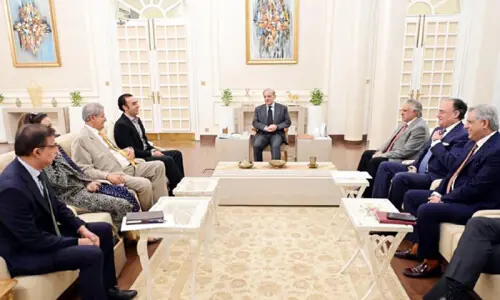
Bilawal joined the budget debate a day after he held a meeting with Prime Minister Shehbaz Sharif, who is reported to have convinced the head of his coalition partner PPP to attend the budget session in the NA.
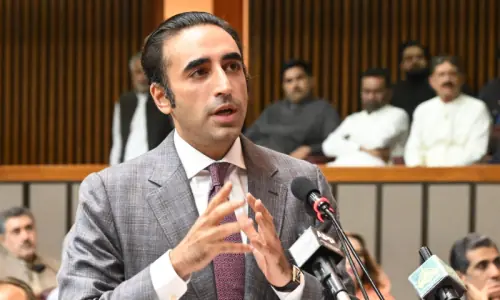
“The provinces’ NFC award and financial resources have been kept protected; no damage will be caused to them,” Bilawal declared while addressing the NA, which was debating the proposed federal budget for the next fiscal year (FY27).
“Besides this decision, the provincial governments will not be required to make any sacrifices,” he added.
The government has decided to freeze development allocations for the provinces for three years to generate more than Rs900 billion in additional resources for the Centre’s strategic needs.
Referring to this decision, Bilawal said that the Centre and provinces had decided to jointly bear the burden of “extraordinary needs pertaining to defence and national security”.
He affirmed that “we came up with such a constitutional and democratic solution which meets the national security needs and also minimises complaints from the provinces”.
The PPP chairman emphasised that the decision was not taken unconstitutionally but rather under Article 164 of the Constitution.
“The Constitution enables that if the provinces and the federal government have to spend on a subject which does not fall under their domain, under the article, provinces can give grants to the Centre or the Centre can give grants to the provinces,” he explained.
He thanked Prime Minister Shehbaz Sharif, Deputy PM Ishaq Dar and Finance Minister Muhammad Aurangzeb for remaining engaged with PPP representatives and finding a constitutional and democratic solution.
“This is not just a financial or administrative [success], but the success of Pakistan’s politics. It is proof that when national interest is at stake, then democratic institutions, political parties, and all parts of the federation can make decisions together,” Bilawal said.
He underscored the significance of the consensus reached on the development allocations at a time when “the India-Israel nexus wants to harm Pakistan in every way, [such as] terrorism and our issues with Afghanistan”.
Bilawal also welcomed the opposition PTI for “keeping aside its politics”, noting that the decision was made not just by the parties in the ruling coalition but also by the PTI-ruled Khyber Pakhtunkhwa.
“If PTI and our opposition allies adopted similar politics, where there could be political differences […] but we work together like this in national interest, then there is no issue that we cannot face,” he remarked.
However, during his speech, Bilawal termed such temporary moves as “non-sustainable solutions”.
He called for the federal and provincial governments to chart out a long-term, sustainable plan and introduce “growth-oriented economic policies”.
On Tuesday, the PPP chief warned of the NA session’s boycott if their demands remained unmet. A source said Bilawal appeared upset with the budget, stating that it was different from the document shared with the PPP.
During Wednesday’s meeting at the PM House, the premier agreed to address all the PPP concerns regarding the federal budget.
The PPP chairperson was also initially reluctant to join the NA session where the FY27 budget was presented. It had taken Deputy PM Dar and Interior Minister Mohsin Naqvi to convince him to come to the house so that the budget could be tabled.
‘No province given its due share’
The PPP chairman also took note of “strange rumours” circulating before the budget was debated in the parliament, including the abolishment of the 18th Amendment and changes in the NFC award.
He further noted that there had been an impression that “the provinces have fiscal space after the 18th Amendment and the NFC and that the federal government does not”. He stressed that although the Centre may have economic challenges, so do all the provinces.
“While it is true that the NFC and 18th Amendment were historic and constitutional achievements, it is also true that despite these, no province has been given its due share,” the Bhutto scion asserted.
Bilawal recalled that the petroleum development levy (PDL) had been temporarily introduced to help the country deal with the floods during the previous PPP government. Noting that it was still being collected, he contended that it was in violation of the NFC award and the 18th Amendment.
“Instead of distributing the petroleum levy among the Centre and the provinces under the NFC formula, the Centre retains 100 per cent of it,” he said.
“That petroleum levy is being collected till today, and provinces are not getting their due share from petrol and gas levies. They are being deprived of their resources and their rights,” the PPP chairperson asserted.
Bilawal went on to decry that provinces also “gave another sacrifice” to prevent the country from economic default.
“Every provincial government is asked to show their surplus in their provincial budget, and that surplus means that we cannot spend that money on our people,” he said, highlighting that Punjab made the “biggest sacrifice” in this.
“In the national economic interest and so we can complete the IMF programme and save the country’s economy, provincial governments and those residing in the provinces are making this sacrifice and giving funds to the Centre,” he said.
The PPP chairman remarked that the Sindh government’s Rs400 billion surplus this year could have been utilised for Karachi’s Lyari and Korangi areas or Larkana or Nawabshah if it did not have to be shown as surplus.
Bilawal went on to observe that KP had its own challenges, noting that despite the merger of the tribal districts, they were not accounted for in the NFC allocations. He asserted that both the provincial and federal governments had “failed in fulfilling their promises” of development in the tribal areas.
He termed it unfortunate that the tax exemption for tribal areas, which is set to expire this year, could not be extended in the proposed budget.
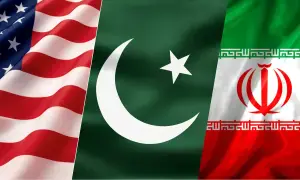
Bilawal began his speech by praising the efforts of Pakistan’s leadership, particularly the prime minister and the army chief, in the peace agreement between the United States and Iran.
“We have experienced the economic impact of uncertain situations. This is why Pakistan always promotes peace,” he said, terming peace “not just a moral necessity but also economic”.
“When there is stability in the region, investment increases. When there is peace, the youth get employment, and the country progresses,” he said.
“Today, when the world is inching towards peace, Pakistan will have to take a step towards development,” the PPP chairman stressed, adding that he would present his budget speech with the same “spirit”.
“The truth is that peace has not been restored completely in the region,” the former foreign minister said, before noting security challenges on the border with Afghanistan, the “threats of Operation Sindoor 2.0” from India and New Delhi’s unilateral contestation of the Indus Waters Treaty (IWT).
“I can say with pride that Pakistan has responded to the challenge with political unity and democratic tradition,” he added, referring to the freeze on provincial uplift funds.
‘BISP also a national security programme’
Speaking on the floor of the NA, Bilawal said the Benazir Income and Support Programme (BISP) had been “targeted in an unfortunate and shameful manner”.
The PPP head thanked the government, especially PM Shehbaz, for deciding to expand BISP in the FY27 budget “despite the remarks made against it”.
Presenting four arguments in support of the PPP-launched programme, Bilawal highlighted that its success in supporting the lower-income groups had been acknowledged by international bodies such as the World Bank.
He said that global platforms instead recommended expanding the programme to tackle poverty.
“The second argument is that it is both humanity and Islam,” Bilawal said in defence of the BISP, adding that religious teachings advocate taking care of those in need.
The third point he made was that BISP was a “good economy”, asserting that development takes place from the lower slabs to the upper instead of trickling down from the affluent to the masses.
“When one poor household gets BISP funds, […], they buy flour, medicine, books for the kids,” he said, highlighting that it creates more income opportunities.
Lastly, Bilawal argued that BISP was also a “national security programme” as insurgencies of any kind, even foreign-backed, “cannot be fought with weapons alone”.
“If you have to fight insurgency, militancy, extremism and terrorism, you have to win hearts and minds,” he emphasised, saying the assistance in the form of BISP wins people’s hearts.
“Most importantly, this is a programme of a stronger relation between Pakistan and its people,” the Bhutto scion declared.
He called on the government and those making economic decisions to adopt the mindset that the country’s economy will not progress until the downtrodden factions of society do so.
“Our policies should be such that we focus on growth and progress in underdeveloped areas,” he said, advocating for a growth-oriented approach so that Pakistan has to rely less on loans.
More to follow