I have written in these pages before about my forays into learning Urdu. Now I think through the need for mentors in adult language acquisition.
Learning a language later in life is challenging. In middle age, my memory is less elastic, and my thought processes more deeply inscribed than when I was in my teens and twenties. Yet models exist of people who have given themselves to a new language with Sufistic surrender. One such figure is the late Ralph Russell. Although he began earlier than I did, he remains an inspiring example of how adult learners can pleasurably drown the ego and the mother tongue in a new language.
Russell was born in East London in 1918 but, like me, he spent his formative years in Yorkshire. His home was in the then East Ridings (mostly Holme-on-Spalding-Moor) rather than my own West Yorkshire (Leeds).
I can’t help but notice the pattern of initials either. Like the distinguished Urdu scholar Carlo Coppola, my co-translator Aqeel Ahmad, and me, Russell’s name carries doubled initials, “RR.” Such coincidences are insignificant, but for someone immersed in language learning, faint linguistic echoes resound with hope.
After his Yorkshire infancy, Russell moved back to London, where he was sent to public school. He is careful in his first autobiography, Findings, Keepings, to stress the “minor” status of that institution and his own lowly scholarship boy standing. This hedging was due to his left-wing politics, which I’ll discuss shortly.
In school, and at Cambridge soon after, he specialised in Classics. Russell’s love for the ancient world stayed with him for life. In his writing, he drew a direct line from that early grounding in Latin and Greek to his later passion for Urdu literature.
Folklore, stories, slogans, jokes and poems all delighted him. He often recalled lines from songs and seems to have relished parody, rewriting lyrics to familiar tunes and singing them in comic fashion. These moments of levity pepper his prose, suggesting that, for Russell, language was always about play as well as scholarship. In terms of the lessons he transmits to a contemporary student like me, having fun while working is an effective technique. This is demonstrated by the gamification of language learning by apps such as Duolingo.
In both autobiographies, Findings, Keepings and Losses, Gains, Russell pledges to be honest about his life, sometimes proving disarmingly so. He offers more detail than many readers might expect from a scholar sharing personal experiences.
These include reflections on his inept or even predatory sexual behaviour as a young man. Russell’s determination to record his life without self-censorship is part of his philosophy about the art of life writing. “My belief,” says he, “is that there ought to be no subject whatever which mature adults should not be able to talk about to each other.” He wanted not only to relay his story but to tell it truthfully, however uncomfortably that honesty might land. Even so, the anecdotes have not aged well in the era of MeToo.
As a teenager, Russell became a communist, an ideological allegiance that moulded the rest of his life. His memoirs disclose, sometimes unwittingly, the intellectual contortions required to reconcile this commitment with his experiences. Such experiences include his service as a soldier in the British Army during the Second World War. He was posted to India for three years after deciding that fighting an imperialist war was preferable to a fascist victory.
Similarly, he had to weigh up his lifelong support for the Soviet Union against Joseph Stalin’s bloodthirsty despotism. Toeing the party line at the time, he later admitted that he had been “blind to the horrors” of communist Russia.
More positively, communism gave him a strident belief in social and economic equality. It also sparked the young Russell’s study of Urdu. Unlike most Britons of his generation, he resolved to speak to, and build relationships with, ordinary Indians. Despite some political missteps, it is admirable how determined he was to keep faithful to an ideal, even while wrestling with its contradictions. He declares “communis[m], the study of Urdu, and an awareness of love” to be “the three main strands of my life.”
Russell was, at first, open-minded and then became knowledgeable about South Asian customs and religions, while holding on to his atheism. Given this worldview, it is unsurprising to find that he formed strong links with several members of the Progressive Writers Association, being close friends with Krishan Chander in particular.
Later, again like me, Russell became a university academic, teaching Urdu for roughly 30 years at the School of Oriental and African Studies in London. His scholarly contributions were immense. Through translations, teaching, and his enthusiasm for Urdu literature both in university and community settings, he shaped generations of students and helped to bring the richness of that tradition into English.
The British academic’s legacy is rightly associated with ghazal poetry. He admits he didn’t understand the form at first, writing in The Pursuit of Urdu Literature that he saw such verse as “a string on which are threaded, in apparently haphazard order, pearls, rubies, pretty pebbles, and cheap beads.” But over time, he became the genre’s devotee and ultimately did more to make Mirza Ghalib’s ghazals famous in the West than almost anyone else.
Russell is full of good advice I keep coming back to, for example cautioning against “letting [one’s] Urdu rust” through lack of use. I’ve begun to view this as daily exercise for the mind, doing my reps to see incremental progress, just as I would in the gym.
He discusses how he fought against getting too comfortable with “saaf tor par” [correct or bookish] Urdu. Instead, he recommends speaking to people with a range of voices, accents and dialects. This is salient because orality differs from books and can easily wrongfoot the inexperienced student. The idea also carries across to the written word, as it is important for novices to get used to various fonts and to read a wealth of texts, from newspapers and public notices to social media posts and old handwritten manuscripts.
Russell died in 2008 after a life that, while full enough on its own, was “immeasurably enriched” by Urdu. I don’t want to be like him — which would anyway be impossible. Nonetheless, I aspire to the single-minded focus with which he pursued the beauty and complexity of Urdu literature.
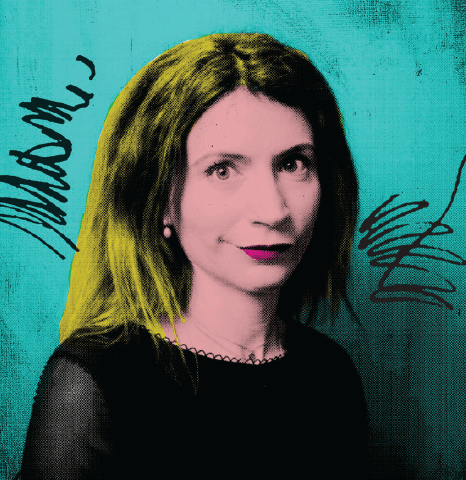
The columnist is Professor of Global Literature at the University of York in the UK, and author of five books. Bluesky: @clarachambara
Published in Dawn, Books & Authors, November 23rd, 2025