KARACHI: Sindh Chief Minister Murad Ali Shah on Friday called upon private organisations and individuals to join hands with the government in promoting education, announcing that if any private entity or individual adopts a school under the Accelerated Digital Learning Programme (ADLP), the government would match their contribution by establishing another school bearing their name.
Addressing the Sindh Education Foundation (SEF) programme of the Phase-II of the ADLP, he said that the initiative was aimed at underserved and out-of-school children across the province.
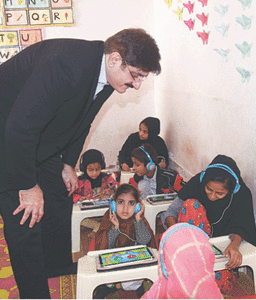
The ADLP, launched in Aug 2023, utilises digital technology to extend quality education to out-of-school children, especially in remote and underserved communities, using modern digital tools through “Micro Schools” for out-of-school kids and digital classrooms for students with flexible learning access.
In Phase-II of the ADLP, as many as 200 new “Micro Schools” will be established over the upcoming two fiscal years, facilitating access to digital learning for approximately 30,000 out-of-school children.
CM Murad invites private entities to adopt educational institutions under Sindh’s digital learning programme
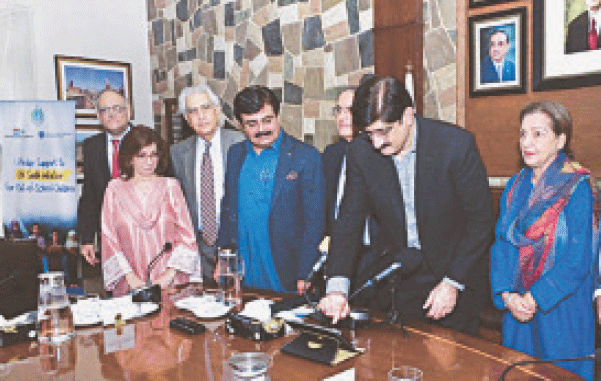
The launching ceremony, held at the CM House, was attended among others by Education Minister Syed Sardar Shah, Education Secretary Zahid Abbasi, SEF Managing Director Ganhwar Leghari, Shafiq Khan and Arshad Anis of Teach the World, Shahnaz Wazir Ali, Haji Nazim, Stephen Lyon, Imam Jahangir, Dr Kalbe Abbas, Javed Jabbar, Sultana Siddiqui and Zubair Chhaya.
The chief minister said that approximately 22.6 million children are out of school nationwide, with seven million in Sindh alone. The number of out-of-school children in the country surpasses the total populations of many countries globally.
“This is why the Sindh government, in collaboration with the Sindh Education Foundation (SEF), has decided to launch phase II of the Accelerated Digital Learning Programme,” he added.
Speaking on the occasion, Education Minister Sardar Shah said that building upon the success of the pilot project, the Sindh government, through SEF, had approved the launch of ADLP Phase II, which would establish 200 new Micro Schools over the upcoming two fiscal years. “One hundred new centres have been made operational, which the chief minister inaugurated today, and a further 100 in 2026–27 will be launched next year,” he added.
The education minister said that the new centres would operate alongside the current 100 Micro Schools from Phase I, as they completed their full implementation cycle. “The expansion aims to facilitate access to digital learning for approximately 30,000 out-of-school children, greatly expanding the programme’s reach,” he added.
CEO and founder of Teach the World Foundation Shafiq Khan said, “At Teach the World, we believe that our single greatest issue is the vast number of children who are out of school. We are singularly focused on solving that problem.”
He added that their solution tackles both the shortage of teachers with a game-based curriculum delivered on tablets and the deficit of schools through their Micro School model, which could be established in weeks at very low cost. With the support of the Sindh government, they managed to launch 125 digital schools in under 18 months.
At the end, the chief minister inaugurated 100 schools by clicking a button on a laptop.
100 ‘Micro Schools’
According to the midterm evaluation by an independent firm, the ADLP pilot programme has demonstrated significant progress. A total of 100 Micro-Schools and 25 In-School digital classrooms have been established, enrolling more than 11,000 children across both models.
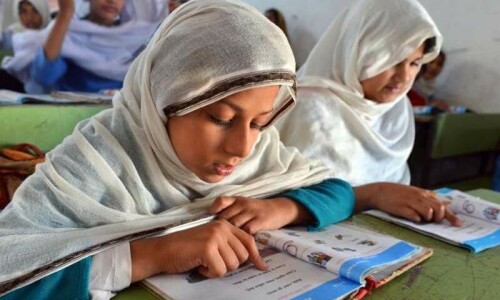
Micro-Schools, set up as single-room community learning centres, operate in four daily shifts, each offering a two-hour, self-paced, tablet-based digital learning cycle. These centres are strategically located in low-income urban and peri-urban settlements with high concentrations of out-of-school children.
The evaluation reports notable improvements in foundational learning among Micro-School participants who have completed at least nine months in the programme. Girls have outperformed boys, reflecting a positive gender-equity impact.
Published in Dawn, November 22nd, 2025