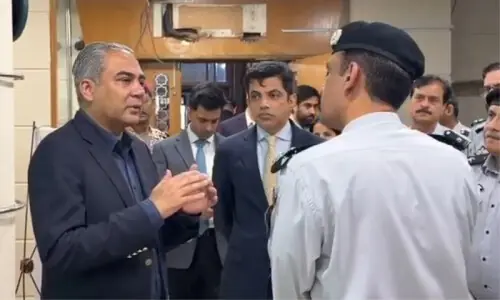
KARACHI: Sindh Chief Minister Syed Murad Ali Shah on Monday expressed concerns regarding the 46 per cent dropout rate among students who complete their primary education due to the lack of middle schools in the area and directed the school education department to introduce afternoon shifts for middle school classes at primary schools, aiming to address this problem.
At a meeting held at the CM House, Mr Shah was briefed by Education Minister Syed Sardar Shah that there are 16.89 million children aged five to 16 enrolled in the province, which includes 5.20m in public schools and 4.01m in private schools.
Additionally, schools under the Sindh Education Foundation (SEF) have 93,000 students, non-formal education serves 5.66m children, and madressah have 1.03m students.
During the discussion, the CM pointed out two major challenges facing the school education department, enrolling 7.8m out-of-school children and reducing the dropout rate, which currently stands at 46pc.
He emphasised that these two challenges could only be addressed by strengthening both formal and non-formal education streams in terms of access, quality and governance.
To a question, the CM was informed that there were 36,300 primary schools and 4,600 post-primary/middle schools. The significant gap between the number of primary and post-primary schools contributes to the dropout rate.
Shah directed the education department to initiate post-primary schools during the second shift/afternoon shift in primary schools, with plans to upgrade them to the middle school level.
He emphasised that private schools are significant stakeholders, catering to 40pc of enrolment, and therefore must be properly regulated, monitored, and evaluated.
Visits two schools
The CM also paid a surprise visit to two schools operated by different NGOs in the underprivileged localities of Korangi, in collaboration with the SEF.
He first visited the Green Crescent Trust (GCT) School in Bilal Colony, toured the classrooms and engaged with the students, reviewing academic activities and the daily attendance register.
Mr Shah learned that the SEF offers regular financial assistance to partner schools based on student enrolment. The SEF currently funds Rs1,300 per student per month for its affiliated schools run by NGOs.
The chief minister instructed the education minister to conduct regular inspections of SEF-affiliated schools in the city, emphasising that the government’s efforts should yield positive results.
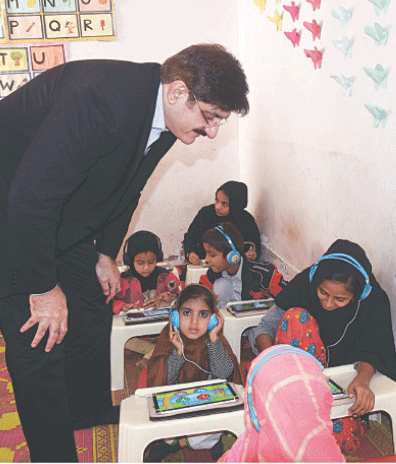
Later, the chief minister visited the Digital Micro School in Awami Colony, which also operated in partnership with the SEF.
During his visit, he learned that tablet computers are being used to educate 100 students at the school, all of whom come from underprivileged backgrounds and had not previously attended school.
He reviewed how students were using the tablet computers for regular classroom education, focussing on English and Mathematics through an engaging learning system.
He stated that he initiated this surprise visit to assess the effectiveness of using tablet computers in an underserved area, adding that this technology could be extended to other schools if it proves beneficial for student learning.
Published in Dawn, January 21st, 2025