Early in November, selected artworks from the recent Arjumand Painting Award were on show at Islamabad’s Gallery 6. The exhibition featured not just the winning paintings and merit prize awardees, but over 50 of the short-listed artworks as well.
The standard for this year’s awards was incredibly high, with a variety of styles and methods on show, from Mughal-inspired miniatures to mind-bending surrealist works, tongue-in-cheek works worthy of the Dadaists, stunning realism and almost everything in between.
This year, judgement was tied between three artists for the first prize. So, what was it about these three works that was so compelling? What made them stand out in a sea of excellence?
All the winning pieces — while being wildly different — share a common thread in that they’re not just different from each other, but are really quite a break from what has become somewhat of a calling card for Pakistani artists: incredibly skilled and clean execution, often with a sense of harking back to the miniaturists, even if it’s just stylistically or the use of flat perspective.
A showcase of works from the Arjumand Painting Award demonstrated the variety found in Pakistan’s current artistic landscape
In contrast, in the winners of this award, we see unfinished edges, tightly controlled fractals and technique that defies the ordinary but, above all, an almost hypnotic and emotional resonance that keeps you coming back for more.
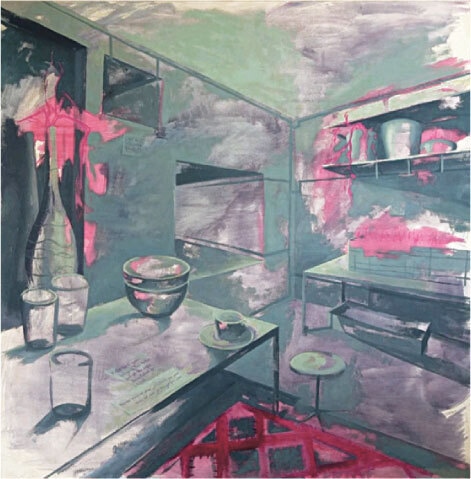
Aafia Ali Shah captures something disturbing and mesmerising in her work The Waiting Room. A jarring but simple palette of grey, blues and pinks immediately takes us out of any thoughts of realism and the longer we stay with the image, the more questions we start asking. Are we in a hospital? The colours seem to remind us of that — but then why is there a teacup and where do those vents go? But hang on, that’s not a vent, it’s in the middle of the wall — and what’s that written on the wall?
The viewer is immediately taken on a journey and, all the while, we’re slightly puzzled and uncomfortable. But why? And then it dawns on you: the rough edges, the unfinished lines, the half-imagined vases, those cryptic messages. All of this is an illusion, a hastily applied distraction to keep you from seeing that the real waiting room is what lies beneath.
Miza Zeeshan Hussain’s Tangle and Bloom is best appreciated up close and personal. You will be hypnotised by the blooming fractal sky that looms heavy over a bloody mountain range and a field of flowers — or is that stains of pomegranate on a tablecloth? However you like to interpret it, the image captures stillness and movement in a way that is mesmerising, with the fractal nature tricking our eyes — as soon as we look away, the colours on the canvas are moving in our peripheral vision, keeping us coming back again and again to look closer.
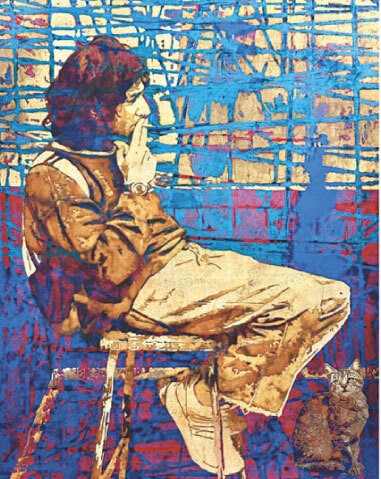
Mastery of technique takes on a new generation as Swarim Abid Hasan’s work in metal oxidation continues a legacy started by his father, the artist Abid Hasan. The incredible depth and detail achieved through oxidation of metals is a mix of science and art, with Hasan showing his exacting mastery over the unusual technique through the detail and depth of colour. This is not something easily achieved, as it requires precision, perfect timing and a deep understanding of the mediums in use.
More than this though, the emotional resonance of the work highlights a kind of generational disassociation, a moment of disconnection in an environment that is chaotic and unnatural. The audience feels a kindred spirit with the cat that looks up wonderingly at the central figure and seems to ask: “When will you wake up?”
Selected works from the Arjumand Painting Award 2025 were on display at Gallery 6 in Islamabad from November 1-4, 2025
The writer is an Australian based in Pakistan. She is an avid enthusiast of contemporary Pakistani art and culture
Published in Dawn, EOS, November 23rd, 2025