Textile exports drift lower for third month

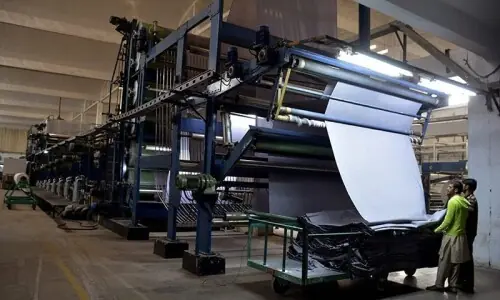
ISLAMABAD: Amid growing concerns over the country’s export performance, Pakistan’s textile and clothing sector recorded a 0.67 per cent decline in October, which was the third straight month of negative growth, signalling persistent challenges in one of the country’s key industries.
The October decline extends a trend of volatility in the textile and clothing industry, which had seen a sharp rebound of over 30pc in July. The stark contrast highlights unstable global demand and ongoing domestic challenges that continue to weigh on the sector’s performance.
Official data released by the Pakistan Bureau of Statistics (PBS) on Tuesday showed that textile and clothing exports fell to $1.616bn from $1.625 billion in October 2024.
This sustained downturn signals persistent challenges facing the country’s largest export-earning industry. In September, textile and clothing exports declined by 1.99pc and 7.34pc year-on-year in August.
The PBS data showed exports of ready-made garments rose 5.11pc in value and 3.64pc in quantity during 4MFY26, while knitwear rose 8.23pc in value and 16.50pc in quantity. Bedwear was up 6.94pc in value and 7.16pc in quantity.
Towel exports dipped 0.29pc in value and 1.39pc in quantity in 4MFY26, whereas cotton cloth went down 12.75pc in value and contracted 8.87pc in quantity, respectively.
The decline in value-added textile exports sends a troubling signal to policymakers. Industry stakeholders have long warned that the high cost of doing business, especially when compared to regional competitors, is eroding Pakistan’s export competitiveness in these crucial segments.
Yarn exports rose 7.74pc in 4MFY26. The exports of made-up articles, excluding towels, increased by 4.17pc, and tents, canvas and tarpaulin went up by 32.34pc. Export of raw cotton doubled in 4MFY26.
Meanwhile, the import of synthetic fibre increased 37.15pc, and the arrival of synthetic and artificial silk yarn rose by 14.79pc in 4MFY26. However, other textile items’ import increased by 29.21pc the period under review.
The import of raw cotton declined 20.09pc and second-hand clothes grew 12.35pc and textile machinery also recorded a growth of 50.23pc during 4MFY26.
The country’s overall exports declined by 4.05pc to $10.45bn in 4MFY26, from $10.88bn in the same period last year.
Oil imports
Pakistan’s oil import bill grew 0.58pc in 4MFY26, reaching $5.15bn from $5.12bn in the same period last year. This suggests an uptick in demand, particularly for petroleum products and petroleum crude. Data showed a 10.47pc increase in the value of petroleum products, driven by a 21.41pc rise in quantity, suggesting a shift in the types of oil products being imported.
Crude oil imports increased 13.52pc, with a 23.55pc rise in quantity, indicating that local refineries are processing more crude oil. On the other hand, imports of liquefied natural gas (LNG) and liquefied petroleum gas (LPG) fell by 29.18pc and 0.86pc, respectively.
Machinery imports
The machinery imports grew 21.54pc to $3.54bn in 4MFY26 from $2.91bn last year. The power generating machinery arrival surged by 25.18pc, followed by office machinery 52.51pc, construction machinery 110.75pc and agriculture machinery 23.54pc. However, electrical machinery and apparatus declined 4.42pc.
The imports of the telecommunication group surged by 42.48pc year-on-year, mainly due to a 53.18pc increase in mobile handset arrivals during 4MFY26.
Published in Dawn, November 19th, 2025