Current account deficit surges by 255pc to $733m in July-Oct


 3
3

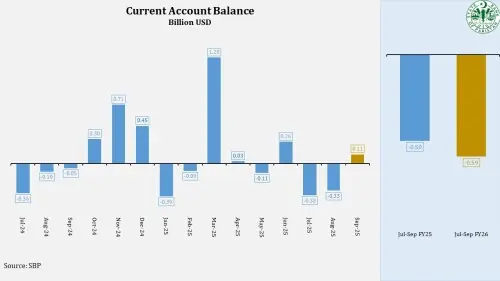
KARACHI: Pakistan’s current account deficit (CAD) widened by over 255 per cent year-on-year during the first four months of FY26, primarily driven by rising imports and falling exports.
The latest data issued by the State Bank on Monday showed that the country posted a CAD of $733 million in July-October compared with $206m in the same period last year. Another vital change was that October posted a $112m deficit, compared with a $83m surplus in September.
The pressure on the current account is directly related to higher imports, while the exports remained stagnant during the current fiscal year. Under pressure from the International Monetary Fund, the government had relaxed import curbs.
The government is under severe criticism for failing to boost economic growth over the last three years, and financial circles believe it was a deliberate attempt to cut GDP growth to keep the current account under control. The government achieved a surplus of $1.9bn in FY25, but economic growth remained at 2.6pc, which was later revised to 3pc.
Rising imports and falling exports contributed to poor performance
Experts have been advising the government to ease import restrictions to boost economic growth, as the country has an import-led growth model.
The data shows that imports of goods and services during the first four months of the current fiscal year rose to $24.919bn, up from $22.647bn in the same period last year. However, the export did not show any significant change as the total stood at $13.664bn during July-October compared to $13.041bn in the same period of FY25.
The trade deficit during the 4 months of the current fiscal year was $11.255bn compared to $9.606bn in the same period of FY25.
Despite the higher current account deficit, other external account indicators are supportive of the government. Remittances in October totalled $3.4bn, up from $3.2bn in the preceding month. Overall remittances, compared to last year, increased during the 4 months, which was against policymakers’ expectations. The government expects to receive $40bn remittances in FY26.
At the same time, the expected inflow of $1.2bn from the IMF under the EFF and RSF programmes, and support from the United States for investment, have changed sentiment towards Pakistan. Some analysts believe remittances will rise as a result of the defence pact with Saudi Arabia.
“The current account deficit is the key to the stability of the external account of the country and a basic need for higher foreign exchange reserves that stabilises the exchange rate,” said an analyst. He said that if the current account deficit persists in the first half of the fiscal FY26, it would be damaging to both the economy and the country.
Published in Dawn, November 18th, 2025