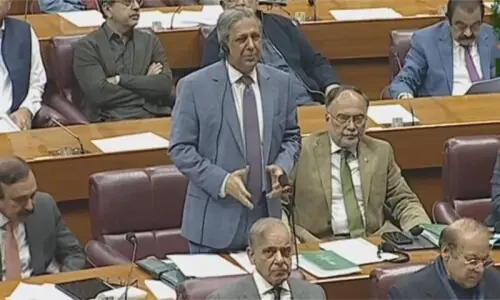
THE 27th amendment is testing the very boundaries of parliamentary authority — perhaps even crossing them. It is no doubt parliament’s right to amend the Constitution. But this authority is not absolute. The apex court has previously held that if an amendment strikes at the basic structure of the Constitution, the judiciary not only has the right but also a duty to intervene.
The bill, passed by the National Assembly yesterday but due to return to the Senate for debate on proposed adjustments, seeks to create a new federal constitutional court to handle constitutional issues, while also altering the Supreme Court’s composition and powers. If passed in its current form, it would remove functions of the chief justice and transfer much of the top court’s constitutional jurisdiction to the FCC. In effect, the apex court, the ultimate interpreter of the Constitution, will be rendered toothless.
This is not an abstract concern. Justices Mansoor Ali Shah and Athar Minallah of the Supreme Court have written letters warning that the amendment weakens judicial independence and the coherence of our legal system. They are joined by retired judges and senior advocates who have appealed to CJP Yahya Afridi to convene a full court meeting before the passage of the amendment.
The judiciary is a pillar of the constitutional order tasked with interpreting the law, not making it. But when the very existence of the Supreme Court, as defined by the Constitution, is in question, judges will hardly ignore the implications. As Justice Shah observed “the independence of the judiciary is not a privilege of judges; it is the people’s protection against arbitrary power”. That principle must not be diluted under the guise of reform.
The government has framed the proposal in keeping with ‘international best practices’ and says it aims to strengthen the federation. If that is the intention, transparency should not be feared. The amendment needs open debate, not just in parliament but also within the judiciary. Discussions by the full court, or even a larger forum, is the correct way forward, as the proposed change is too radical to be left to individual interpretations or executive assurances.
Both the government and judiciary must refrain from turning this crisis into political theatre. What lies ahead has repercussions beyond a single office-holder or institution. It is a test of our democratic maturity. The creation of an entirely new apex court, without consensus or clear constitutional necessity, risks fracturing an already fragile institutional balance.
In Pakistan, political and institutional confrontations are an unfortunate norm, which often escalates into crises that strain our democratic framework. Yet moments like the 27th amendment debate demand a different approach: both the executive and the judiciary must show maturity, prioritise transparency and encourage inclusive discussions.
Published in Dawn, November 13th, 2025