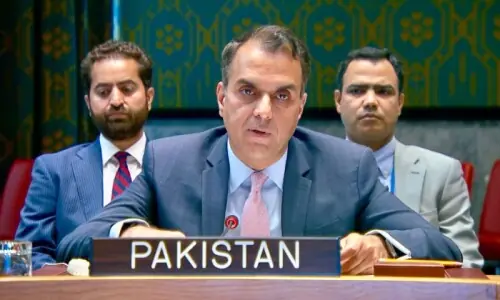
CONSIDERING the state’s strong belief in the involvement of Afghanistan-based terrorists in the Islamabad and Wana attacks, the question of arms and military gear left in Afghanistan by foreign forces — and now in the hands of violent actors — requires closer scrutiny. The issue was raised recently by Pakistan’s permanent representative to the UN in a Security Council debate. As the diplomat pointed out, weapons confiscated at the Pak-Afghan border are traced to arms stockpiles left behind by foreign forces. These illicit arms, he added, are being used by “non-state armed groups, terrorist networks, and criminal gangs”, while calling for global action to stop the weapons ending up in the hands of groups like the banned TTP and BLA. As the Biden administration was keen to get out of Afghanistan, weapons worth billions of dollars were left behind. While some of the gear was rendered inoperable, significant equipment has either been ‘lost’ or sold on the black market. Reported buyers include the TTP and ETIM. Afghanistan has been a dumping ground for weapons since the time of the Afghan jihad. From the period of that engagement till the end of the American occupation in 2021, the US, the Arab states and this country, had been directing arms towards Afghanistan at different periods for different recipients.
From Pakistan’s point of view, the cache of American arms and equipment left behind has been nothing short of disastrous. It was particularly irresponsible for the US to leave behind such deadly gear. Retrieving it may be next to impossible. However, the Afghan Taliban have a responsibility to prevent this equipment from being used by anti-Pakistan militants. This brings us back to the crux of the problem: the Taliban’s denialism regarding the presence of terrorist groups on their soil, and their lack of interest in controlling these elements. If the Taliban refuse to rein in these malign actors, and if the wave of terrorism currently affecting Pakistan does not abate, chances of Pak-Afghan peace will be reduced significantly. Prime Minister Shehbaz Sharif has reiterated that Pakistan wants a “peaceful neighbourhood”. But this peace will remain elusive if one state refuses to control cross-border terrorism impacting its neighbour, and if deadly modern weapons continue to be accessed by terrorist groups.
Published in Dawn, November 13th, 2025