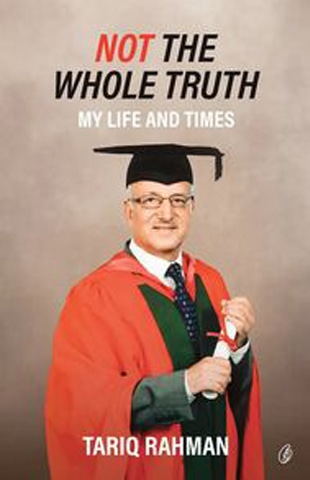
Not the Whole Truth: My Life and Times
By Tariq Rahman
ILQA Publications
ISBN: 978-969-640-307-4
604pp.
For an autobiography titled Not the Whole Truth, Dr Tariq Rahman’s memoirs are remarkably candid and forthright. He has laid bare his life, described his emotions at key moments, admitted to his weaknesses, and elaborated upon his vulnerabilities.
This is a highly enjoyable book — not at all stuffy and formal as many biographies (and particularly autobiographies) are wont to be. One wonders what Dr Rahman withheld or what could have been added to change the title to ‘The Whole Truth.’ I suspect, not much.
In a characteristically self-effacing prologue, Dr Rahman ponders on why he undertook to write an autobiography — is this an egotistical exercise, or an attempt to open the doors on the life of an academic in Pakistan? He concludes that he decided to write about his life as biographies are fun to read and, as he has himself enjoyed many such books, he decided to attempt one.
Further, as he rightly points out, most biographies published in Pakistan are those of people who have held powerful positions in politics, the military or the bureaucracy. There are hardly any biographies of academics, professors or people in the arts. This is a valid point and his readers, students and fans of his scholarly books will endorse this effort.
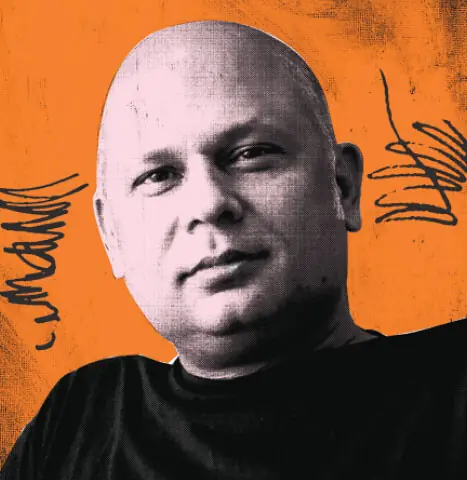
Scholar, writer and researcher Dr Tariq Rahman has penned his highly enjoyable memoirs, which tell all about his and his family’s life with disarming candour
Tariq Rahman begins by going back in time to his grandfather’s home in pre-Partition India, and sketches out a bit of family history. Both sets of grandparents were generally well off, and his father and uncles were well educated (in Aligarh Muslim University). As in many Subcontinental households, the family lore is replete with tales of the derring-do of various eccentric elders, but Dr Rahman does not spend too much time on these tales. Instead, he describes how his memories begin with his family moving from India to Karachi in the early 1950s, when he was about three years old (having been born soon after Partition).
After a short stay in Karachi, the family ended up in Kakul, a suburb of Abbotabad, where Dr Rahman’s father got a job teaching at the Pakistan Military Academy (PMA). This is where Tariq Rahman grew up, the place he thought of as home (with some reservations) and the place where his fondest memories lie. He describes an almost idyllic boyhood, filled with the shenanigans of childhood friends, episodes of playing truant from school and developing a love of books and horses (we learn that Dr Rahman was a fearless rider and much admired for this skill in his boyhood and youth). It was a privileged life, but not one lived in the lap of luxury.
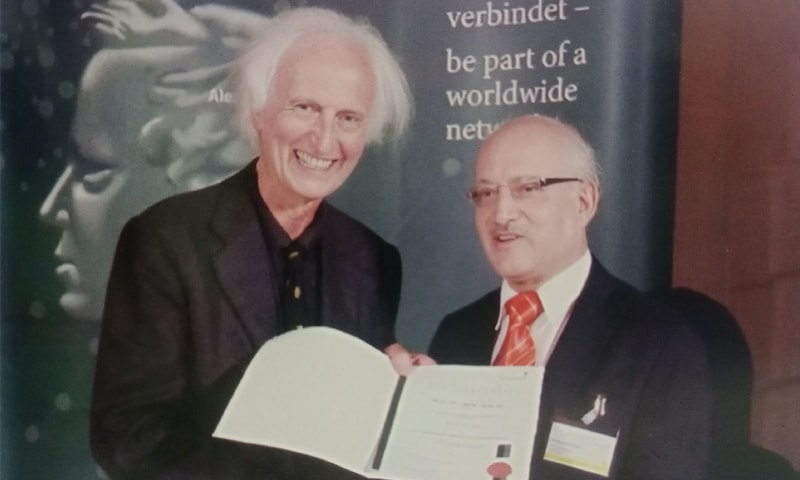
The account of the author’s schooldays and teens in PMA is enlivened by stories of his friends, both boys and girls, many of whom are now distinguished academics, military personnel and professionals. Thanks to Dr Rahman, we now have an insight into their childhood adventures, first crushes and escapades. Quite a few of them appear again and again throughout the book — the author appears to have a knack for keeping old friends close, in addition to making new ones easily.
For someone who ended up as a distinguished academic, Tariq Rahman’s academic career and early choice of professions was quite interesting. Suffice to say that, upon finishing school (and doing extremely well), he never really settled down into college, and drifted from one discipline to another for some years.
Not surprisingly for a child who grew up on the Kakul campus, he was keen to join the armed forces in his teens, and was actually commissioned into the air force. He was soon out of sorts, and decided to do his bachelors and then the first of three masters degrees privately. This was followed by a short stint in the army — returning to Kakul as a “gentleman cadet”, before being commissioned into the elite Probyn’s Horse regiment.
However, this was the period of the troubles in East Pakistan (now Bangladesh) and Tariq Rahman was deeply conflicted about the army’s role in that unfortunate conflict. He became a conscientious objector and, although not relieved by the military, found that he could not continue as a military officer. He thus resigned his commission and returned to the world of academia, this time as a teacher.
At this point, in spite of many ups and downs, the author seems to have found his calling, and added significantly to his credentials, with further studies (ending in a PhD) in the UK, and a series of appointments in universities across Pakistan. A few chapters are devoted to his travels — generally on conferences and for fellowships, of which he has held several. He has been a prolific writer along the way, and some of the more interesting passages in the autobiography are on how he got ideas for his various books. Some pen portraits of his colleagues and peers are decidedly unflattering but, at his stage in life, Dr Rahman has nothing to lose.
But it is not all about work. As said earlier, Dr Rahman is open about his personal life. His accounts of his relations with his parents, particularly his father, will strike a chord with many desi men of his generation who grew up with distant father figures, yet had an unspoken bond with them that strengthened in later life.
His account of his first unsuccessful attempt at sending a proposal is charming, as is the later story of his engagement (which he initially tried to get out of by writing a missive to his father-in-law, laying out all his faults). This reviewer was a little concerned when he started talking about his children though — I wonder if millennials (his children are in their late 30s/early 40s) are comfortable with their private lives being discussed in their parents’ books.
The author talks of their hopes and fears, the challenges they have faced, their illnesses and their relationships with their parents, with disarming frankness. This is interesting for the reader, but one can only hope that his children are comfortable with these things being made public.
All in all, this book holds your attention, in spite of its significant length (almost 550 pages). Dr Rahman has followed his heart, at least when it comes to career and interests, and it seems to have worked out well for him. He is not a man who hankers for greatness or wealth in the conventional sense, but his academic achievements are formidable and he has more than enough reason to be content. It is a life well-lived.
The reviewer is a researcher and policy analyst
Published in Dawn, Books & Authors, November 9th, 2025