Only Sohail Afridi can make decisions for peace in KP, says CM’s aide
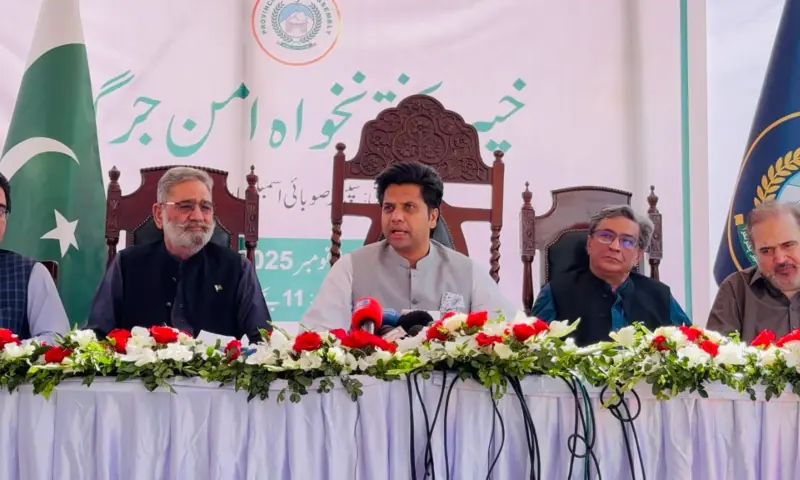

Shafiullah Jan, the special assistant to the Khyber Pakhtunkhwa chief minister on information and public relations, said on Thursday that only the provincial chief executive could make decisions for ensuring lasting peace in the province.
“We have the mandate. Any decision for lasting peace in the province will be made by the chief minister, and the provincial government will implement it,” Jan said while addressing a news conference in Peshawar.
He said law and order was the biggest challenge for the provincial government, adding that the KP government was making efforts to address the issue.
Jan further said that a multiparty conference was scheduled to be held next week and that the finalised terms of reference (ToRs) would be presented to the chief minister for further discussion with the stakeholders, to decide a future course of action for lasting peace in the province.
Meanwhile, PTI Provincial Secretary General Ali Asghar requested all the political parties to share their suggestions, adding that PTI founder Imran Khan and his party were against any military operation in the province.
“The consequences of military operations are faced by the locals who vacate their homes,” he said.
The PTI has been opposing plans to conduct anti-terrorism operations across the province, with its incarcerated founder Imran Khan in August telling then-KP CM Ali Amin Gandapur not to allow the Centre to conduct any military operations.
Imran had made a similar demand in September as well.
However, Gandapur had deviated from the party line while he was the CM and justified the use of mortar shells, drones and fighter jets against terrorists as the constitutional right of the military.
It was against this backdrop that Imran decided to remove Gandapur as the provincial chief executive and nominated Afridi for the post, who was elected as the chief minister on October 13. Imran’s this decision is also being linked to his opposition to military operations in the KP.
Three days before Afridi’s election, Inter-Services Public Relations (ISPR) Director General (DG) Lt Gen Ahmed Sharif Chaudhry had addressed a press conference at Peshawar Corps Headquarters.
He was asked on the occasion about the Pakistan government’s past engagement with the banned terror outfit Tehreek-i-Taliban Pakistan and the change in the KP leadership.
In his response, the DG ISPR had said: “Who is saying today that there should be talks and not operations against them (terrorists)? […] Who is that person who is carrying out this whole campaign of talking to them and stopping operations?
‘‘Who is [the one] saying that he cannot accept his provincial government that does not stand against operations? It is for everyone to see that today […] who is that person and the political thought that says there should be talks with terrorists.’’
For his part, Afridi announced following his election that a jirga would be held in his hometown of Bara in the Khyber district on Oct 25 to establish enduring peace in the restive province and resist decisions made without the input of residents. He also asserted that the provincial government stood by the ideology of Imran and the interests of the KP residents.
In his first official high-level meeting as the CM on Oct 20, he had maintained that the resurgence of terrorism being witnessed in the province was due to the “flawed policy” of the federal government.
More recently on Oct 29, he used stronger words to criticise military operations in KP while speaking to the media in Peshawar, saying that civilian deaths during security operations constituted a “war crime” and not collateral damage.