

NFC issues to be taken up by relevant forum: Aurangzeb

• ‘Kickstart’ meeting to be held later this month
• FBR chief puts total income tax gap at Rs1.7tr; claims collection from retailers has increased
• Power minister vows shift towards automatic metering, pre-paid billing
ISLAMABAD: Finance Minister Muhammad Aurangzeb on Monday said that discussion on ending the protection of provincial shares in the federal divisible pool resources would take place at the upcoming meeting of the National Finance Commission (NFC).
“The entire discussion will take place at the kickstart meeting of the NFC, which is the [relevant] constitutional forum,” he replied at a news conference, when asked about PPP Chairman Bilawal Zardari-Bhutto’s statement regarding the removal of protection for provinces over their NFC shares, and the transfer of population and education back to the Centre.
The minister said this meeting would be convened later this month, after being postponed at the last minute due to floods in September.
He did not announce a date for the first NFC meeting, which is tentatively planned for Nov 17.
Many responsibilities in the federal domain, including population, health, education, and other social sectors, were devolved to the provinces under the 18th Constitution Amendment in 2010.
Under Article 160(3) of the Constitution, “the share of the provinces in each award of NFC shall not be less than the share given to the provinces in the previous award”.
At present, the provinces are entitled to more than a 57.5 per cent share of the federal divisible pool under the 7th NFC, in place since 2010, instead of the previous share of 47pc.
Powerful quarters have been advocating the reversal of the “imbalance” to meet rising debt and security expenditures.
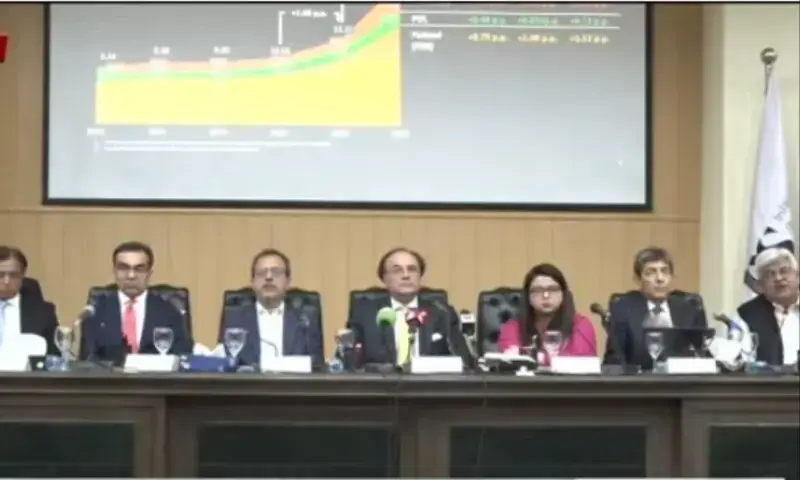
Mr Aurangzeb, who called the joint press conference alongside select members of the economic team, comprising power, privatisation and information technology ministers as well as the secretary finance, the Federal Board of Revenue (FBR) chairman and ‘rightsizing specialist’ Salman Ahmad to project economic reforms, said the country’s direction had been towards sustainable and inclusive growth.
Retailers’ contribution
FBR Chairman Rashid Mehmood Langrial ducked a question relating to additional income tax collection from retailers — a key theme of the government reform agenda under the International Monetary Fund (IMF) programme for expansion and deepening of the tax net. However, he said the country’s tax-to-GDP ratio had increased by 1.49pc last year — a “historic achievement”.
He said the total collection from retailers had increased from Rs82bn to Rs166bn. He continued that the bureau’s income tax collection had increased by 102pc in one year.
The FBR chief said 0.71pc improvement in the tax-to-GDP ratio was achieved through new taxes and increasing existing tax rates among other measures, while 0.77pc gain was gained through better compliance.
This also included about 1.15pc of GDP worth of PDL, which he said was also considered a tax revenue. However, technically it is described as non-tax revenue.
Mr Langrial said the government and tax machinery was working on the target of tax-to-GDP ratio to 18pc by 2028 from 10.33pc, which includes provincial revenue and PDL, which is a 5.79 percentage point increase from 2025. Of this 18pc, the federal and provinces share would be 15 and 3pc, respectively.
He conceded that provincial tasks were more difficult than those of the Centre. He noted that data suggested an income tax gap of top 1pc income earners was Rs1.2 trillion at present. The total income tax gap, he added, stood at Rs1.7tr. Responding to a question, he said around 80pc of the Rs1.2tr gap would be filled by 2028.
Trade deficit
Mr Aurangzeb conceded that Pakistan’s trade deficit had increased 9pc in the first quarter as exports went up by 8pc. He said the export growth should be greater, but maintained that it would be “unfair” to say exports had “collapsed”.
“Remittances are providing us with a cushion. We expect remittances to hit $41-42 billion by the end of this fiscal year,” he said, adding that ultimately the current account deficit at $0.5bn was “very manageable”.
Power & privatisation
Power Minister Awais Ahmad Khan Leghari said the government’s top priority was to reduce electricity rates within our “tightened hands” as energy cost at Rs9.97 per unit was internationally competitive, but capacity payments due to devaluation of currency and high interest rate were a predicament.
“The government has the cut average power rates by Rs10.5 per unit and by Rs16 per unit for the industrial sector,” he continued.
The minister said the government was aggressively rolling out automation in the power sector.
“The entire metering landscape will be overhauled to automatic metering and pre-paid billing.”
Adviser to PM on Privatisation Muhammad Ali said the government remained committed to privatisation reforms “at the highest level”.
“The Privatisation Commission is now working on taking as many transactions as possible,” he added.
Published in Dawn, November 4th, 2025




























