Lahore’s mass transit project along canal ‘postponed’ over funds diversion to flood-hit areas
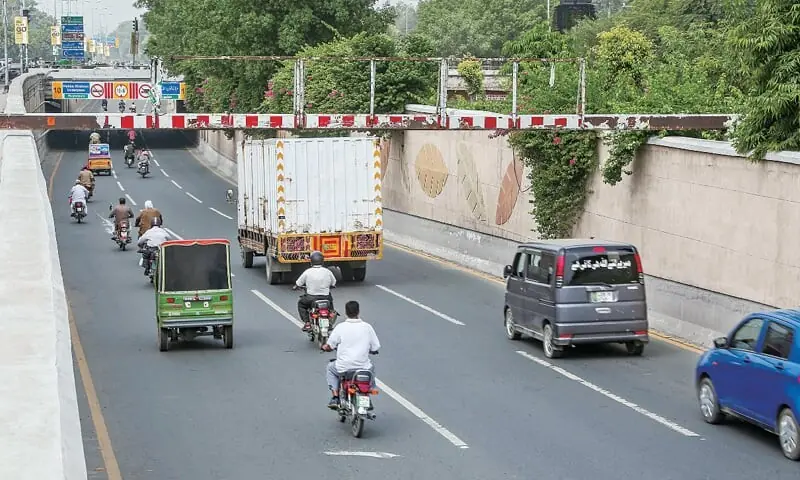


LAHORE: The provincial government may not be able to launch the Lahore Yellow Line mass transit project during the ongoing fiscal year as various activities have been slowed down in this regard keeping in view the other projects and diversion of funds to flood-hit areas.
However, the government has no plan to delay the project for a longer period or drop it despite objections raised by the civil society, Dawn has learnt.
“There is no plan to either delay or drop this project as the government wants to complete it by all means well before the next general election. But one thing is clear that the launch of the project seems impossible within this fiscal year (2025-26), ending on June 30, 2026, as various options for construction that could save the trees, cost and time are yet to be finalised,” a senior official explained while talking to Dawn on Sunday.
“The National Engineering Services Pakistan (Nespak) is working out various design options, including one called ‘cut and cover’ requiring no cutting of trees, but disruption/closure of traffic on the Canal Road for a long time,” the officer said while requesting anonymity. He said though the government had earlier planned to launch the project before March 2026 but not it seemed impossible.
However, govt is firm to complete it before next general election; project design issue another reason for the ‘delay’
In June, this year the Lahore High Court while hearing multiple petitions on environmental issues had warned the government that felling of the trees on the Canal Road could not be allowed for the Yellow Line project or any other development project.
A number of civil society organisations had also written a joint letter in July to Chief Minister Maryam Nawaz, raising concerns at the proposed project on the Canal Road. The organisations, which wrote to the CM included Lahore Conservation Society, WWF (World Wide Fund for Nature), IAP (Institute of Architects Pakistan), PCATP (Pakistan Council of Architects and Town Planners), HRCP (Human Rights Commission of Pakistan), Heritage Foundation & INTBAU, Shirkatgah, Heritage Pakistan, SOCH, Pilac, Sarang, WAF, CROM Lahore, Lahore Sangat, Urban Resource Centre and the Sarhad Conservation Network. They highlighted the social, environmental and cultural costs of the project, which could cause irreversible damage to the city. The organisations outlined key issues, stating that the project contravened Supreme Court’s orders besides violating the Canal Urban Heritage Park Act 2013 and international conventions including the Unesco’s World Heritage Convention.
Later, in the same month, the civil society activists also staged a protest demonstration in front of the Lahore Press Club and warned the government against launching the project as it involved chopping down a huge number of trees along the canal. They gathered in a dialogue on environmental impact of the Yellow Line held at the Human Rights Commission of Pakistan wherein they, while raising objections termed the project ‘needless’ on the Canal Road.
“An option has been worked by Nespak under which there is no need to even cut a single tree. But, if the government goes for this option, the entire Yellow Line infrastructure would go underground having no visibility on the ground,” said another officer closely linked with various activities in this regard. According to him, the Yellow Line project seems not a priority these days as the main government’s main focus is on the Lahore-like metro bus project in Faisalabad and the busway project in Gujranwala.
“Though the busway project would have a dedicated track, the time duration of the arrival/departure of buses would be more than five minutes that could be up to 30 minutes. But the metro bus project is a rapid transit system, as the time duration of the arrival/departure of the articulated buses (as in Lahore) is three minute or so,” he explained, adding that the Yellow Line project would not be possible in this fiscal year keeping in view this situation.
“Another reason is the lack of funds for this project, as the government has diverted huge funds for the rehabilitation of the flood-hit people in many districts of Punjab. The government wants the mass transit system in all major cities keeping in view the success of metro bus projects in Lahore, Multan and Rawalpindi/Islamabad and the Orange Line train project in the provincial capital.”
According to the officer, the ridership of the Lahore metro bus and orange line metro train systems is around 150,000 and 235,000 passengers daily on an average which reflects their success.
It is pertinent to mention that since the original design of the project involved felling of 1,400 grown trees, Nespak, in its first large-scale digital mapping of an urban green cover had geotagged nearly 28,000 trees at the 24km-long stretch of Lahore’s Canal Road—the largest urban green corridor in Lahore. Nespak, on the orders of the Lahore High Court, also recorded each tree’s species, height, girth, age and condition during the survey. The teams also identified some dead trees, stating that 5,000 shrubs also exist in this green corridor.
Published in Dawn, November 3rd, 2025