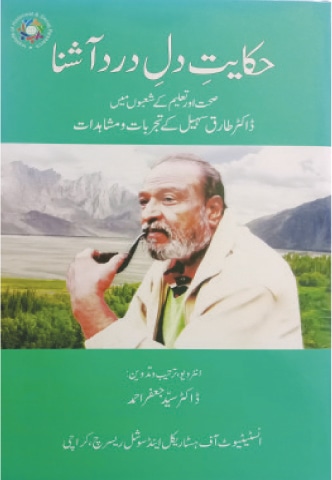
Hakayat-i-Dil-i-Dard Ashna
By Syed Jaffar Ahmed
Institute of Historical and Social Research
ISBN: 978-969-7985-51-7
190+pp.
Memoirs are a good way to get to know a person and his work. And if a person has a multi-dimensional personality and has been involved in varied fields, it is all the more interesting to know about him and learn of the various things he has been doing. One such person is Dr Tariq Sohail, known to most as a psychiatrist. But he is more than just a psychiatrist.
The book Hakayat-i-Dil-i-Dard Ashna, though not a memoir in the true sense of the term, showcases the various aspects of Dr Sohail’s personality and the work he has been doing through his life. Based on a series of long interviews, the book is a product of labour by Dr Syed Jaffar Ahmed, who is a scholar and academic, former director of the Pakistan Research Centre at the University of Karachi, and currently the director of the Institute of Historical and Social Research, as well as the dean of the Faculty of Social Sciences at Sohail University in Karachi.
Dr Sohail came to Pakistan in 1947, soon after Partition, at a young age. He graduated from Dow Medical College (DMC) in 1965. DMC had not only been a centre of student politics during the 1950s and ‘60s but many students’ rights movements had started from there. Student leaders belonging to this college adopted a positive attitude towards rights and succeeded at resolving many issues faced by students.
The book reminds readers that student leaders of that era, such as Dr Mohammad Sarwar, Dr Haroon Ahmed and Dr Adeeb Rizvi, not only succeeded as doctors in their relevant fields but also played a prominent role in the social and political life of the country. It is people like these who influenced Dr Sohail and he, too, remained active in such activities. Perhaps politics was in his blood, as his father was involved in Muslim politics in India and was a part of the Independence movement and later became involved in Muslim League politics after coming to Pakistan.
The life story of a well-known psychiatrist provides insight into the healthcare and education system of Pakistan as well as its politics
Whatever the case, Dr Sohail not only participated in student politics but also joined national politics at a later stage, and even contested elections and became a member of parliament, though his active involvement in national politics was short-lived. From 1988 to 1990, he worked on formulating the national health policy and took actions to have it implemented. In the book, he discusses the salient features of his policy, such as provision of universal healthcare for all by 2000, controlling preventable diseases, the provision of clean water and sewerage systems etc.
In the book, he has expressed his opinion on varied subjects, from Marxism and socialism, to Ayub Khan’s politics and his family law and its opposition by the Jamaat-i-Islami, as well as the tragedy of East Pakistan in a larger perspective — including Pakistan nationalism, problems due to the imposition of ‘One Unit’, the attempts to keep East Pakistan in control and not allowing it to prosper economically or politically.
He has also created a social picture of Karachi during the 1960s, and talks about international airlines coming to Karachi, many having their own hotels, the national institutes/departments that had their offices in the city, such as PIA and the naval headquarters, as well as the night clubs, bars, many theatres and cinema houses etc that existed then. He says it didn’t seem that politics would end all this. Especially for a Karachiite, it comes as a reminder of the city’s past glory.
The book discusses in detail the situation of the healthcare system in Pakistan during the past 60-65 years and the stages of its evolution to what it is today, the technological development that has taken place, and research institutes in the country.
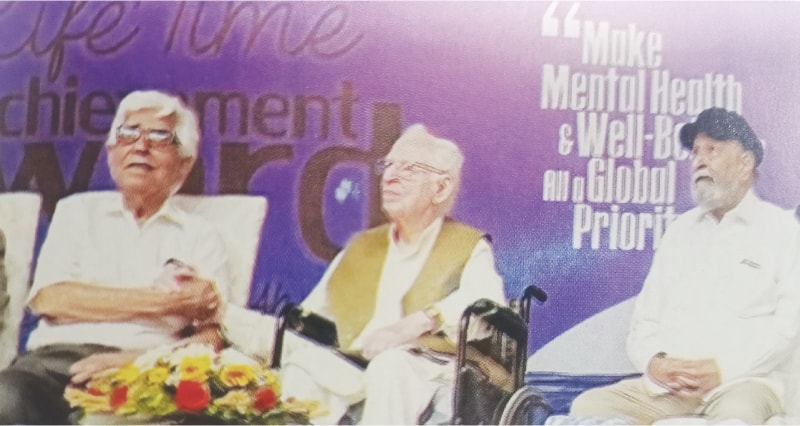
After coming back to the country from the UK, where he had gone for higher studies, Dr Sohail joined the DMC as an assistant professor of psychiatry. At the same time, he worked for the development of psychiatry in the country and, for this purpose, sent a proposal to the government. He laid the foundation of Medicare Hospital with a few like-minded friends and later established the Jinnah Medical and Dental College in 1996, a decision that was based on a desire to raise the standards of medical education in Pakistan. In 2018, Sohail University was founded, with the aim to establish centres of excellence in emerging areas of science, engineering, technology, management and other allied areas.
Talking about private healthcare and setting up a hospital, he says, “In our country, people see healthcare as a government responsibility and want it for free. It was not easy to introduce private healthcare and maintain it. People would [wonder] why they should pay for healthcare. … It is not very good but since people need it, the private healthcare system exists.”
Dr Sohail is a proponent of giving priority to primary healthcare, which includes immunisation and population planning programmes, as well as initiatives for clean water and sanitation. Pakistan is a poor country and there is scant attention paid to public health programmes, but new hospitals are being built every day. It is because, he says, “Building a hospital is beneficial to the politicians, because they become known… they can show the people the building and that work is being done. But there is no glory in public health.”
In this context, he also expresses his views about population planning, nutrition, Lady Health Workers, the need for Basic Health Units and Rural Health Centres, maternal and child mortality, as well as drug addiction.
Tracing the history and evolution of the healthcare sector and medical education in Pakistan, he recalls that, at the time of Partition, there were only two medical colleges in the country and only a few institutes had nursing colleges. The number of medical colleges rose to seven by 1974 but, since 1985, a rapid change came about after the establishment of the Aga Khan University Medical College and many private medical colleges. In fact, so many private medical colleges were established, especially in Punjab, that it became a matter of concern for the Pakistan Medical and Dental Council (PMDC) to regulate them.
Dr Sohail does not seem happy with the fact that the PMDC has not yet been able to come up with a curriculum that is indigenous — all the textbooks that are used are foreign published. He thinks it is because our government wants the doctors to go abroad to work and send remittances, which is beneficial to the government.
In between telling you about his work, Dr Sohail also talks about his travels, especially while he was studying in England and even after that. He explains places he visited and the people he met and travelled with. He fondly remembers some personalities who deeply influenced him, such as Roshan Ali Bheemjee, Syed Sibte Hasan, Prof Zaki Hasan, Miraj Mohammed Khan, Sher Afzal Malik and others with whom he worked or interacted in politics. Among his peers, he fondly remembers Dr Haroon Ahmed, Dr Sarwar and Dr Adeeb Rizvi.
Hakayat-i-Dil-i-Dard Ashna allows the reader a peep into Dr Sohail’s personality and work, and to get familiar with his views not only on health and medical education, but also on politics. He is a well-read person and believes that the writings and views of Charles Darwin, Karl Marx and Sigmund Freud have influenced him and helped him come up with his own world view.
The reviewer is a freelance journalist. X: @naqviriz
Published in Dawn, Books & Authors, November 2nd, 2025