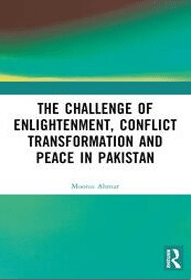
The Challenge of Enlightenment, Conflict Transformation and Peace in Pakistan
By Moonis Ahmar
Routledge
ISBN: 978-1-03-239405-3
143pp.
Pakistan is enjoying its moment on the world stage. The moment in the sun has been brought on by its role as a negotiator between two of the three warring parties in Iran. However, a variety of tensions continue to simmer domestically, and on its borders with Afghanistan and India.
In this book, Professor Moonis Ahmar suggests that Pakistan follow the path that Europe took to emerge out of the Dark Ages, a process known as ‘Enlightenment’. It liberated people’s minds from the biases and prejudices that had held them back and allowed scientific progress to occur. That led to the industrial revolution and to peace and prosperity.
The book argues that if Pakistan follows the European Enlightenment paradigm and embraces secularism and pluralism, it will achieve social cohesion, a prerequisite to economic progress. Enlightenment certainly lessened internecine violence in Europe and promoted social welfare. However, despite being ‘enlightened’, Europeans proceeded to colonise other nations and, in a few cases — such as Australia, Canada, New Zealand, South Africa and the US — the colonisers settled there and pushed the natives into the background.
Enlightenment also failed to prevent violence between nations. Not one but two world wars broke out, the second far worse than the first. Even today, a large-scale war is being waged between Russia and Ukraine. Today, the world is witnessing the resurgence of a nefarious seed that was planted millennia ago. Right-wing racism is on the rise in European culture, and it is manifesting itself in the emergence of anti-immigration sentiment.
A book argues Pakistan can overcome its challenges by embracing the values of the European Enlightenment, but offers oft-repeated theoretical prescriptions rather than insight about why they have never worked in practice
Turning to Pakistan, it’s worth noting that even Bangladesh, formerly East Pakistan, which lagged behind West Pakistan, has moved ahead of Pakistan on a variety of metrics. How did Pakistan get into this mess?
After a long struggle that began in March 1940, Pakistan gained independence from imperial Britain in August 1947. But, given the divisions within society, it took Pakistan nine years to develop a constitution, and even that declared it to be an Islamic Republic, the opposite of M. A. Jinnah’s secular vision. In December 1971, the relatively secular eastern province, in which a significant portion of the population was Hindu, seceded, after a long and bloody civil war that eventually escalated into a full-scale war with India.
Ahmar says that “[T]he eastern part of Pakistan (now Bangladesh)… was neither feudal in nature nor religiously ultra-conservative like its western counterpart.” It goes on to say that the loss of the eastern wing weakened enlightened forces in Pakistan because “the people of East Pakistan were religiously more tolerant and democratic in nature than their western counterparts.”
Indeed, the secession triggered a lot of soul searching in Pakistan. Unfortunately, instead of focusing on the root causes of the secession, which was the economic and cultural exploitation of the east wing by the west wing, religious fervour swept through what remained of Pakistan, so much so that even during the tenure of the secular prime minister, Z.A. Bhutto, the Constitution was amended in 1974 to declare that anyone who did not believe in the finality of prophethood was not a Muslim. From that point on, “lingual, ethnic, sectarian and resource-based conflicts” broke out in Pakistan.
In addition to suggesting that Pakistan follow the process of the European Enlightenment, the book suggests that Pakistan revert to the norms of the Indus Valley Civilisation that prevailed here nearly five millennia ago, since it was “a symbol of peace and tolerance.” However, little is known about the inner workings of that civilisation, since its script has yet to be deciphered.
It’s much too abstract and speculative to suggest that it serve as a role model for today’s Pakistan. What happened during the past millennia is much more relevant to Pakistan’s conundrum. The rulers were invaders from Afghanistan, Central Asia and Imperial Britain. They were dynastic rulers who instilled fear and authoritarianism in the public’s mind, not enlightenment.
The book mentions Prime Minister Imran Khan’s attempt to bring about “change” in Pakistan. It acknowledges he failed. What else could have been expected from a political demagogue, albeit a cricket legend and philanthropist, who had no experience in governance?
The book also cites Gen Musharraf’s concept of “enlightened moderation” to achieve enlightenment. It acknowledges he failed. But what else could have been expected from a general who had seized power illegally? He was a dictator, not an enlightened ruler.
Towards the end, the book suggests that Pakistan considers a three-step process to achieve enlightenment. Firstly, political parties should develop a “tolerant, professional, visionary and clear mindset.” They should focus on why economic, social, cultural and societal degeneration has set in the country. Instead, as the book acknowledges, politicians focus on self-aggrandisement. Thus, “one cannot expect any meaningful breakthrough as far as positively transforming the political culture of Pakistan is concerned.”
Secondly, it argues that the rule of law should be allowed to prevail in the country, along with good governance. Otherwise, society will be destabilised, and the nation will be prone to outbreaks of violent conflicts. Thirdly, laws should be established through a fair and transparent process. Once approved, they should be executed fairly, allowing justice to be “delivered by those who are able, ethical, neutral, independent and within the reach of ordinary people.”
There is no doubt that Pakistan needs structural reform, such as that which is envisaged in this three-step process. The process is worthy of consideration, but it’s not entirely new. It has been suggested multiple times by academics, columnists, journalists, scholars and politicians. It has also been suggested by each of the four military dictators that between them governed the country for more than three decades.
Why do these lofty ideals not make it to practice? What is the hidden trap that swallows them? Is it elite capture, militarism or something else? That is the enigma that Pakistan’s intellectuals need to analyse and dissect. This topic is fertile ground for new scholarly work. It will require field work, ie empirical rather than theoretical research.
The reviewer is the author of Rethinking the National Security of Pakistan: The Price of Strategic Myopia. X: @ahmadfaruqui
Published in Dawn, Books & Authors, June 7th, 2026