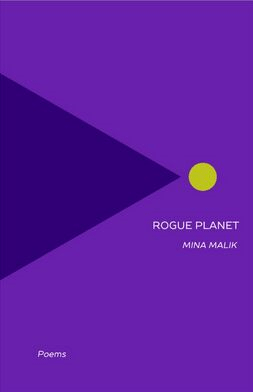
Rogue Planet
By Mina Malik
The Peepul Press
ISBN: 978-96923860-2-9
20pp.
Chapbooks are often viewed as calling cards, whereby authors showcase their literary talents in the earnest hope that they will be noticed by publishers. However, this perception tends to reduce the chapbook to an opportunistic medium rather than a literary form in its own right.
Readers believe brevity is the defining attribute of chapbooks and many of them fail to recognise how these short, compact booklets can feature compelling work that takes risks. Wrapped in a purple book jacket without any back-cover text, Mina Malik’s Rogue Planet epitomises this spirit of creative boldness.
The Lahore-based, Oxford-trained poet’s debut collection offers moving meditations on the intricate role of identity and individuality, especially when it is in danger of being stymied within a romantic partnership.
Since chapbooks are usually driven by some degree of structural cohesion, Malik’s 14 poems are arranged in a manner that mirrors the psychological trajectory of someone trapped in a hopeless relationship. As a result, the poems take readers through an array of conflicting emotions, from disillusionment to doubt and, ultimately, to spiritual awakening.
A debut collection of poems offers moving meditations on the intricate role of identity and individuality in the journey of a crumbling romantic relationship
The title of the collection alludes to a starless, free-floating planet that is adrift in the cold vacuum of space. The use of the term ‘rogue planet’ signals a rebellious streak, which may evoke either the ache of loneliness or the thrill of independence, depending on how it is perceived. Malik mines the tension between rebellion and conformity to striking effect in this collection. Readers are, nonetheless, advised to conform to the prescribed order of the collection to fully appreciate its emotional arc.
The title and the first stanza of ‘The Andromeda Paradox’ suggest that the poem is a nod to a thought experiment proposed by physicist and philosopher Roger Penrose. According to this hypothesis, two people can have contrasting perceptions of the same events. However, Malik seamlessly blends science with Greek mythology by invoking the tale of Andromeda, a princess who is chained to a cliff to appease a sea monster and rescued by the heroic Perseus.
Malik constructs a moment filled with the stereotypical trappings of love at first sight, only to undermine it with a shadow of doubt. By stripping this moment of its romantic overtones, the poet reveals Andromeda’s rescue as a metaphor for the ultimate deception, where emotional signals are misinterpreted.
Subsequent poems in the chapbook depict the dramatic fallout of these misperceptions. ‘After Juliet’ captures the sheer monotony and emotional drudgery that besiege romantic partnerships once the initial stirrings of love have subsided. The disconnect between unrealistic expectations and crippling realities experienced by the poet’s modern-day Andromeda is conveyed through the following lines:
“It said ‘companionship’ on the brochure
it said laughs and films and happy little babies
then why am i defrosting a deep-freezer, why
are the children fighting
why are you wiping chocolate on my thousand
thread count sheets”
Amid the exasperation of waiting for circumstances to change, the narrator is driven by an overpowering desire for order. Fuelled by a heady mix of sarcasm and self-deprecation, ‘Storage’ examines her persistent efforts to contain her disappointment in a man and a relationship that have failed her. She blackens her fingertips while rummaging through a cupboard in an effort to arrange her partner’s belongings, performing her role as a glorified custodian of all things — useful yet expendable.
The poem explores her isolation and her utter despair over being short-changed by fate, albeit with wit, grace and flair. Faced with such discomfort, people often take stock of their choices, analysing them from various angles, to assess where they stand. This rationale provides a plausible explanation for why the next poem, titled ‘Inventory’ appears inverted on the page.
Using this visual technique to great advantage, the poet allows readers to experience the labour undertaken by Malik’s contemporary Andromeda to locate herself within the confines of her lacklustre relationship. This poem offers tell-tale signs of the chasm within their bond as well as a reminder of the narrator’s position as a perceptive observer of these frictions.
In ‘The End of Love’, the poet anthropomorphises the titular emotion, commenting on its surreptitious arrival and unhurried ability to weaken the narrator’s relationship with her partner. Malik writes:
“The End of love comes one lost touch
at a time. One evasion at a time, one
flinch at a time.”
The beating heart of Rogue Planet is undoubtedly a poem titled ‘Sabr, shukar’ [Patience, gratitude], where the narrator examines how patience is often presented as a universal remedy, unconstrained by language, culture or nuance. The poet juxtaposes this notion with clichéd notions of gratitude, which are habitually invoked to gaslight or diminish the experiences of those in distress.
In ‘Smoke/mirrors’, Malik’s Andromeda reflects on the haunting image of a phantom-like figure who resembles her partner but whose aura is both threatening and alien. Steered by curiosity about this overwhelming shift in her partner’s spiritual energy, the narrator draws attention to the couple’s mutual loss of selfhood. Ultimately, she has lost faith in the relationship, leaving her paralysed by doubt. Malik writes:
“There was a time i would have taken an axe to it to rescue you from the abyss — now
the ghost is me, drifting through the walls.”
The despondency that takes root as prospects for reconciliation begin to dwindle is skilfully conveyed in ‘These are the days’, where the emotional wastelands of the heart resemble silent landmines. This is followed by ‘Circe’, an accomplished piece that effectively employs the second-person perspective to offer some degree of distance and perspective to the narrator.
The next four poems are driven by a deeper sense of self-interrogation, as the narrator navigates the untamed corners of the heart and learns to capitulate to impulses that she has tried to suppress. In ‘Galileo’, she likens her plight to that of the eponymous Galileo Galilei, whose discoveries helped defy the Aristotelian view that the heavens are the embodiment of perfection. Through the following lines, Malik’s Andromeda makes peace with her own circumstances:
“Once you’ve seen the sun you can’t look away”
The final poem is an ode to how even meticulous plans and emotional calculations fall short when the heart decides that it must choose liberation over societal constraints.
Rogue Planet stands out owing to Malik’s refreshing simplicity of expression. She eschews any obscure phrasing, instead appealing directly to the reader’s emotion through terse language. However, this choice to remain fluid and accessible shouldn’t be mistaken for a lack of complexity. Malik’s simplicity is of a deceptive kind, concealing entire worlds and complex ideas within it.
She also uses the blank page with competence and measured precision, preferring not to treat it as a dumping ground for the narrator’s emotional confusion. What emerges from this restraint is a rich, intriguing collection that leaves readers eager for more from this exciting new poetic voice.
The reviewer is the author of the critically acclaimed novels Typically Tanya and No Funeral for Nazia. X: @TahaKehar
Published in Dawn, Books & Authors, June 7th, 2026