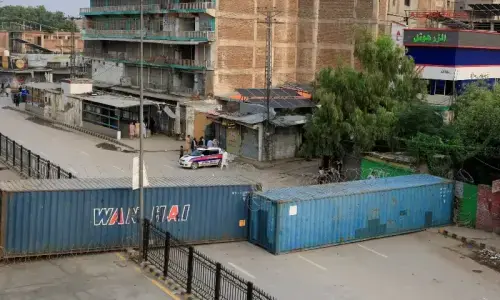
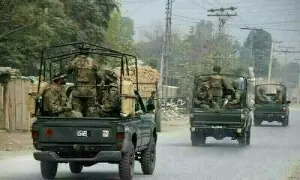
ONCE again, the residents of Quetta were cut off from the world for their own ‘security’. Mobile and internet services in the provincial capital remained suspended for all of Friday, after authorities in Islamabad said they had received intelligence warnings of possible militant activity, which necessitated a shutdown of vital communication services. The frequent information blackouts imposed on the city and, indeed, the wider province have always been presented as a necessary precaution; however, they seem to be becoming disturbingly routine. The question must be asked: how long should the residents of Quetta live in this perpetual state of uncertainty and insecurity? Each shutdown deepens the isolation of a region that has already been struggling with underdevelopment and neglect. The authorities seem to forget that for a major urban centre like Quetta, internet and telephone connectivity is not a luxury but a lifeline: banks, small businesses, media outlets and citizens all depend on it. In this, Quetta, or any other city, cannot be treated any differently than Lahore or Karachi.
Cutting the lines of communication means disrupting livelihoods, hampering emergency access and services, and reinforcing a sense of civic exclusion. For those inconvenienced by these measures, it is a reminder that the state’s first reflex is to restrict their lives. To be clear, there is no question that the government must respond swiftly to credible threats. However, blanket information blackouts are blunt and counterproductive. Instead, the authorities would be better served by investing in targeted intelligence and addressing the root causes of the security crisis. A city as big as Quetta cannot continue to be treated as an ‘exceptional case’. Unless some form of accountability is established, it is possible that information blackouts will continue to be used to curtail even basic civil freedoms under the guise of security. This is more likely to increase the feelings of alienation that feed Balochistan’s security crisis than solving the problem.
Published in Dawn, November 2nd, 2025