ISLAMABAD: The Islamabad High Court (IHC) has ruled that all matters arising under the National Accountability Ordinance (NAO), 1999, must be heard by division benches, an interpretation that directly contradicts a ruling from the Rawalpindi bench of the Lahore High Court (LHC).
The LHC bench held earlier this year that such cases should ordinarily be heard by a single judge.
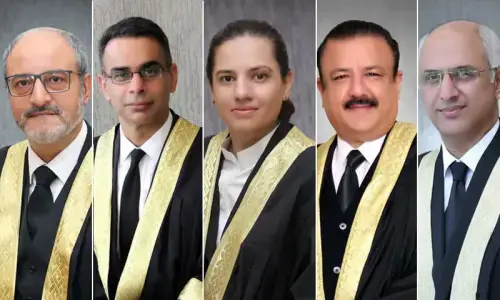
The IHC’s detailed order, authored by Justice Mohammed Azam Khan in a criminal appeal, elaborates the constitutional and statutory basis for assigning National Accountability Bureau (NAB)-related cases to division benches of two or more judges.
“Proceedings under the National Accountability Ordinance are not routine writs or criminal matters; they concern institutional accountability, protection of public money and constitutional guarantees of fair trial,” the ruling emphasised.
The court argued that accountability proceedings involve complex constitutional and statutory questions of public importance and therefore require adjudication by more than one judge to ensure consistency, fairness, and institutional confidence.
IHC mandates division benches for NAB cases, contradicts LHC ruling
The judgement examined Article 192 of the Constitution, which it said empowers each High Court to frame rules for distributing business between single judges and larger benches.
The IHC observed that the NAO, as a special law dealing with public office holders, falls into a category of cases with statutory intricacy or greater public consequence that warrants the scrutiny of more than one judge.
Referring to Article 192 and the Islamabad High Court (Procedure) Rules, the bench stated that the jurisdictional assignment of NAO cases to a division bench is a “constitutional safeguard intended to maintain judicial balance, avoid inconsistency, and uphold the integrity of the accountability process.”
The court also addressed Section 32 of the NAO, which specifies that appeals from accountability courts must go before a division bench. It said this provision reflects the legislature’s intent for higher judicial scrutiny, supporting the principle that all proceedings under the ordinance should be similarly handled.
This interpretation, however, is in direct contrast to an April ruling from the LHC’s Rawalpindi bench, delivered by Justice Jawad Hassan and Justice Tariq Mahmood Bajwa.
The judges held that constitutional petitions should be heard by a single judge, citing court rules that allow it unless a law expressly mandates otherwise. They argued that Section 32 of the NAO only authorises division benches for appeals from final judgements, not for initial petitions.
They said that bypassing single judges for such petitions deprived litigants of their right to appeal and contravened Article 10A of the Constitution.
Published in Dawn, November 2nd, 2025