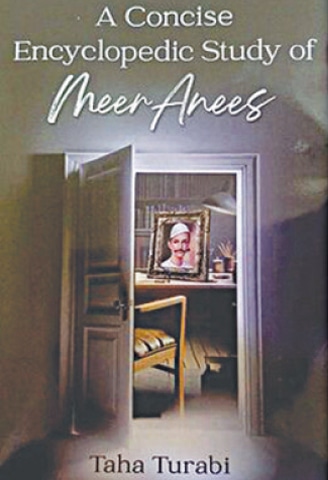
A Concise Encyclopaedic Study of Meer Anees
By Taha Turabi
Paramount Books (Pvt) Limited
ISBN: 978-627-94680-0-0
250pp.
On a bus ride from Manchester to Stratford-upon-Avon — home to Shakespeare’s memorials — a British woman overheard a group of Pakistanis and Indians, including myself, praising Shakespeare. Curious, she turned and asked, “Why are Indians and Pakistanis so awed by Shakespeare? We only see him as a dramatist.” I replied, “True, if one knows only English and only Shakespeare, he appears solely as a dramatist. But we place him alongside Rumi, Anees and other epic poets — thus recognising his universal greatness.”
That exchange offers a fitting prelude to Taha Turabi’s new book. A Concise Encyclopaedic Study of Meer Anees does not merely explore the 19th century poet’s Urdu verses; it re-imagines his stature by placing him among the world’s epic masters. Turabi invites readers to view Anees not as a regional poet of lamentation but as a member of a global constellation of literary greatness.
Turabi brings to this undertaking both pedigree and passion. He is heir to an extraordinary intellectual lineage. His father, Allama Rashid Turabi, was a revered scholar and orator across the Indo-Pak Subcontinent and his uncle, Dr Mazhar Ali Khan, served as Professor of English Literature at Peshawar University, shaping generations of students. To grow under the mentorship of such figures is a rare advantage — one that deeply informs this study.
At just 250 pages, the book seeks to position Meer Anees among the world’s literary giants. Turabi situates his output within the epic tradition that includes Homer’s Iliad and Odyssey, Virgil’s Aeneid, Spenser’s The Faerie Queene, Milton’s Paradise Lost, and even Shakespeare’s history plays — works often seen as the Bard’s attempt at epic form. Other connections with the Persian masters Hafiz Shirazi and Ferdowsi and the Bengali polymath Rabindranath Tagore are also briefly mentioned.
A landmark comparative study of the poetry of Meer Anees places him not merely as a regional poet of lamentation but as a member of a global constellation of literary greatness
While many have written about Anees’s poetic brilliance, Turabi’s distinctive achievement is his comparative lens. He examines Anees not only as the supreme chronicler of the events of Karbala but as a craftsman whose imagination and artistry stand beside those of the great epic poets of the world. In this broader frame, the grandeur of Anees’ language and the universality of his themes — valour, loss, faith and redemption — emerge with renewed force.
The book could easily have been much longer. Had Turabi quoted extensively from the parallels he traces between Anees and Homer, Virgil or Shakespeare, the work might have doubled in size. Instead, he opts for brevity, trusting contemporary readers — accustomed to online searches — to pursue those references themselves. The gain is concision and readability; the loss is only the tactile pleasure of seeing those echoes side by side. Nevertheless, the study offers a rich bouquet of allusions and insights across epic traditions, enabling readers to sense Anees’ rightful place within them.
One area for refinement lies in translation consistency. Turabi provides elegant English renderings of Anees’ couplets, but not every Urdu verse is translated, and not every translation is paired with the original. A more systematic approach — complete with references to marsiya line numbers or page citations from standard editions — would greatly assist readers, especially those less familiar with Anees’ extensive corpus.
The tragedy of Karbala, of course, forms the heart of Anees’ poetic universe. Today, its resonance extends far beyond the Indo-Pak world. The Arbaeen walk [the pilgrimage on foot from Najaf to Karbala on the 40th day of Imam Hussain’s martyrdom] now features on CNN and BBC, symbolising the global reach of this moral drama. A concise prose summary of Karbala’s key events would have enriched the book, particularly for younger readers unfamiliar with the Muharram majlis or the marsiya tradition. For them, the cultural landscape that once saturated everyday life has become sporadic and fragmentary. Turabi, who grew up immersed in this tradition, might have bridged that generational gap with a brief contextual preface.
Turabi brings to this undertaking both pedigree and passion. He is heir to an extraordinary intellectual lineage. His father, Allama Rashid Turabi, was a revered scholar and orator across the Indo-Pak Subcontinent and his uncle, Dr Mazhar Ali Khan, served as Professor of English Literature at Peshawar University, shaping generations of students.
Equally engaging is Turabi’s mapping of Western epic conventions on to Anees’ verse. His discussion of the invocation to the muse is especially compelling. Where classical poets turned to the Greek goddess Mnemosyne and her nine daughters, Anees turns instead to a Divine voice. His invocations — celebrated for their mastery of imagery, tone and rhythm — stand among the most powerful openings in world poetry. Through this comparison, Turabi demonstrates that Anees’ spiritual impulse fulfils the same artistic function as the pagan muse: it connects the poet to a transcendent source of inspiration.
Even casual browsing reveals Turabi’s meticulous attention to textual detail. On page 88, a fascinating chapter analyses Anees’ recurring use of the word jab [when] to begin 43 marsiyas out of 237. This single observation shows the depth of Turabi’s devotion — both critical and emotional — to his subject. By examining how one word can establish tone, tempo and atmosphere, he illuminates Anees’ precision and musicality. The inclusion of a full list of these marsiyas further exemplifies the scholarly care our poets deserve.
A few editorial shortcomings remain. Stronger proofreading would certainly elevate the work: minor typographical slips occasionally intrude. More problematic is the decision to print book-cover images in the bibliography — an unnecessary embellishment that distracts from the seriousness of the study. A straightforward list of sources would have been preferable. The claim that these images add “vibrancy and visual appeal” feels overstated; greater editorial restraint would enhance the book’s credibility.
A tribute to Dr Mazhar Ali Khan with a photograph at the end of the book, provides a graceful close. It embodies the book’s underlying conviction that East and West can meet meaningfully through comparative vision. Indeed, this is the quiet triumph of Turabi’s work: it bridges traditions without diminishing either. Anees emerges not merely as a poet of mourning but as a universal voice of moral imagination.
Despite its minor flaws, A Concise Encyclopaedic Study of Meer Anees is a landmark contribution. It reclaims Anees for the world stage and urges readers to encounter him as an epic poet whose art transcends sectarian or linguistic boundaries. Turabi’s erudition and emotional sincerity combine to produce a study that is both intellectually rigorous and deeply felt.
In re-imagining Meer Anees, Turabi also re-imagines how we read ourselves: as heirs to a literary civilisation capable of standing beside the best of world culture. The East and West do meet here — not as opposites, but as mirrors reflecting the shared grandeur of the human spirit.
The reviewer directs the Teachers’ Development Centre. He can be reached at abbas.husain@gmail.com
Published in Dawn, Books & Authors, October 26th, 2025