PM laments resurgence of terrorism in Balochistan
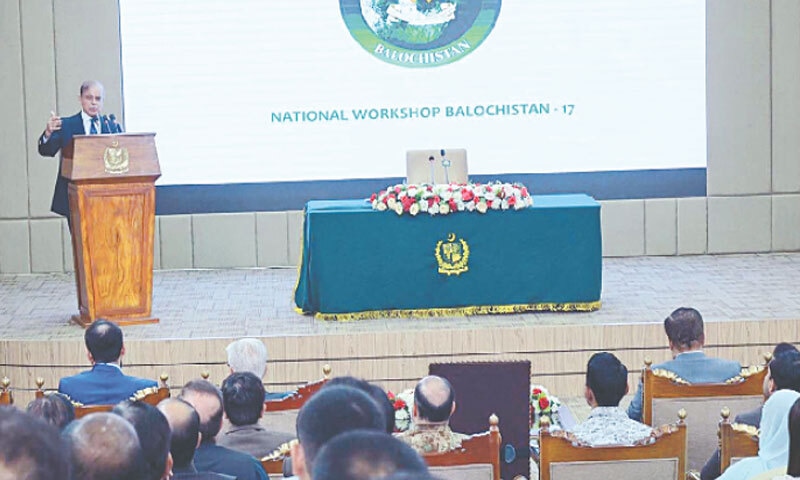

ISLAMABAD: Prime Minister Shehbaz Sharif on Saturday said complete harmony, consensus and unity among the provinces was necessary to meet the challenges facing the country, including terrorism.
“Whether Punjabi, Sindhi, Baloch or Pashtun, we are Pakistanis first. We are a family and have to collectively help extinguish fire wherever it erupts,” he remarked while speaking at a national workshop on Balochistan here.
He stressed upon fostering affection, unity and brotherhood among all segments of society living in different provinces, a spirit of sacrifice for each other and dedication for the country’s progress and prosperity.
The premier recalled that during the year 2010 when new National Finance Commission (NFC) award was discussed under the government led by former prime minister Yousuf Raza Gilani, the then Balochistan Chief Minister Nawab Aslam Raisani insisted it would not be accepted unless 100 per cent financial resources were added to his province’s share.
Calls for unity among provinces to overcome challenges
Amidst thumping of desks, PM Shehbaz, who was the Punjab chief minister at that time, said he had declared that Punjab was ready to contribute whatever amount was required to meet his “brother” Aslam Raisani’s demands.
“This is what we call true spirit of a federation and this is what we call four brothers living together under one roof,” he added.
He said it was a pinching question as to what went wrong after that which had created differences among the provinces.
“Balochistan is the largest province of Pakistan in terms of geography and it’s a province which voluntarily joined Pakistan. This was something history would always remember in golden words,” he remarked.
PM Shehbaz said Balochistan has its own history, culture and blessed with “infinite natural resources, which if counted runs into trillions and trillions of dollars”.
“But unfortunately as I speak, those great national resources of our wealth are still hidden and buried under tonnes of mud and mountains,” he lamented.
“Unfortunately what has happened in the last few years, rather spanning over more than decade, is a matter of self-introspection,” he observed.
He noted that the Baloch people have always been very generous in promoting those, who either migrated to Quetta and other places or were living there since ages.
“Pashtuns of course are a part of Balochistan. Punjabi migrants and other tribes were living in Balochistan and there was complete harmony and peace between all these segments of society for a very long time,” he observed.
“The question now is how to meet these challenges so that the people of Balochistan — Baloch, Pashtun and all other communities living there — should not only own Pakistan but also feel like active participants and beneficiaries of economic growth.”
‘Resurgence of terrorism in Balochistan’
The premier regretted the resurgence of terrorism in Balochistan and other regions, calling for a serious look at “the reasons that led to the unrest”.
PM Shehbaz noted that during the year 2018, terrorism had been completely eliminated from the country, but it has reared its head again. He called for national unity and harmony to overcome all challenges including terrorism.
He said nature designed Balochistan in a manner where with a much smaller population, geographical distances brought up a challenge by itself.
“[There are] distribution lines spanning over hundreds of kilometres between two communities. Road infrastructure is again a very big challenge because without a proper road network, how can you commute efficiently to schools, colleges, industries, cities, towns etc. And then of course other challenges etched in history.”
‘Bloody road’
PM Shehbaz went on to recall that the Regional Cooperation for Development Highway (also known as N-25), which connects Karachi to Chaman, was infamously known as the “bloody road” in Balochistan due to “accidents that occur every other day there”.
The prime minister highlighted his government’s decision in April this year to divert money saved from reduced oil prices to development projects in Balochistan by skipping providing relief to fuel consumers.
“This bloody road has a [reconstruction] estimate of Rs300 billion-350bn,” he said, adding that the petrol and diesel prices declined by about Rs8-10 per litre.
“I calculated so it amounted to Rs180bn per year. If I retain that, then this bloody road can be turned into a road of peace.”
The prime minister said that when he had decided it, he had only one objective in his mind — to promote provincial harmony, affection, unity, progress — and from Peshawar to Karachi, there was no voice opposing his decision.
Published in Dawn, October 26th, 2025