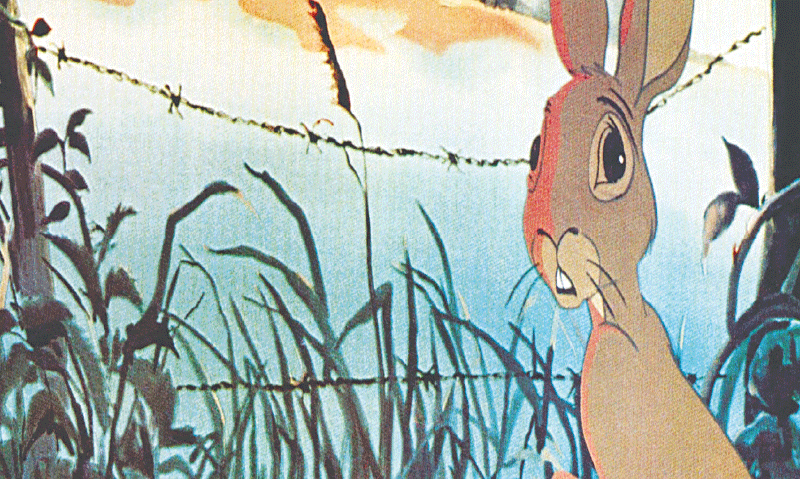
When I think of my first encounter with horror, I don’t think of a vampire, a witch, or even a possessed girl’s head spinning round (I saw The Exorcist at the age of seven). I think of a Sun God, I think of teeth and claws slicked with blood, I think of the Black Rabbit of Death. And he wasn’t even the bad guy.
I’m not talking about some campy folk horror from the 1960s. I’m talking about the 1978 animated version of Richard Adams’ Watership Down.
I was perhaps four when I saw it. The opening sequence remains a core memory: the myth of the Prince with a Thousand Enemies, the Original Rabbit, rendered in gorgeous animation that evoked Aboriginal art via the films of New Zealand artist Len Lye. Then, the great crimson wave of blood flowing across the fields. Death, cold and indiscriminate, was coming to the gentle slopes of Watership Down.
The value of horror is that it gives us a safe space to process fear. And why the animated film about woodland creatures Watership Down is a horror film
That was the moment I first felt awe and terror at the fragility of life. And the utter indifference of death. The kind of awe and terror we assume children’s minds can neither comprehend nor bear.
And that was just the beginning.
It’s easy to assume that because Watership Down is a cartoon about woodland animals, it must be gentle. It isn’t. And that’s why it’s so powerful. My parents had already let my older siblings and I watch the campy spectacle of Hammer Horror at Halloween, but they couldn’t have guessed the deeper impact of Adams’ rabbits — they let me watch alone from the safe distance of the shag rug one sunny afternoon in 1984.
Nothing terrible had yet happened to me. I hadn’t known grief or loss. Watership Down cracked that open. For the first time, I understood, viscerally, that all the earth’s creatures — including myself — are mortal, and that death was coming for us all.
But don’t let that put you off sharing it with your four-year-old.
The value of horror is that it gives us a safe space to process fear. It takes the anxieties we can’t name and turns them into something we can face. I watched horror films with my family every weekend — Poltergeist, Day of the Dead, The Evil Dead.
Afterwards, I slept like the actual dead. Soundly. Peacefully. I didn’t have nightmares, even if I did dream of rabbits. I didn’t need nightmares. For, what is a horror film, after all, if not a nightmare you share with people you love — a nightmare that can be switched off and tucked back into its case?
And, yes, I am saying that Watership Down is a horror film. Like Lovecraft’s cosmic horror, like The Thing or Alien, the terror of Watership Down arises from mortal insignificance. We too are small, powerless, unmoored, no different to the rabbits fleeing the down.
The film’s horror depends on empathy, the recognition that every creature wants what we want: to live, to love, to survive. Children understand that we are not special.
However, it is perhaps the most primal and defining characteristic of humanity that, not only do we fear death, but we know it is coming. Such darkness is part of being human and we can’t insulate children from the fullness of being human.
If we try, the chances are that the darkness will come out anyway in their nightmares, understood as a terrible thing that their own mind created in the dead of night. To share a film like Watership Down with them is to say: “I trust you with this. You are ready for awe, wonder and, yes, for fear too. And it is because we fear that we hope.”
Richard Adams opened his novel with a gruesome quote from the ancient Greek tragedian Aeschylus and added: “If that makes the child put it back on the shelf, then to Hell with the child.”
His provocation was not contempt but a refusal to patronise. Children, he argued, deserve stories that take them seriously. Indeed, to live without curiosity, without discomfort, without provocation, is the stuff of nightmares. That is hell.
Both the book and the film trust their audience to confront mortality honestly. That trust makes for stronger children — and stronger adults. Adams rejected allegorical readings of his story, insisting that this gut-wrenching heroes’ journey, with its keen sense of justice, really was about rabbits.
Children understand that not everything has to be about us. Only adults insist on being the default main character. Children know that, in this beautiful, terrible world, everything — even us — just wants to live.
Perhaps all of this is more than one would expect from a cartoon film about woodland animals. Maybe we could all use a sunny afternoon on the rug, watching Watership Down, and remembering what it is like to be small and afraid and full of hope.
The writer is a lecturer in Film Studies at Queen’s University Belfast in Northern Ireland
Republished from The Conversation
Published in Dawn, ICON, October 26th, 2025