Aurangzeb ‘quite hopeful’ Pakistan can achieve close to 3.5pc GDP growth during ongoing fiscal year
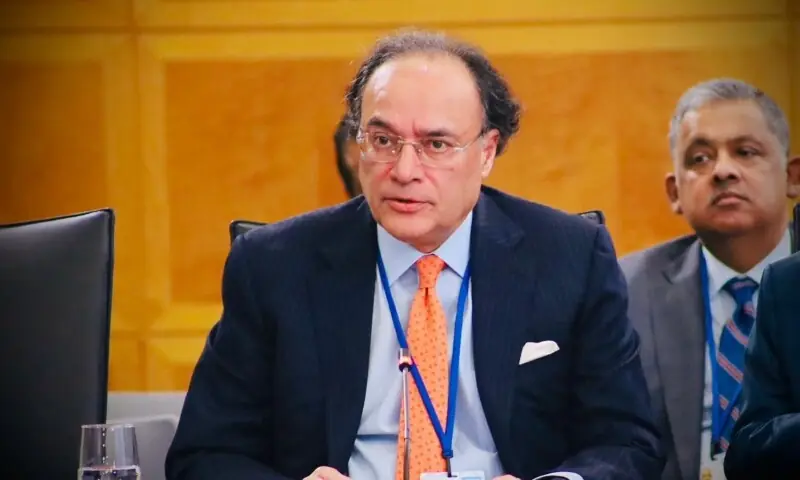

Finance Minister Muhammad Aurangzeb has said he is “quite hopeful” that Pakistan could manage to achieve GDP growth of close to 3.5 per cent during the ongoing fiscal year despite the impact of recent floods.
The finance czar shared this projection during an interview on CGTN America programme ‘One on One’, which was published on Tuesday. During the interview, the finance minister was asked how big a challenge the recent floods posed to economic recovery.
To that, Aurangzeb began his reply by underlining that climate change was an “existential issue for Pakistan”.
“We are living it day in and day out,” he said.
He then went on to recall previous floods and their impact, and stated: “We grew at 3pc GDP last year. We had estimated that we would grow a little over 4pc this year, but now, given the flood situation, this will shave off a certain percentage around that. But, I am still quite hopeful that we can manage anything close to 3.5pc during this fiscal year.”
At the outset of the interview, the finance minister was asked about the efforts to restore Pakistan’s economy and the main challenges being faced on that front.
To that, Aurangzeb said Pakistan had “consolidated gains on the macroeconomic stability front. […] Inflation continues to be a good story, which is now in single digits. [The] policy rate has been halved. And as a result of that, what we have seen during the course of this year is [that] all global rating agencies have upgraded us during the course of this year. [It] started with Fitch, then S&P, and then two months back Moody’s upgraded us. So it is after a hiatus of two and a half or three years, we have alignment between the rating agencies.”
In reply to a question about the International Monetary Fund (IMF), Aurangzeb recalled that the global money lender and Pakistan had agreed upon a staff-level agreement on its loan programmes earlier this month, which would allow the country to access $1.2 billion after approval from the fund’s board.
“We are very grateful that the management of the Fund continues to repose trust and confidence in the authorities in Pakistan in terms of staying the course, especially with respect to structural reforms,” the minister said, highlighting that Pakistan had made progress in the areas of taxation, energy, state-owned enterprises, privatisation and public finance.
“Privatisation was one area where we didn’t do well,” he acknowledged. But, he added, “today, we had the first asset — it’s a small bank, but it’s been on the privatisation list for a long time. It’s been nominated out to the UAE, which came in with a very successful bid. So it’s going to be handed over, and they are going to invest further in terms of increasing its footprint, taking it digital, etc.”
About the Pakistan International Airlines, he said “we are very sanguine” that it is going to be privatised before the year’s end.
“As a result of all of these developments, we have been able to return to the commercial markets,” he added. “We tapped the Middle Eastern bank borrowing again after a gap of two and a half years […] We are also now looking forward to actually printing the inaugural Panda Bond before the year is out.”
At that, Aurangzeb was asked whether Pakistan now being able to access commercial banks was a direct consequence of upgrades from rating agencies.
“Indeed,” he replied. “I keep on saying that macroeconomic stability is not an end in itself, it’s a means to an end. We repaid $500 million of Eurobond payment which was due on September 30 […] We are now clearly poised well to repay the next tranche, which is $1.3 billion, in April of next year.
“But we are refreshing our GMTN (global medium-term note) with a view to go for now a major print after the Panda bond. We haven’t decided whether it’s going to be Euro, USD or Islamic sukuk, but we will be looking for a large print during the next calendar year,” he said.
On Pakistan-China ties and what had this partnership done for Pakistan economically, Aurangzeb said, “It is a longstanding, ironclad partnership.“
The finance minister further stated that “everything that happened in the CPEC (China-Pakistan Economic Corridor), which was a flagship for BRI (Belt and Road Initiative) — The phase one was all about infrastructure. Now, phase two is all about monetisation of that infrastructure, using the special economic zones, etc. This is very much private sector to private sector”.
Aurangzeb then mentioned he had accompanied Prime Minister Shehbaz Sharif to Shenzhen last year, where a number of MoUs were signed.
“The difference this time around in Beijing was that we had 24 joint venture agreements signed. So we have travelled from MoUs to JV agreements, which means there is traction now. It is going to be very much private-owned enterprises from China working with the private sector. And our role is going to be making sure that we provide the necessary ecosystem.”
Asked what was the focus of CPEC Phase II, the finance minister said, “The focus is investment — first of all, making sure that the $19 billion dollar plus trade that we have, we take it to the next level. We have an Free Trade Agreement (FTA) in place, and this can now be upgraded. That’s one part of it.
“The second part of it is investments. And investments in all areas of mutual interest. It’s minerals and mining, it’s agriculture, it’s AI (artificial intelligence) and IT (information technology).”
He also underlined the potential for cooperation in the pharmaceutical sector.
“When I say pharma, I think we have a huge opportunity to get the vaccination production going in Pakistan. We saw it firsthand when the unfortunate Covid situation came in and we had to go helter-skelter finding the vaccinations. This is one of the key areas where we can work with Chinese enterprises to get that production going in Pakistan.“