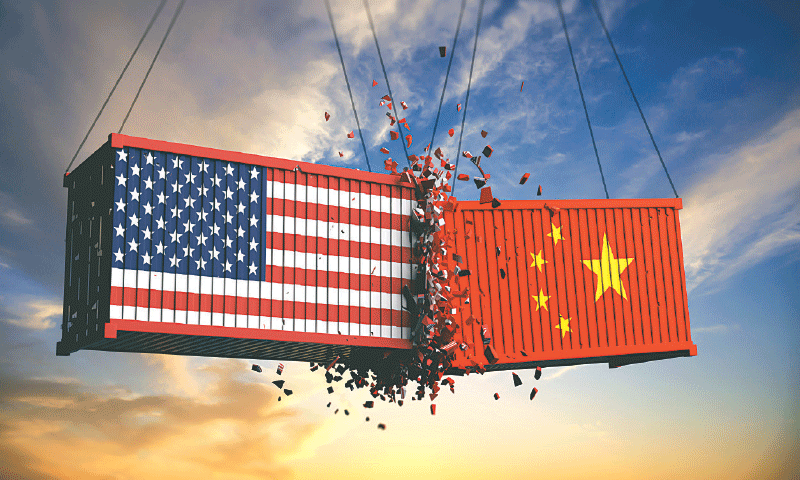

With Chinese President Xi Jinping and US President Donald Trump expected to meet on the sidelines of the upcoming Asia-Pacific Economic Cooperation (APEC) summit in Seoul later this month, global attention is once again fixed on the uneasy relationship between the world’s two largest economies.
The much-anticipated potential Xi-Trump encounter comes amid a renewed flare-up in China-US trade tensions following last month’s relatively successful talks in Madrid, raising a crucial question: is this latest escalation merely a tactical manoeuvre in their long-running economic rivalry, or a sign of a more permanent rupture in their relations?
After all, the outcome of their trade war is going to have far-reaching impacts on the global trade order and the economic future of developing countries like Pakistan.
In the new pre-APEC summit developments earlier this month, China imposed special port fees on vessels with US links, specifically, those flying US flags, built in the US, fully or partially owned, or operated by American companies. These countermeasures took effect on October 14, the same day the US introduced its own port fees on Chinese vessels.
Analysts interpret the latest China-US trade tensions as a tactical escalation rather than a sign of lasting economic decoupling or structural rupture
The Chinese move follows the April 17 announcement by the US Trade Representative of additional port service fees on Chinese-owned or Chinese-built vessels. Beijing said the US measures violate both international trade principles and the China-US Maritime Transport Agreement, disrupting normal maritime commerce between the two countries.
China emphasises that its response is defensive and intended to uphold fair competition in global shipping and shipbuilding. It urges Washington to “rectify its erroneous practices” and resolve the dispute through “equal-footed consultation and cooperation”.
Beijing didn’t stop at that. It had also announced new export control measures on rare earths and related items to, what it contends, refine its export control system. It claims that these are not “export bans”, and that licenses will be granted for eligible applications. China stands ready to work with the rest of the world to enhance dialogue and safeguard the stability of global industrial and supply chains, China’s state media quoted senior officials.
In response, the US imposed a 100 per cent tariff on Chinese rare earth products and announced new export controls on critical software. Washington has already expanded export restrictions to thousands of Chinese entities and introduced measures targeting China’s maritime, logistics and shipbuilding sectors. Beijing said these actions have seriously undermined the atmosphere for bilateral trade talks.
Analysts interpret the latest China-US trade tensions as a tactical escalation rather than a sign of lasting economic decoupling or structural rupture.
“We believe this is a tactical escalation to shape pre-summit bargaining, not a strategic decoupling,” a wire service quoted a Morgan Stanley note. It further noted, “Since China’s rare earth controls apply globally rather than solely to US-bound exports, this move serves both as leverage ahead of top-level APEC meetings and as a calibrated effort to reshape the cost-benefit calculus of US tech restrictions.”
This assessment underscores that despite heated rhetoric and reciprocal measures, both economic superpowers have strong incentives to ease tensions. Some argue that it points to a pattern of “managed rivalry”, in which both sides employ economic tools to gain negotiating leverage without risking a complete breakdown.
Their deep mutual interests in trade, investment, and innovation make a permanent rupture unlikely, even as strategic competition intensifies. The relationship continues to evolve toward selective decoupling in sensitive sectors, while minor frictions are expected to persist and prospects for a comprehensive resolution remain remote, said the note from investment bank analysts. This means that both sides may engage in limited escalation in the near term to strengthen their bargaining positions before seeking de-escalation.
Even so, the timelines for tariff hikes and export licensing remain unchanged: Washington’s new tariffs are scheduled to take effect on November 1, while Beijing’s revised rare-earth export licensing regime begins on December 1. This leaves a narrow negotiation window for intensive discussions to prevent further deterioration.
That the US has once again launched hostile actions against China surprised no one. What did catch many off guard, however, was the firmness and precision of China’s countermeasures.
Historically, Washington has escalated sanctions and manufactured pretexts ahead of high-level bilateral talks; it’s a familiar pattern in its dealings with Beijing. Beijing feels that the US continues to act from a misplaced sense of superiority, making it clear that China no longer tolerates bullying and intends to be treated as an equal power.
To the recent series of unilateral US actions, including new sanctions on Chinese entities, discriminatory port fees and tighter semiconductor export controls, Beijing has responded with increasingly assertive measures that underscore both its capacity and determination to defend its national interests.
The scope and precision of China’s latest response highlight a new phase in bilateral relations. The recent escalation in tensions reflects a shifting balance of power, with Beijing now acting from a position of confidence and strength.
As a Chinese official recently urged the US to work with China to address relevant issues through dialogue and consultation for mutual benefit “on the basis of equality rather than bullying China”. “Willful threats of high tariffs are not the right way to get along with China. China’s position on the trade war is consistent: we do not want it, but we are not afraid of it.”
Published in Dawn, The Business and Finance Weekly, October 20th, 2025