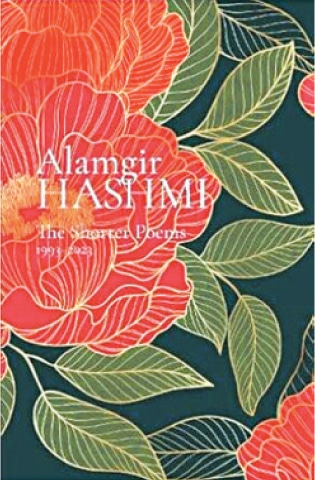
The Shorter Poems 1993-2023
By Alamgir Hashmi
Greenwich Exchange (London)
ISBN 978-1-910996-77-5
160pp.
Alamgir Hashmi is a distinguished academic, critic and poet. He has taught in America, Europe and Pakistan, and is the recipient of many honours and awards, international and national. His celebrated poetry volumes include America is a Punjabi Word, My Second in Kentucky, This Time in Lahore, Sun and Moon and The Ramazan Libation.
He has now added to his rich, significant oeuvre, with his 12th collection The Shorter Poems 1993—2023, consisting of diverse, lyrical poems, that are an interplay of nature and life, memory, multiculturalism and time, beyond borders and boundaries: many poems are located in a nameless, universal space defined by plant and animal life, combined metaphorically with human emotions.
In the very first poem, ‘Tropics’, images of a mulberry tree’s long branches, a ripe peach, mistletoe and a date palm are interwoven with the narrator’s recollections of desire, love and longing. The next poem ‘Diary’ written in the first person, creates memories of romance and wonder, embodied by red hibiscus flowers, the fragrant, quisqualis [Rangoon creeper] and the enchantment of changing light from morning to nightfall. This develops into a debate with his loved one, addressed in the second person, whose recollections are more pragmatic, causing the narrator to consider “Memory is a leaf/ in the wind arising.”
Hashmi’s assertion of a geographical location in the very title of his poem ‘Crossing the Alps’, referring to a spectacular, if challenging, mountain journey, symbolises the problems of traversing man-made boundaries across cultures and countries, impeding freedom of movement, relationships and romantic bonds.
Alamgir Hashmi’s 12th collection of verse consists of diverse, lyrical English poems that combine elegance and subtlety with complex, multi-layered innuendoes
The poem employs a third person narrative to create a sense of distance, which is eroded when the loved one is addressed in the second person, in the opening lines: “Sort of, placed here, yes, he remembers/ being with you at some point/ over there, crossing the borders and guards/ whose vanity box has one secret/ Keep them apart.”
He goes on to portray them both, as a couple, defying the odds in this remote terrain, only to lament, with hindsight, that their romantic relationship is disrupted because he was overtaken by the exigencies of daily life and the divisions between their respective, diverse, distant lands.
Shorter Poems captures many different voices, which skilfully convey the enduring quality of Hashmi’s work and its universalism. ‘For Children in Wartime’, a moving and powerful work, portrays war-riven Sarajevo and its suffering through the graphic paintings of a 12-year-old. Her innocence and her recollections accentuate the horrors of war, which become a foil to the devastating comment on the unspoken, when the narrator looks at an overgrown garden and adds: “But alas, I too, cannot write/ from the point of view of grass.”
Throughout, the collection is permeated with poems contemplating natural life. This includes the impact of changing seasons in ‘Birds in an Tree: An Elegy’; the beauty, behaviour and mysteries of a unique species in ‘Woodpeckers’; the intrinsic affinity with the terrain in ‘Earthworms’; while ‘Peonies’ celebrates a gardener, transforming a rocky land into a garden with flourishing perennials.
Hashmi’s engagement with ecology and human emotions continues with poems set in various countries. ‘Bulrushes, Normandy’ celebrates the joy of water, sand and sea and the flora and fauna; ‘Montana’ evokes a past world of hospitality, horses and log cabins; ‘Adam’s Peak’ tells of a sacred mountain in Sri Lanka linked to both Abrahamic and Buddhist legends.
Several other poems, incorporate familiar reverberations of literature and the written word integral to the poet’s experience: in ‘Arrival’, a drive to Perth, across Australia, evokes the fate of Australia’s indigenous communities, drawing parallels with Richard Wright’s incisive writings on America’s racial inequalities; ‘Ne Plus Ultra’ symbolically incorporates Guinevere, Galahad and Lancelot into elegant Singapore; ‘Salaam to T’Sai Lun’ travels back to ancient China to recreate the origins of paper-making, beginning with the lines “See/ before he boiled it/ and rolled its pulp into thin sheets/ this bamboo was the book —/ handy, vertical, quilled —/ in Chinese.”
Shorter Poems captures many different voices, which skilfully convey the enduring quality of Hashmi’s work and its universalism. ‘For Children in Wartime’, a moving and powerful work, portrays war-riven Sarajevo and its suffering through the graphic paintings of a 12-year-old. Her innocence and her recollections accentuate the horrors of war, which become a foil to the devastating comment on the unspoken, when the narrator looks at an overgrown garden and adds: “But alas, I too, cannot write/from the point of view of grass.”
The migration and movement of people and ideas across the centuries are central to the Subcontinent’s long history. In ‘People: For the Sondhis’, Hashmi pays tribute to a much respected multi-faith family of pioneering educationalists and activists, across pre-and post-Independence India and Pakistan. In several other poems, Hashmi creates urban development, scenic rivers, mountains and much else, which resonate with life in Pakistan.
The focus of his poem ‘Taxila/Margalla’ employs the passage of time and changing landscapes to remind the reader of pre-historic, continental drifts and tectonic movements that had created the Margalla hills. This is interwoven with references to the region’s ancient remains of Taxila amid Pakistan’s modern constructions, and the advent of present uncertainties, where “the earth’s gashes/ are ever-new, unhealed.”
Here, amid the earth’s continuing shifts, “the left-over mountains/ are moving away from here/ on nervous feet,/ looking askance,/ for safety is in moving on./ Where will they go, split what country?/ join which continents — America/ with Asia to repatriate Columbus?”
Shorter Poems includes two tight, vivid and powerful poems capturing Pakistan’s devastating 2005 earthquake. The first, ‘Above Balakot’, describes the harrowing destruction of countryside, mountains, town and countless inhabitants: “If any people lived here,/ they are gone, quiet to a fault.”
The next poem, ‘It was Quaking-Grass Awhile’, recreates a survivor’s terrifying experience of the earthquake at night, as strange dreams give way to reality: “Awake now, I saw my house tilt/ to a side,/ then spring back/ aright beam and column/ and hard brick/ inside the quirky plaster of this moment./ The windows are still chattering.”
Hashmi has often employed different poetic forms in his oeuvre. In Shorter Poems, he adds to the diversity and range of the collection in the topical ‘Virus Regulation’, an unusual sequence of sonnets, divided into 12 sections capturing the outbreak of Covid, followed by the unreal life of fear, danger and seclusion. The first sonnet begins: “You are lucky you have your masks/ nearly all your personal protective/ equipment. And you have your/ instructions. The virus protocol/ is a complete code of life.”
The main sequence of poems employs the second person to convey instructions dictated by remote but assertive authorities, ordering individuals to keep a distance from each other, communicate only via mobiles and videos and so on. However, the poem is divided between the sections with authoritarian sonnets with others employing italicised sonnets written in the first person to capture his daily life: the proximity of the woman he loves, the sudden significance of small household details, passing the time by cooking and baking and fretting: “Year-round/ it’s been/ ploughing or gathering,/ prayers for good weather,/ Is it this we live for?”
The sense of the unreal continues to develop and grow as the final verses merge life and death.
This is a really significant collection, which combines elegance and subtlety with complex, multi-layered innuendoes and engages with topical issues in both Pakistan and today’s global world.
The reviewer is the author of Hybrid Tapestries: The Development of Pakistani Literature in English
Published in Dawn, Books & Authors, October 19th, 2025