In 1639, in the 11th year of his reign, the Mughal Emperor Shahjahan took the decision to build a new capital at Delhi. He named the new city Shahjahanabad; it embodied his personal philosophy of architecture.
There was no precedent for a planned city with a fort complex from Shahjahan’s predecessors. Agra and Lahore, the two other capital cities of the Mughals, had forts but they were designed within an existing city. The Red Fort at Shahjahanabad symbolised the relationship of the emperor and his subjects; it was the focus of the daily ritual of the Mughal Empire. It called for a special relationship between the palace and the city.
After Shahjahan’s death, the victory of his third son, Aurangzeb, reintroduced a pattern of active conquests, which necessitated his absence from Delhi. This led to the disuse of many spaces and rituals associated with the Mughals. During the rule of Muhammad Shah Rangila (1719-48), the Persian ruler Nadir Shah dealt a severe blow to Mughal power. Subsequently, the Marathas and the Jats repeatedly attacked the city, damaging the Fort and other royal buildings.
When the next ruler, Akbar Shah, came to the throne in 1748, the Mughal Empire had further weakened; the political situation continued to decline rapidly in the reign of Alamgir II (1754-59) who was mostly a prisoner of his minister Ghaziuddin. Alamgir’s successor, Shah Alam, had escaped from Delhi after his father’s murder and did not return until 1771. Shah Alam was blinded by the Rohilla chieftain Ghulam Qadir, who also dug up and damaged parts of the Fort in search of a buried treasure.
The victory of Lord Lake, representing the forces of the British East India Company in 1803, and the appointment of a British Resident in Delhi, led to many changes in the Fort and the city. The last two rulers, Akbar Shah (1806-37) and Bahadur Shah II (1837-57) continued to offer patronage to the arts, albeit on a reduced scale. The perception of the Fort was affected by the change in the spaces around the Fort. Gardens began to disappear as churches and military housing appeared. The British Resident’s house appropriated some of the grandeur associated with the Fort.
Ghalib and Momin’s Delhi changed slowly in the first half of the 19th century. But the arts continued to flourish. Delhi was home to many Urdu poets at this time; literary mehfils were the order of the day. Ghalib and Momin were not rivals in the way Ghalib and Zauq are projected. For Momin, writing ghazals was a pastime. He was a hakeem [physician] by profession who had many hobbies — dabbling in astrology, music, chess — and his life was enriched with a circle of friends and admirers. His love affairs were the talk of the town. He was not a contender for royal patronage.
Momin’s poetry has a somewhat limited range because his focus, primarily, is ishq-i-majazi [earthly love]. His long narrative poems (masnavi) are unabashedly personal, where he isn’t shy in describing the physical side of love.
Is shehr mein ek naujawan tha
Ushshaaq mein shohrah-i-jahan tha
Tha naam tau Momin aur deen kufr
Jaa’n mahv-i-butaa’n o dilnashi’n kufr
[There was a young man in the city/ Who was a world-famous lover/ His name was Momin, but he was a non-believer/ His life was steeped with idols and his heart with denial of faith]
As the love story in the above mentioned excerpt progresses, the description becomes amorous:
Lab se mere lab milaye rakhna
Bazu se woh sar uthaye rakhna
Woh munh mein zubaan ki lazzatein haaye
Zahir harkaat se raghbatein haaye
[Keeping her lips sealed to mine/ Lifting her head from the circle of my arms/ The pleasure of the tongue in my mouth, ah/ The obviousness of desire from her actions].
While it is not exactly extraordinary to read descriptions of amorousness in Urdu prose and poetry, it is almost never as obviously personal as in Momin’s case. This kind of poetry earned him a reputation. However, Momin’s ghazal was sophisticated and tender, showing his expertise in moulding language to express his thoughts. Ghalib admired Momin’s style in the ghazal, and famously wrote that he would give his entire divan for this she’r of Momin:
Tum miray paas hotay ho goya
Jab koi doosra nahin hota
[You are close to me as if/ No one else can ever be]
The ghazal from which this verse is selected is outstanding enough to put Momin among the best of poets in this genre. It begins with:
Asar usko zara nahin hota
Ranj rahat fiza nahin hota
[It has no effect on her/ Sorrow doesn’t bring relief]
The language is simple; but the idea is unique. The lover’s sorrow does not have any impact (asar) on the beloved; therefore, sorrow doesn’t bring relief. But this begs the question: what does bring relief (rahat) to the stricken lover? What is said is fine, but what is left unsaid, hanging in the air so to say, is even finer.
In Ghalib’s favourite verse from this ghazal, there is an air of ambiguity, created by the word choice of goya, a word with multiple meanings. Goya conveys a contemplative ‘as-if’ that nonetheless feels like reality, and describes the suspension of disbelief that can occur, often through good storytelling. Thus, the verse implies a suspension of reality, an imaginary state of nearness or closeness that is unique.
Ghalib and Momin’s Delhi was packed with poets of high calibre: Shah Naseer, Zauq, Sheftah, Azurdah, Imam Bakhsh Sehbai and, above all, the last Mughal ruler, Bahadur Shah Zafar, and his heir apparent, Mirza Fakhru, all composed ghazals. For Momin, to make a place among the illustrious needed formidable talent, which he certainly possessed in good measure.
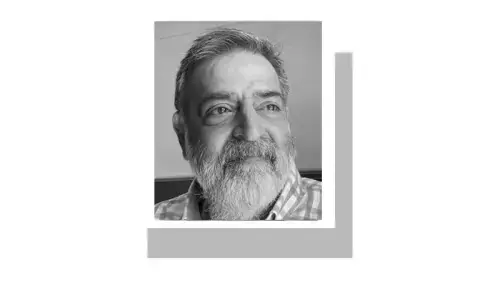
The columnist is Professor in the Department of Middle Eastern and South Asian Languages and Cultures at the University of Virginia in the US. X: @FarooqiMehr
Published in Dawn, Books & Authors, October 19th, 2025