Govt chose not to seek foreign aid after floods: Aurangzeb
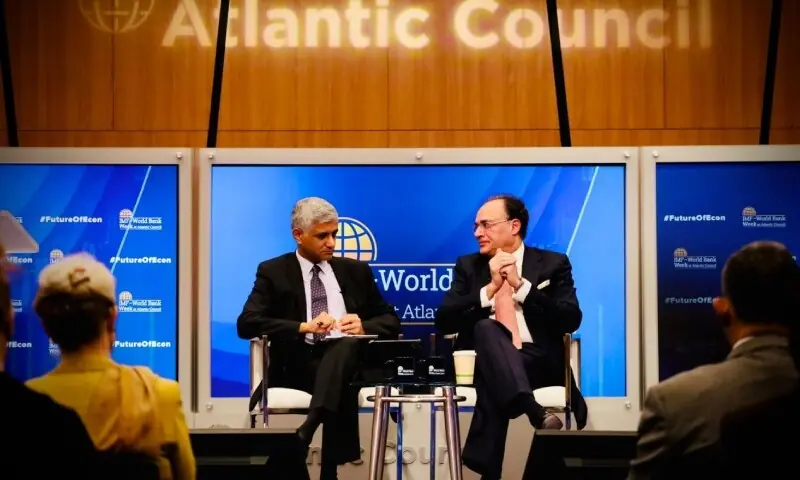


WASHINGTON: Finance Minister Muhammad Aurangzeb said on Thursday that Pakistan deliberately chose not to seek international aid after the 2025 floods, stressing that an improved macroeconomic position allowed the government to rely on its own resources.
Addressing a select gathering of scholars and economists at the Atlantic Council in Washington, the minister discussed the government’s approach to economic reform, disaster response and private-sector-led growth.
“Because we are in a relatively comfortable macroeconomic situation, which was different in 2022 — we didn’t rush out to appeal to the international community for even the rescue and relief effort,” said the minister while responding to a question.
“It was a very deliberate choice by the government and our administration that we are going to use our own resources, the fiscal space which is available, and see how and what we can repurpose,” he added.
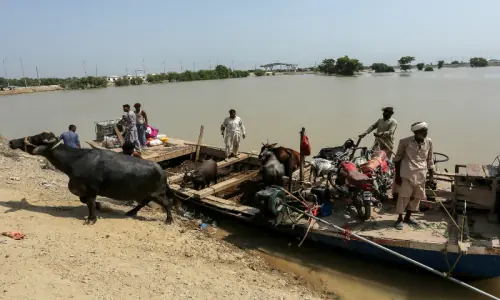
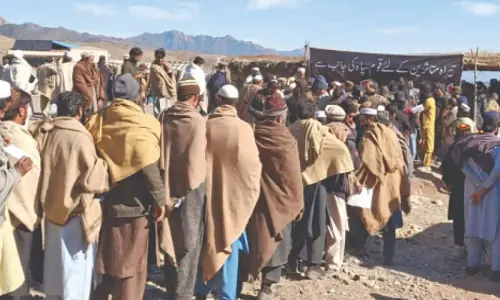
Mr Aurangzeb described this year’s floods as “far worse”, noting that in 2022, only one river and parts of Sindh and Balochistan were affected, whereas this year, three rivers were in high flood, and Punjab bore about 80 per cent of the damage.
Introducing the minister, Atlantic Council President and CEO Fred Kempe said the government’s approach “has generated cautious optimism and renewed international attention” towards Pakistan.
Dr Aasim M. Husain, a former deputy director of the IMF’s Middle East and Central Asia Department, observed that the Fund’s latest statement credited the government with “entrenching macroeconomic stability, rebuilding market confidence, and significantly narrowing sovereign spreads”.
The IMF also noted that Pakistan’s recovery remains on track, highlighting that the country achieved its first current account surplus in 14 years and surpassed its fiscal primary balance target.
“So, I guess they’re saying ‘well done’, and it sounds like a pretty good report card,” Dr Husain added.
The finance minister agreed that floods were a recurring problem, adding that Pakistan’s high population growth rate and changing climate “posed existential threats” to the country.
He said the post-damage needs assessment would take months. “For now, we’re using fiscal space and available World Bank and RSF funding without long-term planning,” he said, referring to the IMF’s Resilience and Sustainability Facility.
The prime minister has announced a 300-day plan anticipating earlier monsoons next year, the minister added, warning that agricultural damage would reduce GDP growth from a projected over 4pc to still above 3pc.
Mr Aurangzeb highlighted the government’s success in consolidating macroeconomic stability over the past year, noting external validations from the IMF and rating agencies.
“We have received two external validations… and after about two and a half to three years, we have seen the three rating agencies aligned,” he said, referring to upgrades from Fitch, S&P and Moody’s.
Highlighting progress in broadening and deepening the tax base, he said, “Last year, the FBR tax-to-revenue ratio rose from 8.8pc to 10.2pc; we aim for 11pc by year-end and 13pc during the programme.”
He also emphasised the role of technology in revenue collection, stressing that technology — data analytics, AI, digital invoicing and monitoring — is critical in reducing leakages, particularly in sugar, cement, tobacco and beverage sectors.
On private-sector-led and export-oriented growth, the minister stressed a shift from past public-sector-driven cycles. “This time, the focus is deliberate: export-oriented, private-sector-driven growth,” he said.
He mentioned reforms including tariff rationalisation, energy sector improvements and trade corridor expansions. Highlighting the strategic significance of projects like Reko Diq, he said: “When projects like Reko Diq come through… the first year of commercial operations will bring about $2.8 billion in exports — roughly 10pc of our current export base.”
The minister also acknowledged ongoing efforts to manage the country’s debt burden. “Debt servicing is the government’s single largest expense. Liability management trades and domestic debt buybacks help reduce the debt service burden,” he said.
With stability improving and reforms underway, the minister said the aim was a resilient, private-sector-led growth trajectory while meeting immediate humanitarian needs.
Meetings on ratings, investment
Earlier on Thursday, Mr Aurangzeb met an S&P Global team, welcoming its recent ratings action and noting that the three major international agencies are now aligned. He briefed the team on recent fiscal, monetary and external-sector developments and progress under the government’s reform programme.
In a separate meeting with Saudi Finance Minister Mohammed bin Abdullah Al-Jadaan, Mr Aurangzeb discussed the privatisation of Pakistan International Airlines (PIA) and key airports, reaffirming the government’s resolve to attract strategic investments through transparency and efficiency.
Addressing a regional roundtable on digital transformation, he shed light on FBR’s modernisa-tion plan, noting that Pakistan’s tax-to-GDP ratio had improved from 8.8pc in 2024 to 10.24pc in 2025.
Later, in a meeting with Pakistani entrepreneurs, the finance minister discussed efforts to streamline regulations, improve taxation and resolve energy and privatisation-related issues. He also invited proposals to further strengthen Pak-US economic ties.
Published in Dawn, October 17th, 2025