Palestinian-origin Yaghi among trio to win Nobel chemistry prize for work on ‘Hermione’s handbag’ materials
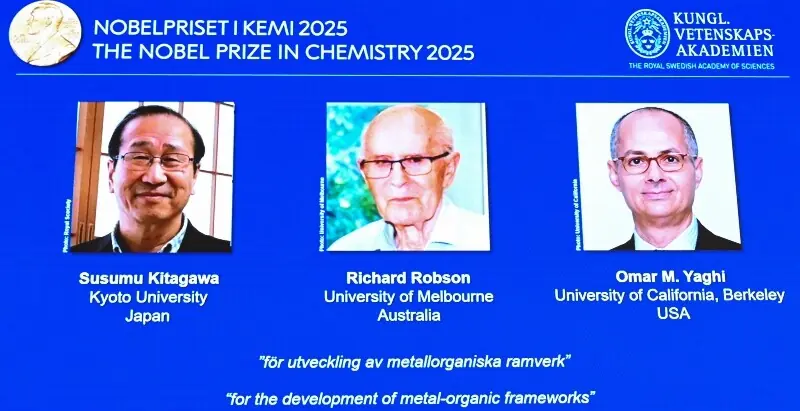

Palestinian-origin Omar Yaghi, Susumu Kitagawa and Richard Robson won the 2025 Nobel chemistry prize for developing a new form of molecular architecture, yielding materials that can help tackle challenges such as climate change and lack of fresh water.
The three laureates worked to create molecular constructions, known as metal-organic frameworks or MOFs, with large spaces through which gases and other chemicals can flow and that can be utilised to harvest water from desert air, capture carbon dioxide or store toxic gases.
Describing the “unheard of properties” of these materials, the award committee said some had a remarkably large surface area — a porous material roughly the size of a small sugar cube could contain as much surface area as a large football pitch.
“A small amount of such material can be almost like Hermione’s handbag in Harry Potter. It can store huge amounts of gas in a tiny volume,” Olof Ramstrom, member of the Nobel Committee for Chemistry, said.
Uses could include dealing with ‘forever chemicals’
The more than a century-old prize is awarded by the Royal Swedish Academy of Sciences, and the winners share 11 million Swedish crowns ($1.2 million), as well as the fame of winning arguably the world’s most prestigious science award.
Kitagawa told the Nobel press conference that he was deeply honoured by the award.
“My dream is to capture air and separate air to — for instance, in CO2 or oxygen or water or something — and convert this to useful materials using renewable energy,” he said.
After the discoveries, chemists have built tens of thousands of different MOFs, some of which “may contribute to solving some of humankind’s greatest challenges”, the Academy said, adding that additional uses included separating toxic PFAS, or “forever chemicals”, from water and breaking down traces of pharmaceuticals in the environment.
Kitagawa is a professor at Kyoto University in Japan, while Robson is a professor at the University of Melbourne, Australia, and Yaghi is a professor at the University of California, Berkeley, in the United States.
Kitagawa is Japanese, Robson was born in Britain but moved to Australia in his late 20s, while Yaghi is Jordanian-American.
‘Science is the greatest equalising force in the world’
Yaghi was born to Palestinian refugees in Jordan, where his family shared a one-room home with the cattle the family was raising.
“It’s quite a journey and science allows you to do it,” he said in an interview published on the Nobel website, adding that his parents could barely read or write.
“Science is the greatest equalising force in the world,” he said.
Yaghi, who said he was astonished and delighted to win the award, was 10 years old when he found a book on molecules in the library, and it was the beginning of a life-long love of chemistry.
“The deeper you dig, the more beautifully you find things are constructed,” he told the Nobel website.
Robson said he got the call from Stockholm half an hour before the official announcement and that he celebrated quietly at his home outside Melbourne.