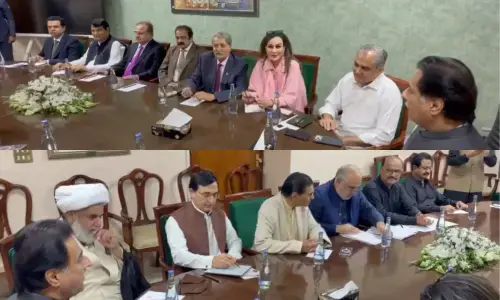
ISLAMABAD: Speakers at a consultative workshop said religious extremism and intolerance were pushing Pakistan away from its original narrative that was presented by the founder of the nation Mohammad Ali Jinnah and called for promoting pluralism at grass-root level.
Former MNA belonging to the Jamiat Ulema Islam (Fazal) and the head of the party’s non-Muslim minority wing, Asiya Nasir, said that social injustice and religious intolerance go hand in hand.
“Such mindset damages the society, destroys the social fabric and discourages growth as many productive members of the society including women and fall prey to their narrative,” she said.
The workshop titled: ‘Promoting Interfaith Harmony & Inclusion Through Responsible Media’, she added that the overall psychological unrest is visible in the country, and that was mainly due to social injustice.
The workshop was organised by Resilient Women Network and the FoRB leadership network, who have held such consultative workshops with parliamentarians, religious leaders and students of various universities.
Mrs Asiya Nasir said that lack of tolerance and widespread injustice were leading to attacks at media too in the country, and many such attackers belong to the extremist ideology.
“This is not the original narrative of Pakistan,” she added.
Dr Akhtar Abbas, head of English department, university of Sialkot, said that extremism, lack of tolerance or pluralism all develop with the mental process that starts in childhood.
“This is just like language – we all learn the good and bad words and understand what to say and what not to say, same way we develop thoughts and these thoughts become permanent part of our personality.”
He added that either the society itself or the conditions around help develop certain perceptions, and at times these perceptions lead to creating differences among communities.
“We need to understand things and in current day Pakistan, there is a need to develop interfaith, intra-faith as well as intra-sect harmony,” Dr Abbas added.
He said that the usage of certain words in media reports have deep rooted meanings and could lead to mass psychological benefit or damage.
Senior journalist Zamir Haider, spoke about the ethics on reporting on sensitive issues, which often leads to mob violence and social unrest.
“The situation has been aggravated by the social media dynamics where the content creators are often driven by hits and likes, therefore sensationalism has taken over facts and rationality,” Mr Haider added.
He also said that lack of harmony in society was also due to commercialisation and politicisation of religious elements.
Other speakers including PML-N lawmaker Gulnaz Shahzad said that the changes occur in the society through evolution and the federal as well as provincial governments were taking note of the situation to counter extremism.
Published in Dawn, October 5th, 2025